The Queen of the Night
- Audio guide stop: 396
- Gallery: Room 56
- Culture: Isin-Larsa
- Made in: Iraq, South
- Date: 19thC BC-18thC BC
- Object type: plaque
- Materials: fired clay
- Museum number: 2003,0718.1
- Museum: The British Museum
- Collection record: British Museum website
- Image © The Trustees of the British Museum, shared under a CC BY-NC-SA 4.0 licence.
Listen to the free audio guide
About this object
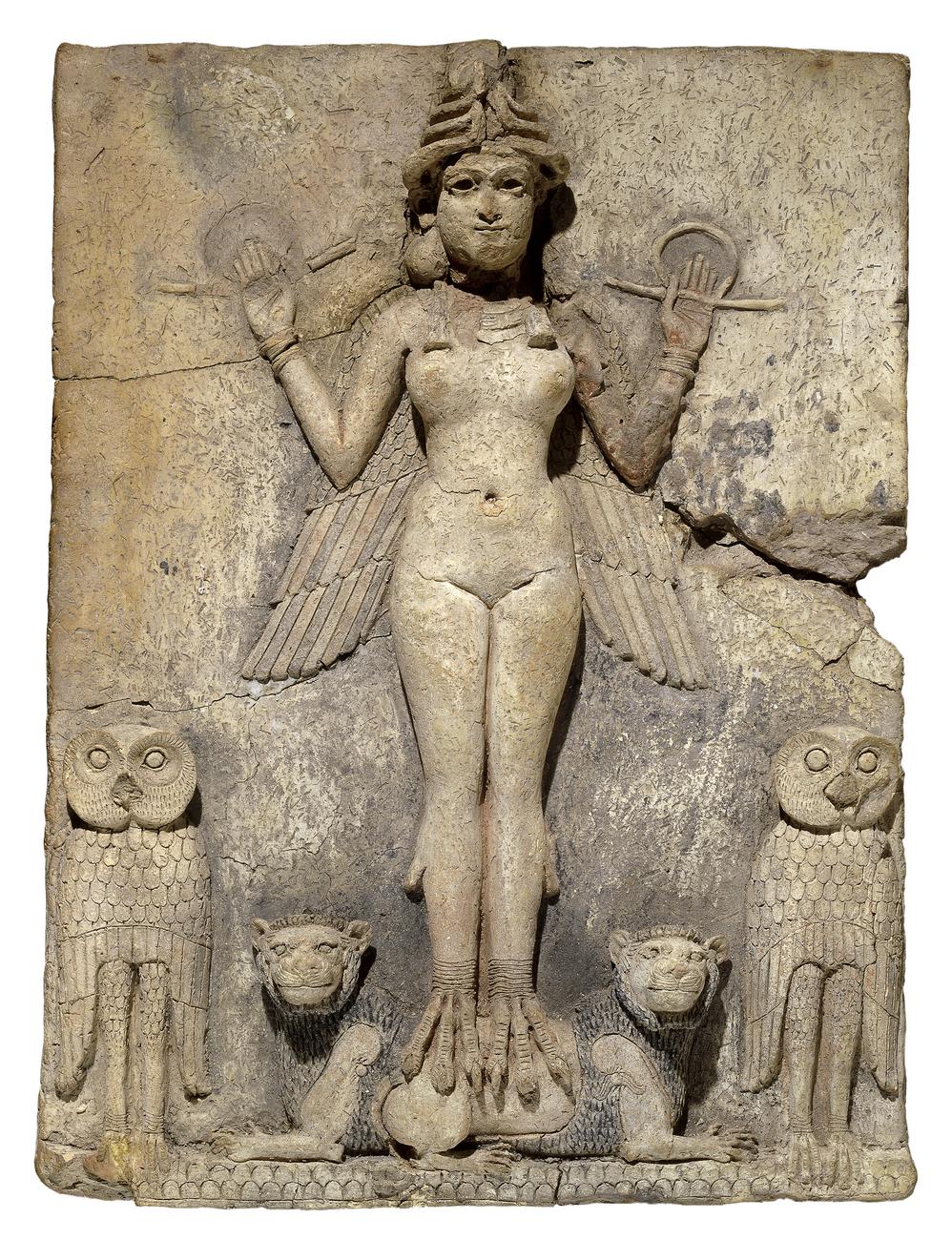
Before you stands a striking fired clay plaque known as "The Queen of the Night." You’re looking at a central nude female figure with feathered wings and talons, standing proudly in the center. She wears a headdress with four horn pairs and a disk, a symbol of great importance in ancient Mesopotamian traditions.
Look closely at her hands. She holds a rod and ring at shoulder height, suggesting a ritual or symbolic act. Around her are two owls and two lions back to back, standing above a patterned ground, possibly representing mountains or the underworld.
Created in the Isin-Larsa period—between 19th and 18th century BC—this plaque was made in southern Iraq. It is hand-modeled and painted with red and black pigments, some now faint. Scientific studies reveal the use of red ochre, carbon-based blacks, and possibly white gypsum.
This figure is part of a broader Mesopotamian iconography, often associated with powerful or divine female imagery. Though once called the Burney relief, she’s now known by the name that best fits her mysterious, regal presence.
See it in person
The Queen of the Night is on display in Room 56 at the British Museum on Great Russell Street, Bloomsbury, London — free to enter. Choose British Museum on audioguide.london and type its audio guide stop number, 396, from the gallery label, or take a photo of it, to hear this free audio guide in six languages — no app download needed.
New, in beta. British Museum support has just launched and is still improving: over 1,000 objects so far, with more added all the time.