The Imdugud Relief
- Gallery: Room 56
- Culture: Early Dynastic III
- Date: 2500BC
- Object type: relief
- Materials: copper alloy; bitumen; lead
- Museum number: 114308
- Museum: The British Museum
- Collection record: British Museum website
- Image © The Trustees of the British Museum, shared under a CC BY-NC-SA 4.0 licence.
Listen to the free audio guide
About this object
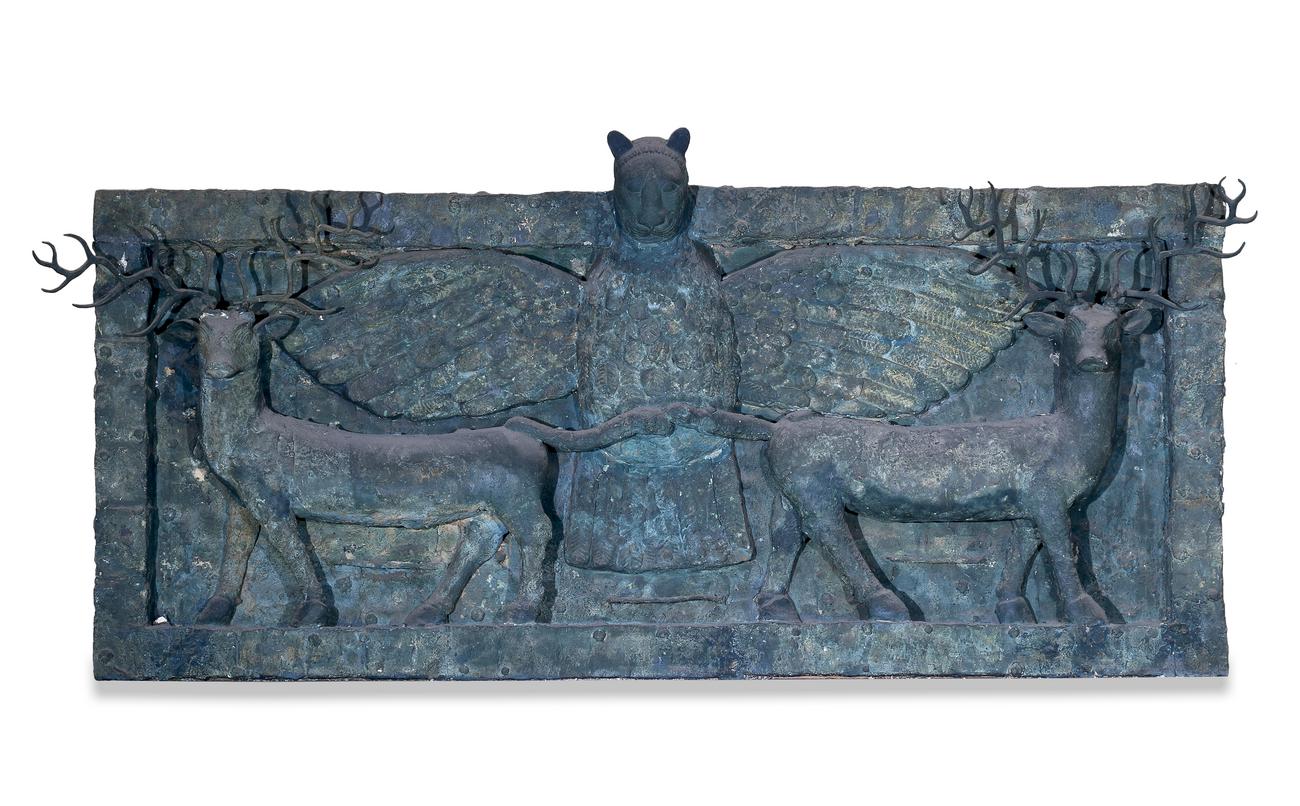
Before you is "The Imdugud Relief," an ancient relief sculpture from more than 4,500 years ago. Created during the Early Dynastic III period, this artwork combines metal and natural materials to depict a mythical lion-headed eagle called Imdugud, gripping the hindquarters of two stags. The figure is carved from copper alloy onto bitumen—a heavy, natural tar used as an early type of adhesive.
Look closely at the strong, stylized features of the eagle-lion’s head and wings. At its sides, the stags are carved with great attention to musculature and detail, though only the bodies remain, as their antlers were once attached using lead fragments—traces of which are still found with the piece.
This relief was excavated at Tell Al-'Ubaid in southern Iraq. Imdugud holds a special place in Sumerian myths, often linked to the storm god and symbolizing power and protection. The craftsmanship reflects a sophisticated early use of materials and storytelling through sculpture.
See it in person
The Imdugud Relief is on display in Room 56 at the British Museum on Great Russell Street, Bloomsbury, London — free to enter. Choose British Museum on audioguide.london and take a photo of it to hear this free audio guide in six languages — no app download needed.
New, in beta. British Museum support has just launched and is still improving: over 1,000 objects so far, with more added all the time.