Landscape No. 109
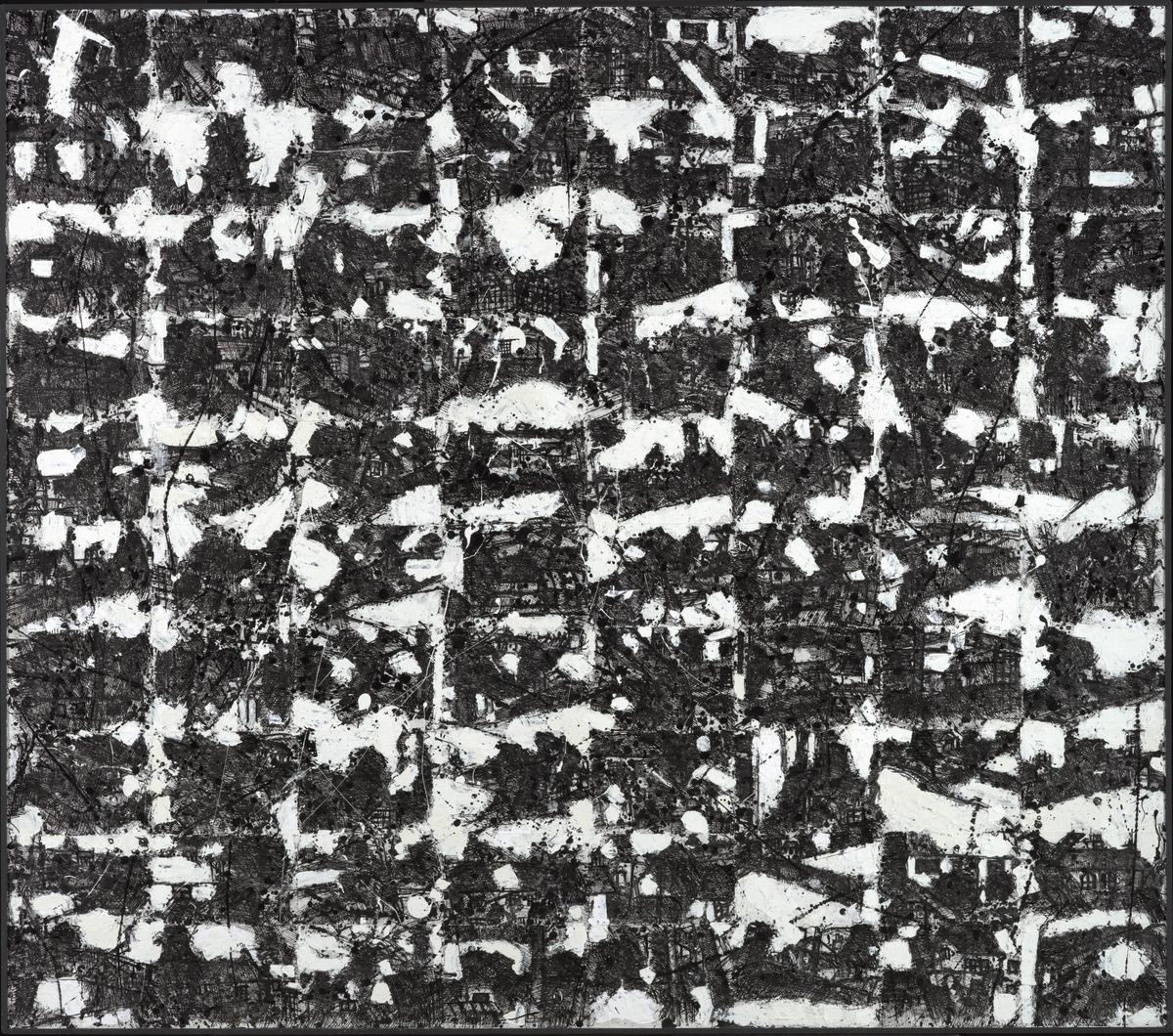
- Artist: John Virtue
- Date: 1990–91
- Medium: Ink, graphite, charcoal, shellac, gouache and acrylic paint on paper on wood
- Dimensions: frame: 1491 × 1695 × 33 mm
- Museum: Tate Britain
- Collection record: Tate Britain website
Listen to the free audio guide
About this artwork
This is “Landscape No. 109” by John Virtue. The piece is a huge mixed‑media work from 1990–91 that brings together eighty individual landscape drawings into a grid ten high and eight wide. Each sheet is black‑and‑white, rendered with ink, graphite, charcoal, shellac, gouache and a splash of acrylic paint. The black ink outlines dominate, but the artist then layers gestural white acrylic across the whole board. That white swoops and shards both breaks up and stitches the individual scenes – trees, treelines, houses, churches, roads – into a single, almost abstract image.
Virtue made these drawings on paper, then mounted them onto wood. The practice began after he left a small Lancashire village, where he’d walked and sketched his surroundings as a postman. By the late 1980s, after moving to Devon, his line work loosened, giving the grid a sense of distance from the immediate landscape. The work moves beyond literal topography, capturing the feeling of walking through a changing world.
“Landscape No. 109” therefore sits at the intersection of drawing and painting, of specific place and abstract rhythm, reflecting Virtue’s fascination with mobility and change in an ever‑shifting landscape.
See it in person
Landscape No. 109 is in the collection of Tate Britain on Millbank, London — free to enter. Point your phone at any artwork there and audioguide.london plays a free audio guide in six languages — no app download needed.