Landscape of Shame
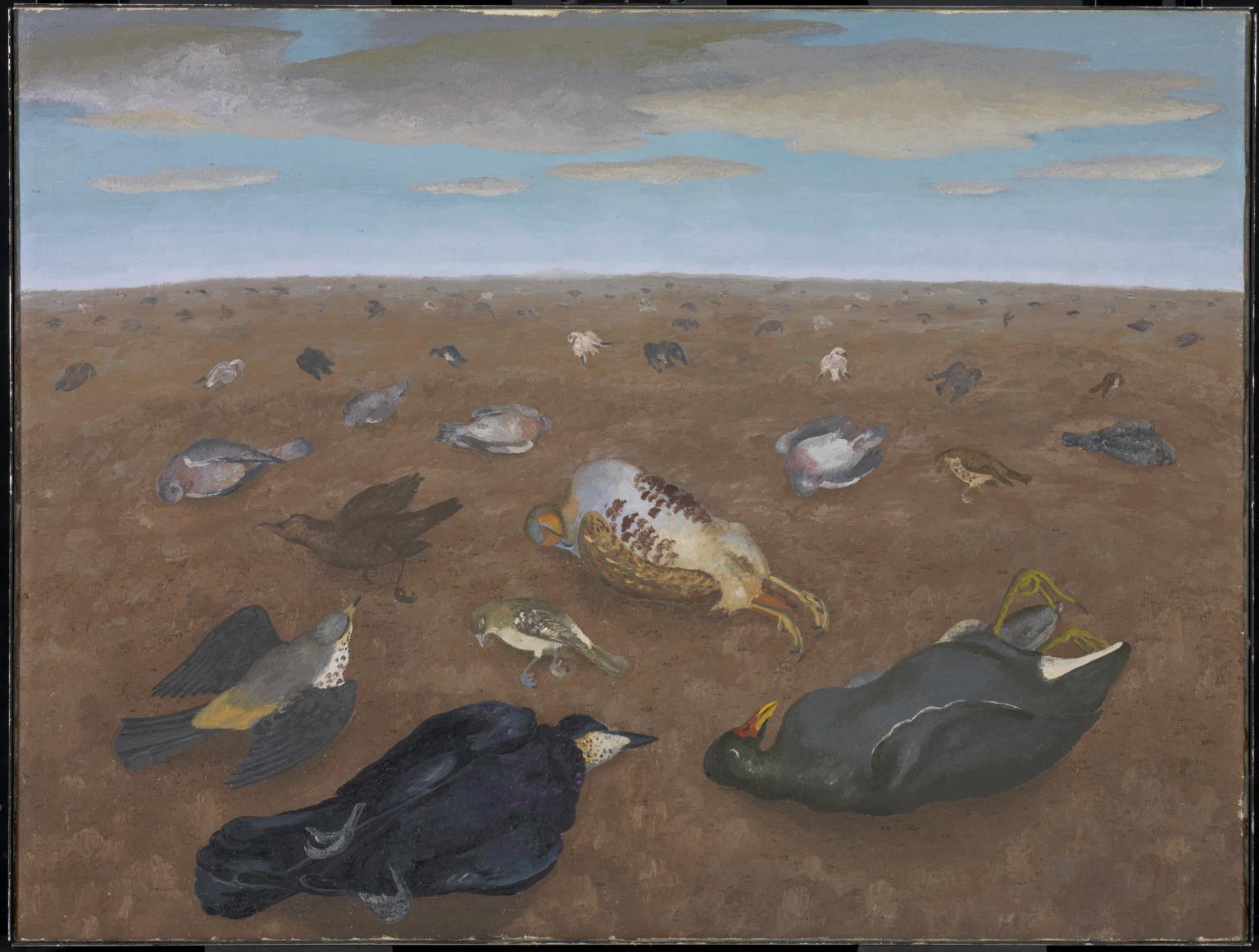
- Artist: Sir Cedric Morris, Bt
- Date: c.1960
- Medium: Oil paint on canvas
- Dimensions: support: 756 x 1002 mm
- Museum: Tate Britain
- Collection record: Tate Britain website
Listen to the free audio guide
About this artwork
This is Landscape of Shame by Sir Cedric Morris, c. 1960. Oil on canvas, the picture is a stark, almost bleak, field of brown earth under a bruised blue sky. In the foreground a black‑tipped rook and a grey‑black moorhen stare out, while a male partridge, dark red on a smoky grey belly, dominates the middle ground. Around them, a scatter of other birds – a blackbird, a wood pigeon, a sparrowhawk – lie abandoned, their bodies frozen in death or decay.
Morris, who had been painting birds since the 1920s, created this work in response to the rising use of crop‑sprays and pesticides in East Anglia. In the 1950s and early 1960s, fields around his home at Benton End in Suffolk were littered with dead birds. He was furious at how chemicals like DDT, dieldrin, and aldrin were silently killing wildlife.
Landscape of Shame is less a landscape in the romantic sense and more a social comment: a raw, visual protest against agricultural pollution and its ecological toll. It stands as a powerful reminder that progress can come at a devastating cost.
See it in person
Landscape of Shame is in the collection of Tate Britain on Millbank, London — free to enter. Point your phone at any artwork there and audioguide.london plays a free audio guide in six languages — no app download needed.