Double Ram Zun
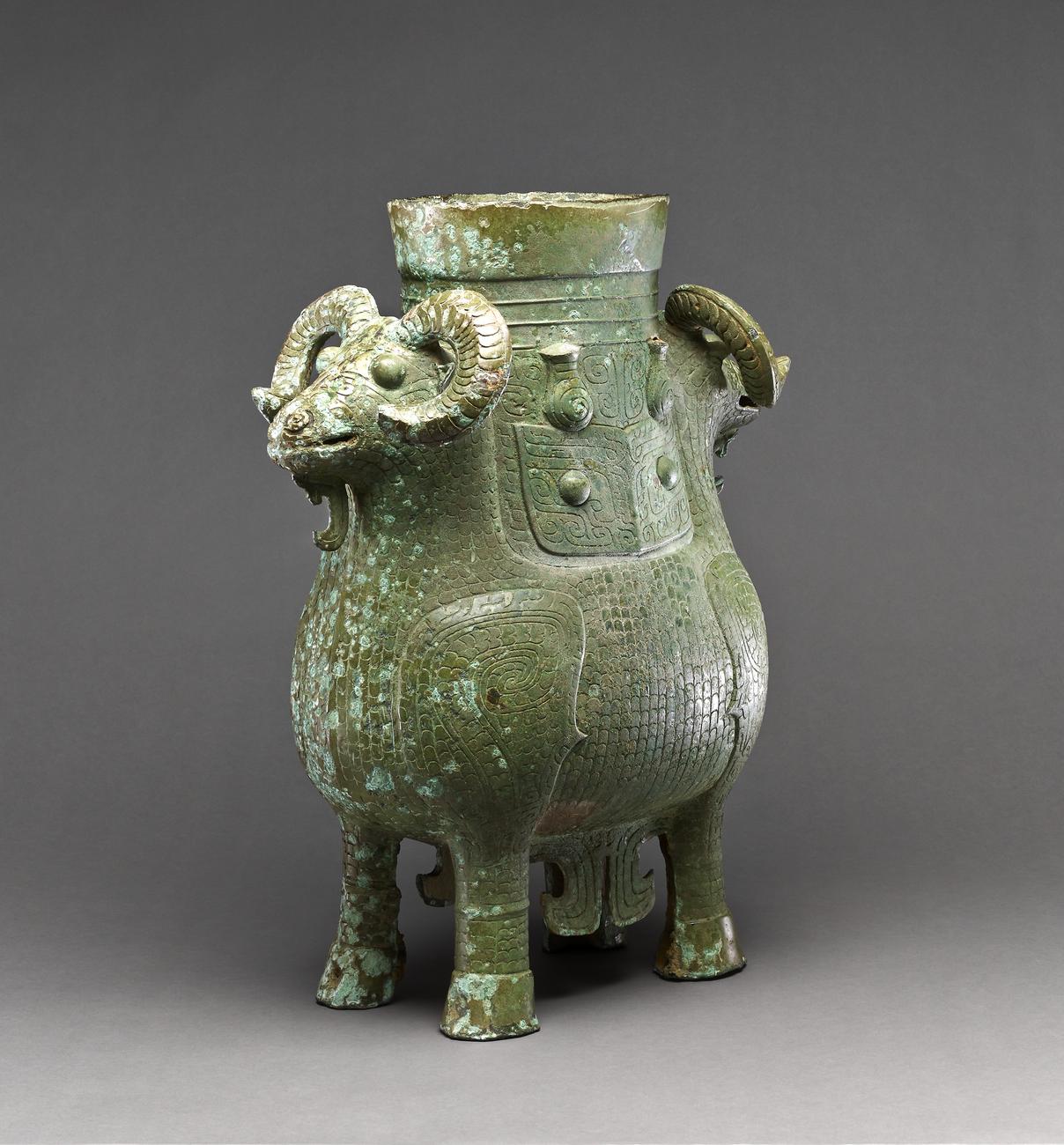
- Audio guide stop: 638
- Gallery: Room 33
- Culture: Shang dynasty
- Made in: Hunan (province) (probably); Chang Jiang (valley; probably)
- Date: 1200BC-1050BC (circa)
- Object type: zun
- Materials: bronze
- Museum number: 1936,1118.1
- Museum: The British Museum
- Collection record: British Museum website
- Image © The Trustees of the British Museum, shared under a CC BY-NC-SA 4.0 licence.
Listen to the free audio guide
About this object
Before you is the "Double Ram Zun," a striking bronze vessel from the Shang dynasty, crafted around 1200 to 1050 BCE. It features two powerful ram heads and forequarters that flank a jar-like body, with curling horns and a surface decorated with scale patterns. Below the opening, panels are filled with stylized animal masks. On the base sits a central semi-circular loop and C-shaped projections.
This bronze was made in Hunan province or the Yangtze valley—regions known for intricate three-dimensional designs on bronze. The rams' heads were cast一体 with the vessel, while their horns were separately added using an advanced technique called lock-on casting.
The piece is remarkable for its style and craftsmanship, indicating a local bronze tradition distinct from Shang capitals. Similar vessels have also been found at Ningxiang and Changsha in Hunan. Scientific study has revealed extensive use of spacers during casting, a detail unique to this piece.
See it in person
Double Ram Zun is on display in Room 33 at the British Museum on Great Russell Street, Bloomsbury, London — free to enter. Choose British Museum on audioguide.london and type its audio guide stop number, 638, from the gallery label, or take a photo of it, to hear this free audio guide in six languages — no app download needed.
New, in beta. British Museum support has just launched and is still improving: over 1,000 objects so far, with more added all the time.