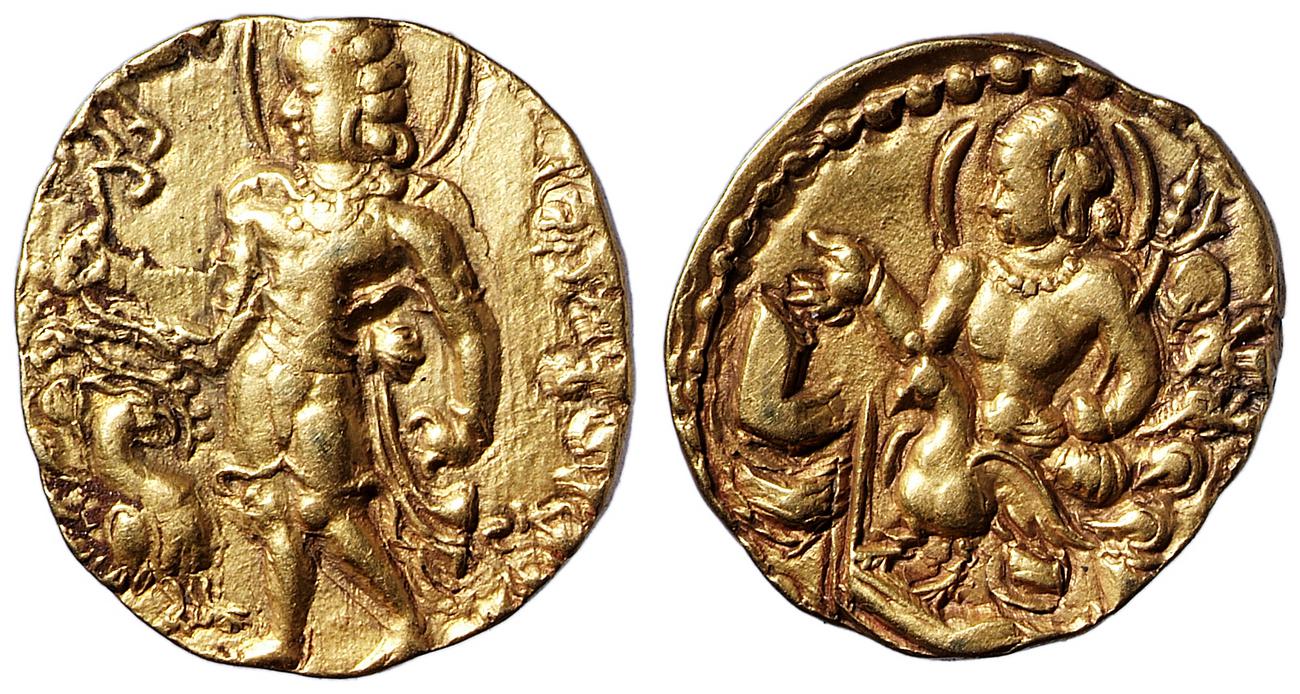
Coin of Kumaragupta I
- Audio guide stop: 612
- Gallery: Room 33
- Culture: Gupta
- Made in: India
- Date: 415-447
- Object type: coin
- Materials: gold
- Museum number: 1910,0403.53
- Museum: The British Museum
- Collection record: British Museum website
- Image © The Trustees of the British Museum, shared under a CC BY-NC-SA 4.0 licence.
Listen to the free audio guide
About this object
Before you is a "Coin of Kumaragupta I," made in India between 415 and 447. This small yet detailed gold coin measures just over 20 millimeters in diameter and weighs about 8.25 grams.
On one side, you'll see Kumaragupta I, the king, standing and facing left. He’s dressed in a waistcloth with long sashes at the back, wearing jewelry and surrounded by a halo. His left hand rests at his hip, while his right hand holds fruit, with which he appears to be feeding a peacock beside him.
On the opposite side sits Karttikeya, a revered Hindu deity, also known as Skanda. He faces three-quarters left, similarly adorned with jewelry and a halo. One hand holds a spear, while the other gestures toward an altar in the left field. He is shown seated on a peacock positioned on a decorative platform.
The coin contains inscriptions in Sanskrit, written in the Brahmi script, though not all the text is fully readable. What is known suggests references to Kumaragupta I’s noble lineage and merit. The reverse inscription mentions the name Mahendrakumara, likely a member of the royal family or religious significance.
See it in person
Coin of Kumaragupta I is on display in Room 33 at the British Museum on Great Russell Street, Bloomsbury, London — free to enter. Choose British Museum on audioguide.london and type its audio guide stop number, 612, from the gallery label, or take a photo of it, to hear this free audio guide in six languages — no app download needed.
New, in beta. British Museum support has just launched and is still improving: over 1,000 objects so far, with more added all the time.