The Hashtnagar Pedestal
- Gallery: Room 1
- Culture: Gandhara
- Made in: Gandhara (historic - Pakistan)
- Date: 384
- Object type: base
- Materials: schist
- Museum number: 1890,1116.1
- Museum: The British Museum
- Collection record: British Museum website
- Image © The Trustees of the British Museum, shared under a CC BY-NC-SA 4.0 licence.
Listen to the free audio guide
About this object
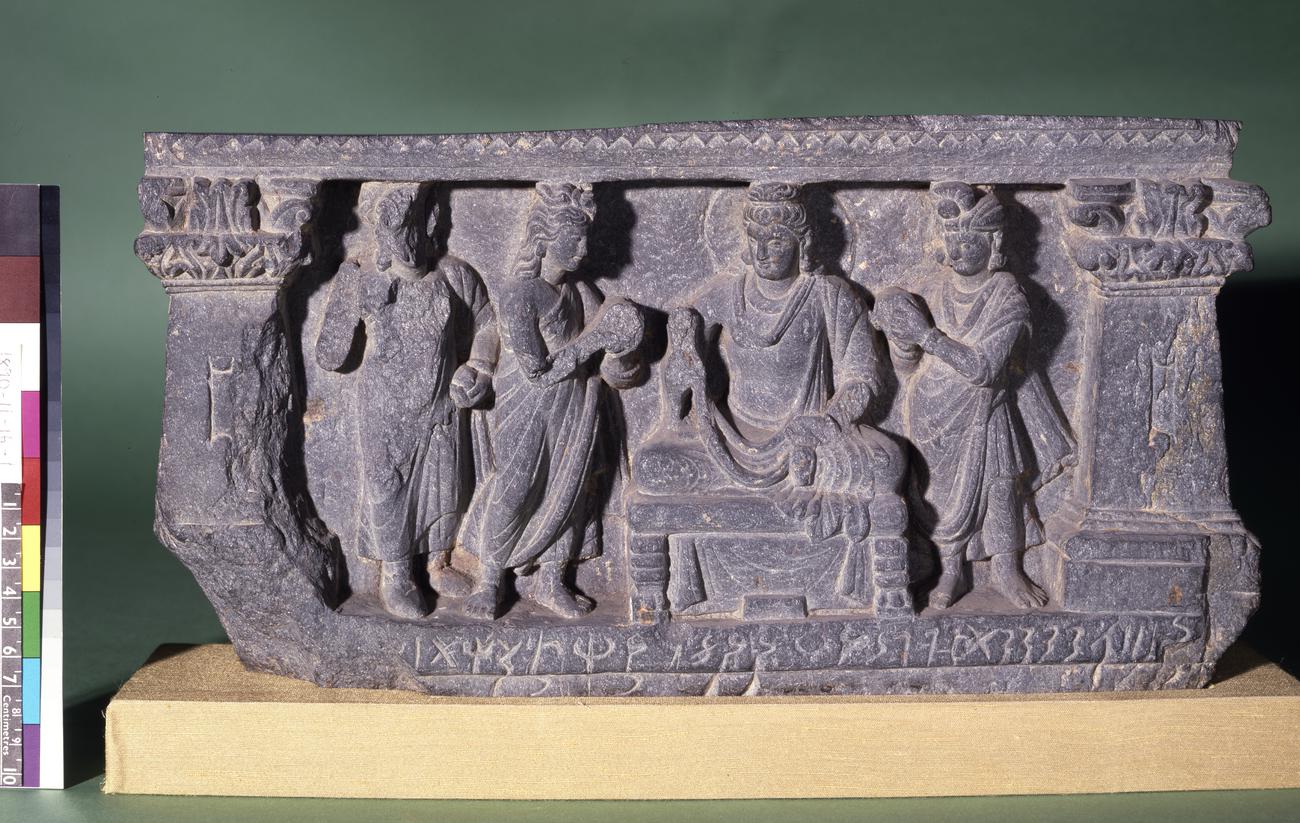
Before you is "The Hashtnagar Pedestal," a 4th-century base carved from schist, originating from Gandhara in present-day Pakistan. The pedestal features a seated Bodhisattva, almost bare-chested, wearing a draped uttarīya garment and crowned by a large chignon tied with a band. His right hand—now damaged—is thought to have shown a gesture of protection, while his left holds a water pot. Flanking him are Brahmā and Indra, each richly adorned with jewelry and elaborate garments.
The pedestal’s frame includes carved pilasters with ornate capitals and a sawtooth cornice, reflecting a Greco-Buddhist artistic synthesis typical of the Gandhara region. An inscription in Kharoshthi script along the base dates the piece to the fifth day of Praustapada in the year 384 of an unknown era.
Discovered in the 19th century and once part of a missing Buddha image, this fragment offers a rare insight into early Buddhist art and the spiritual narrative of a Bodhisattva's path to enlightenment.
See it in person
The Hashtnagar Pedestal is on display in Room 1 at the British Museum on Great Russell Street, Bloomsbury, London — free to enter. Choose British Museum on audioguide.london and take a photo of it to hear this free audio guide in six languages — no app download needed.
New, in beta. British Museum support has just launched and is still improving: over 1,000 objects so far, with more added all the time.