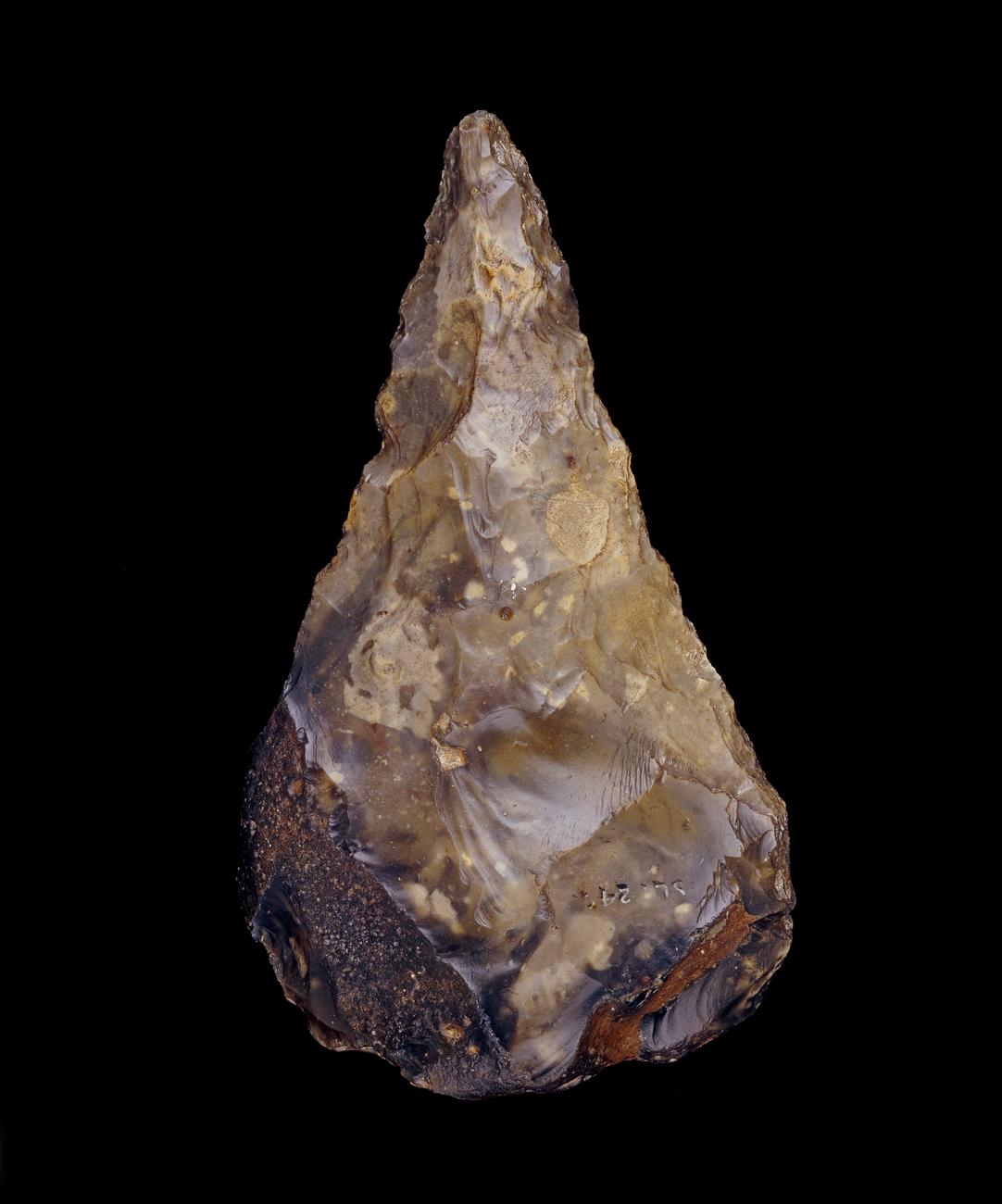
The Grays Inn Lane handaxe
- Gallery: Room 1
- Culture: Palaeolithic
- Date: 350000BC
- Object type: handaxe
- Materials: flint
- Museum number: SLAntiq.246
- Museum: The British Museum
- Collection record: British Museum website
- Image © The Trustees of the British Museum, shared under a CC BY-NC-SA 4.0 licence.
Listen to the free audio guide
About this object
Before you is "The Grays Inn Lane handaxe," a remarkable artifact from the Palaeolithic period, over 350,000 years old. It is made from flint, carefully shaped into a pointed tool with a plano-convex cross section. You can see that it was skillfully modified on both sides to create sharp edges, and the patina has turned the flint a rich orange-brown from being buried in gravel for millennia.
This handaxe is historically significant as it was the first of its kind in Britain to be recorded and published with an illustration in 1715. Discovered in 1673 by John Conyers in what is now Farringdon Road, it was originally thought to be connected to ancient Britons or even the Roman invasion, but Conyers noted its deep gravel context suggested a much older origin.
Acquired by Sir Hans Sloane, it entered a collection that would later form part of the British Museum. This object helped change perceptions of human history, as geological and archaeological evidence began to suggest a past far older than previously believed.
See it in person
The Grays Inn Lane handaxe is on display in Room 1 at the British Museum on Great Russell Street, Bloomsbury, London — free to enter. Choose British Museum on audioguide.london and take a photo of it to hear this free audio guide in six languages — no app download needed.
New, in beta. British Museum support has just launched and is still improving: over 1,000 objects so far, with more added all the time.