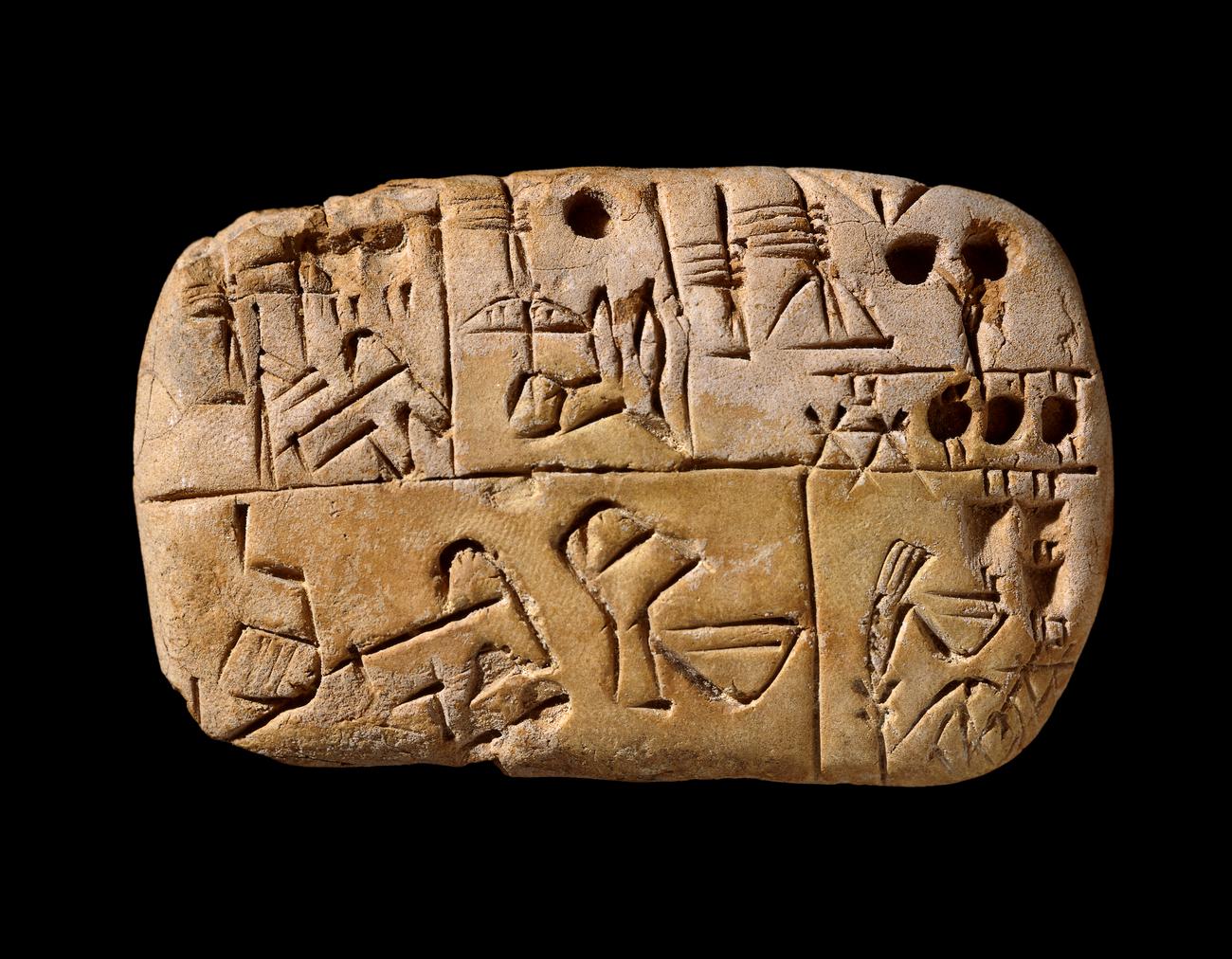
Tablet of food supplies
- Audio guide stop: 392
- Gallery: Room 56
- Culture: Late Uruk
- Date: 3300BC-3100BC
- Object type: tablet
- Materials: clay
- Museum number: 140852
- Museum: The British Museum
- Collection record: British Museum website
- Image © The Trustees of the British Museum, shared under a CC BY-NC-SA 4.0 licence.
Listen to the free audio guide
About this object
Before you is a clay tablet from the Late Uruk period, dated between 3300 and 3100 BC. This small object, less than eight centimeters long, served as a record of food supplies in an ancient administrative system.
What stands out visually is the symbol of a human head with a triangular shape in front of it—an early representation associated with the concept of eating. In later Sumerian, the head symbol became the verb "to eat," and the triangle became the standard symbol for bread. Three distinct numerical symbols are also etched into the clay, indicating a developing system of record-keeping.
This cuneiform-inscribed tablet was used in what was then southern Iraq, in a society forming some of the earliest known written systems. It is a glimpse into the daily logistics and administration of a civilization on the cusp of history.
See it in person
Tablet of food supplies is on display in Room 56 at the British Museum on Great Russell Street, Bloomsbury, London — free to enter. Choose British Museum on audioguide.london and type its audio guide stop number, 392, from the gallery label, or take a photo of it, to hear this free audio guide in six languages — no app download needed.
New, in beta. British Museum support has just launched and is still improving: over 1,000 objects so far, with more added all the time.