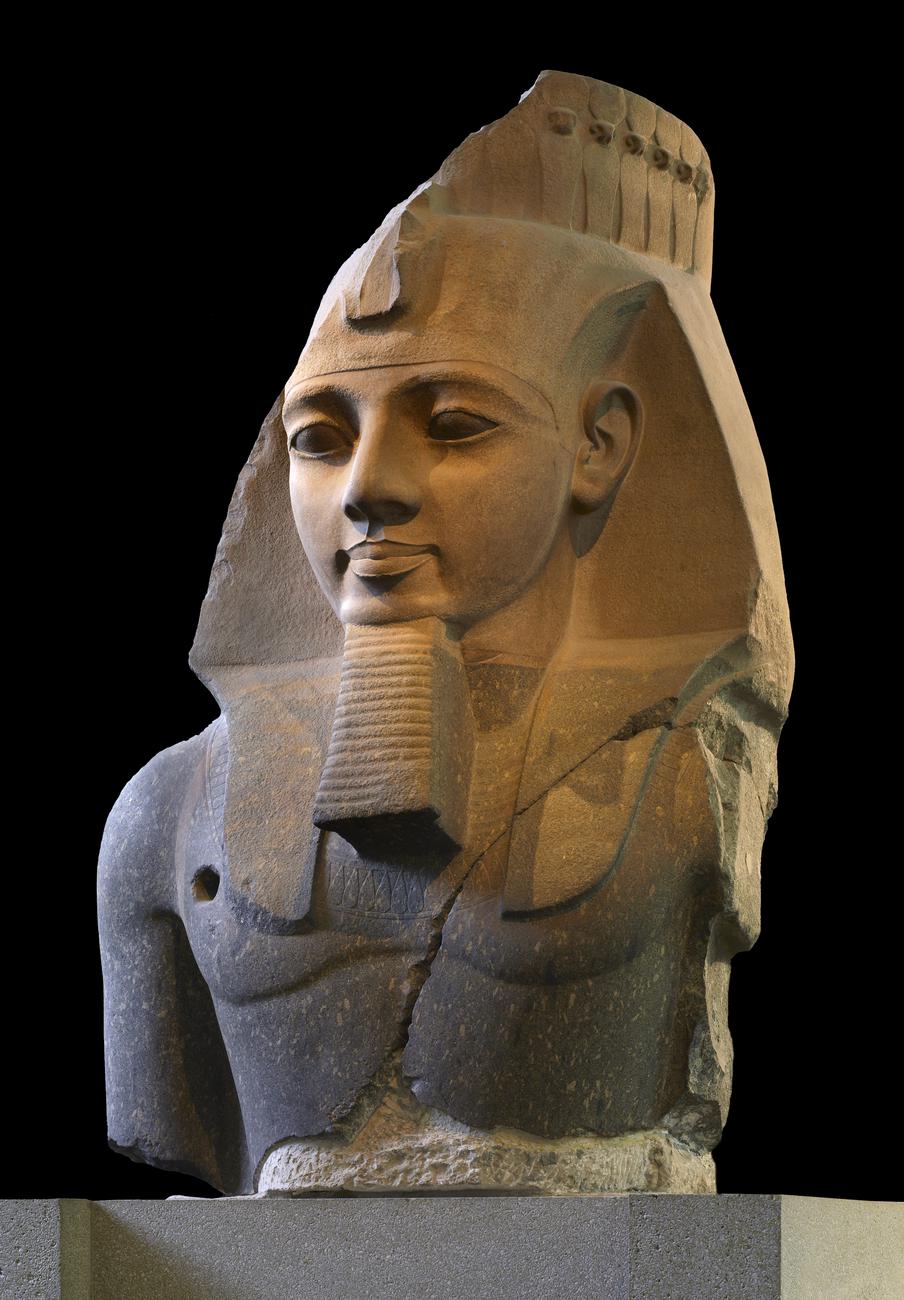
Statue of King Ramesses II
- Audio guide stop: 203
- Gallery: Room 4
- Culture: 19th Dynasty
- Object type: statue
- Materials: granodiorite; red granite
- Museum number: EA19
- Museum: The British Museum
- Collection record: British Museum website
- Image © The Trustees of the British Museum, shared under a CC BY-NC-SA 4.0 licence.
Listen to the free audio guide
About this object
This is The Younger Memnon, a monumental statue of Pharaoh Ramesses II from ancient Egypt’s 19th Dynasty. Before you is the head and upper body carved from pink and grey granite. The figure originally stood in a pair, guarding the entrance to the Ramesseum in Thebes. You can see the nemes headdress with its distinctive tripartite pattern and a circlet of uraei—symbols of royal power.
The sculptor used the natural coloring of the stone to highlight the division between the face and body. Turning around, your eye is drawn to the back of the statue, known as the dorsal pillar. There, vertical rows of finely carved hieroglyphs name the king and list his titles, including a dedication to the god Amun-Ra.
Although only a fragment today, this statue once carried traces of red paint, suggesting it was brightly colored in antiquity. It arrived in the West in 1817 through the efforts of Henry Salt and Johann Ludwig Burckhardt.
See it in person
Statue of King Ramesses II is on display in Room 4 at the British Museum on Great Russell Street, Bloomsbury, London — free to enter. Choose British Museum on audioguide.london and type its audio guide stop number, 203, from the gallery label, or take a photo of it, to hear this free audio guide in six languages — no app download needed.
New, in beta. British Museum support has just launched and is still improving: over 1,000 objects so far, with more added all the time.