Reclamation
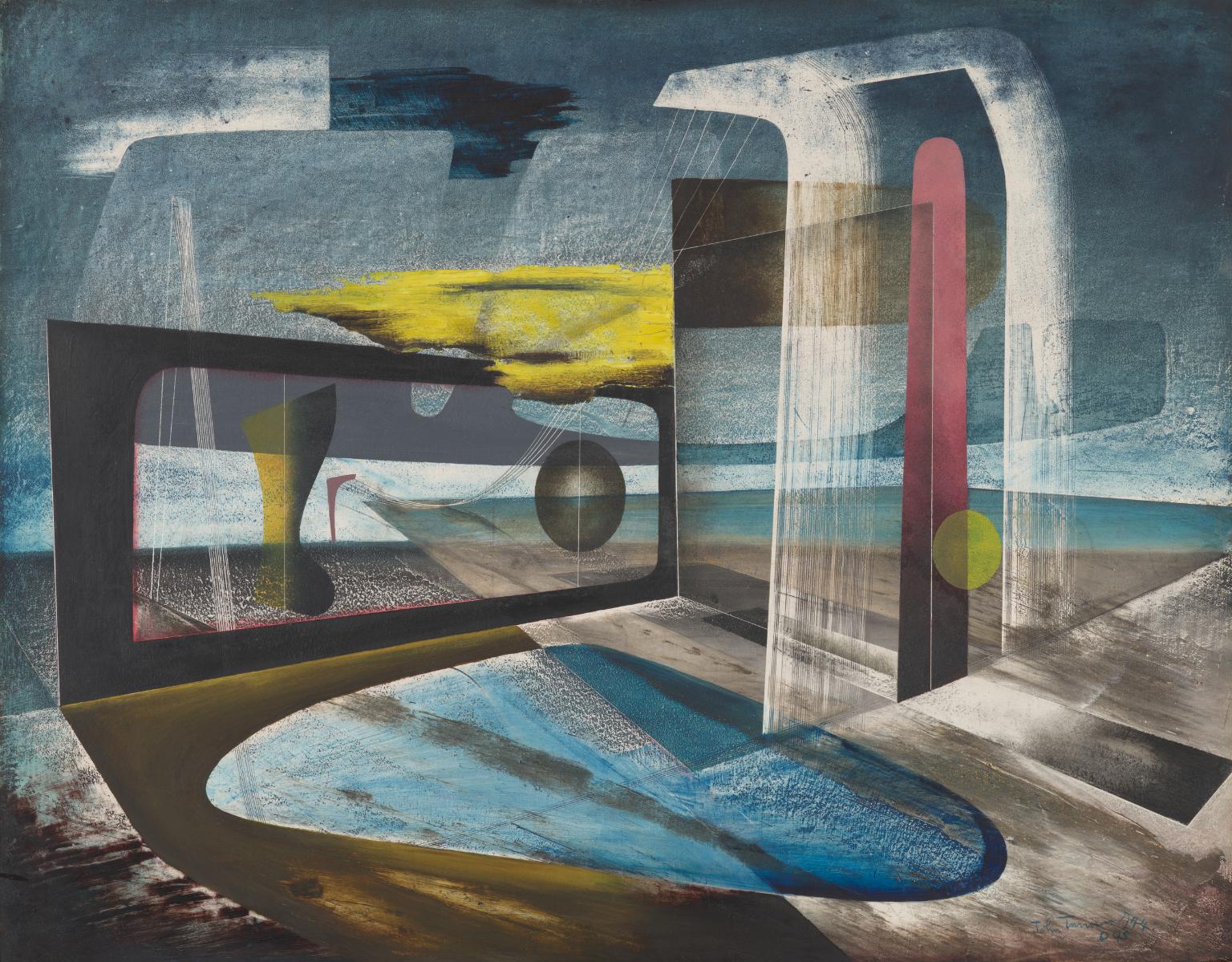
- Artist: John Tunnard
- Date: 1944
- Medium: Oil paint and gouache on board
- Dimensions: support: 559 x 714 mm
- Museum: Tate Britain
- Collection record: Tate Britain website
Listen to the free audio guide
About this artwork
This is the “Reclamation” by John Tunnard. Painted in 1944, it sits at the intersection of war and art, created as the world was in turmoil. Tunnard, a pacifist who joined the coastguard after the war began, was a key member of the London Surrealist Group and worked closely with the Artists’ International Association. The painting echoes his earlier work “Focal Point” shown at the AIA’s “For Liberty” exhibition on the John Lewis bombsite – the same moment of resilience in a time of destruction.
In the canvas we see a fractured, almost abstract landscape where irregular forms hint at boats, aircraft, and the sea. The composition is deliberately non‑representational, yet it feels like a reclamation of space – a re‑appropriation of the horizon under the threat of war. The medium, oil paint and gouache on board, gives the edges a sharp, almost mechanical texture, while the muted tones suggest both the calm of a quiet sea and the bleakness of wartime skies.
Tunnard’s work here can be seen as a subtle act of defiance, a way of asserting that art and memory survive even when the world feels dismantled. The piece is a quiet reminder that, even in conflict, there is an urge to rebuild and to reclaim.
See it in person
Reclamation is in the collection of Tate Britain on Millbank, London — free to enter. Point your phone at any artwork there and audioguide.london plays a free audio guide in six languages — no app download needed.