Queen Anne
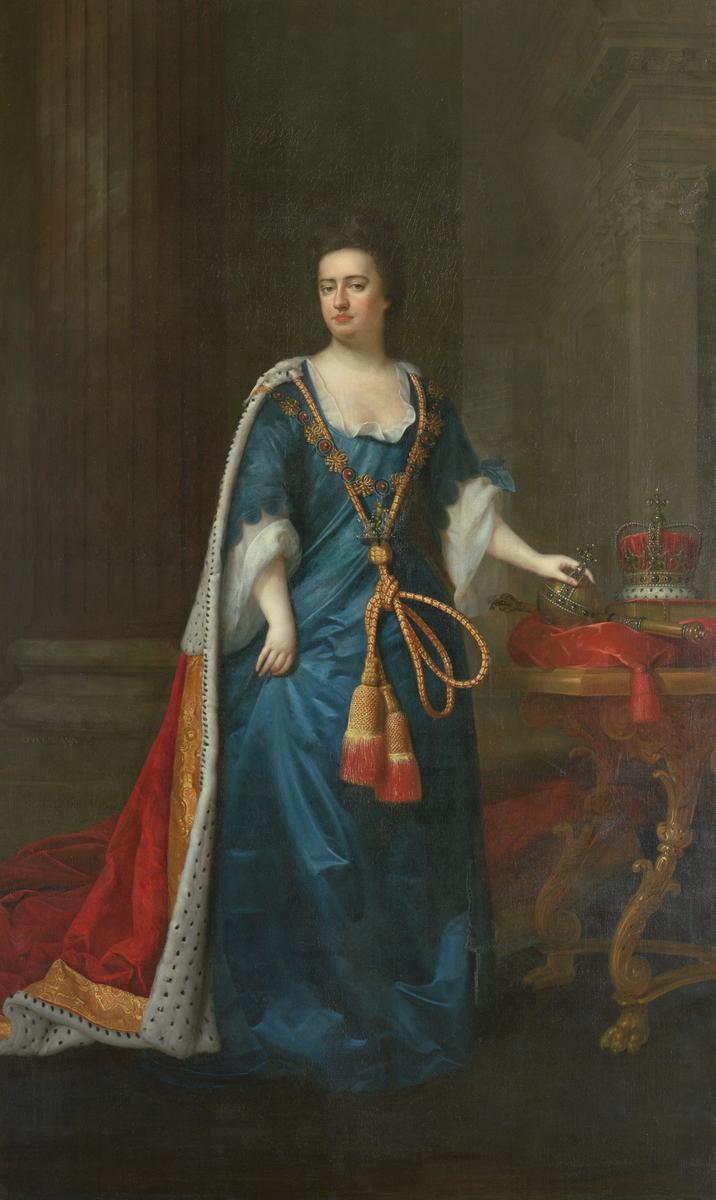
- Artist: Edmund Lilly
- Date: 1706
- Medium: Oil paint on canvas
- Dimensions: support: 2469 × 1481 mm
- Museum: Tate Britain
- Collection record: Tate Britain website
Listen to the free audio guide
About this artwork
“This is “Queen Anne” by Edmund Lilly.” It’s a large oil‑on‑canvas from 1706, with dimensions of roughly 2469 × 1481 mm. The picture shows Queen Anne in full length, standing on a raised stone dais. She wears a deep blue dress and a heavy red velvet cloak trimmed with ermine and gold embroidery, all tied at the collar with a tasselled cord. On a lavish table to her right are the orb and crown—symbols of monarchy—and they sit amidst fluted marble columns that evoke Baroque architecture.
Lilly chose a fictitious yet opulent setting rather than a simple studio backdrop, so the scene feels both grand and cinematic. It isn’t a coronation portrait; she’s not wearing coronation robes, but the dramatic architecture gives the sense of majesty. The painting was originally part of the Clarendon collection—Edward Hyde’s gallery that chronicled Britain’s political figures and royal family—and Queen Anne there served as a visual anchor for his lineage.
Little is known of Lilly himself, but he was a London-based artist from Norfolk who specialized in Queen‑Anne portraits. He produced multiple full‑lengths, as well as half‑lengths and head‑and‑shoulders versions. This work represents one of the two main portrait “types” he made of her—an important example of early 18th‑century British portraiture that blends fashion, status, and architectural grandeur.
See it in person
Queen Anne is in the collection of Tate Britain on Millbank, London — free to enter. Point your phone at any artwork there and audioguide.london plays a free audio guide in six languages — no app download needed.