Prince or Shepherd? (Prince ou Berger?)
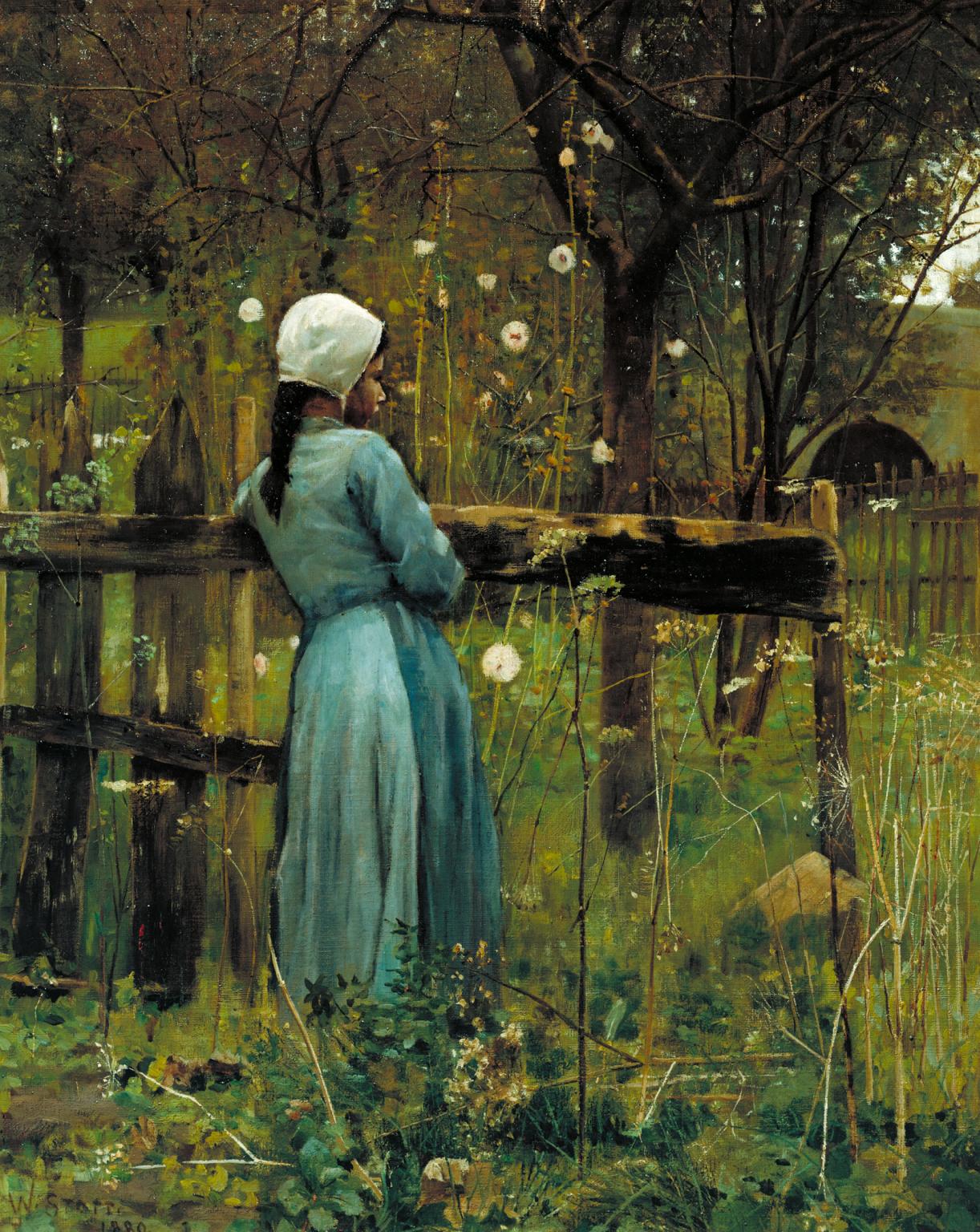
- Artist: William Stott of Oldham
- Date: 1880
- Medium: Oil paint on canvas
- Dimensions: support: 718 x 578 mm
- Museum: Tate Britain
- Collection record: Tate Britain website
Listen to the free audio guide
About this artwork
This is the “Prince or Shepherd?” by William Stott of Oldham. Painted in 1880 while he was in the French village of Grez‑sur‑Loing, the canvas captures a young woman lost in thought, leaning against a broken fence that doubles as a symbolic threshold to an uncertain future. The distant twelfth‑century stone bridge—a frequent motif in Grez paintings—adds a quiet backdrop.
Stott, trained in Paris under Jean‑Léon Gérôme, brought the naturalist rigor of French plein‑air painters like Jules Bastien‑Lepage into his work. His attention to the arrangement of flowers, foliage, and light made his scenes appealing to conservative British patrons, yet the dreamy ambiguity of this piece hints at a deeper narrative: will she marry a wealthy man or stay a country girl?
The painting first appeared at London’s Grosvenor Gallery in 1881, then slipped from public view until a 1928 auction in Vichy brought it to Roger Temperley, who bequeathed it to the Tate in 1939. Its earlier title, “Girl in a Meadow,” was only restored to Stott’s original in 2017.
The motif of a girl leaning on a gate or fence would echo in later works by Clausen and Lavery, underscoring Stott’s subtle influence on the British naturalist tradition.
See it in person
Prince or Shepherd? (Prince ou Berger?) is in the collection of Tate Britain on Millbank, London — free to enter. Point your phone at any artwork there and audioguide.london plays a free audio guide in six languages — no app download needed.