Primroses and Bird’s Nest
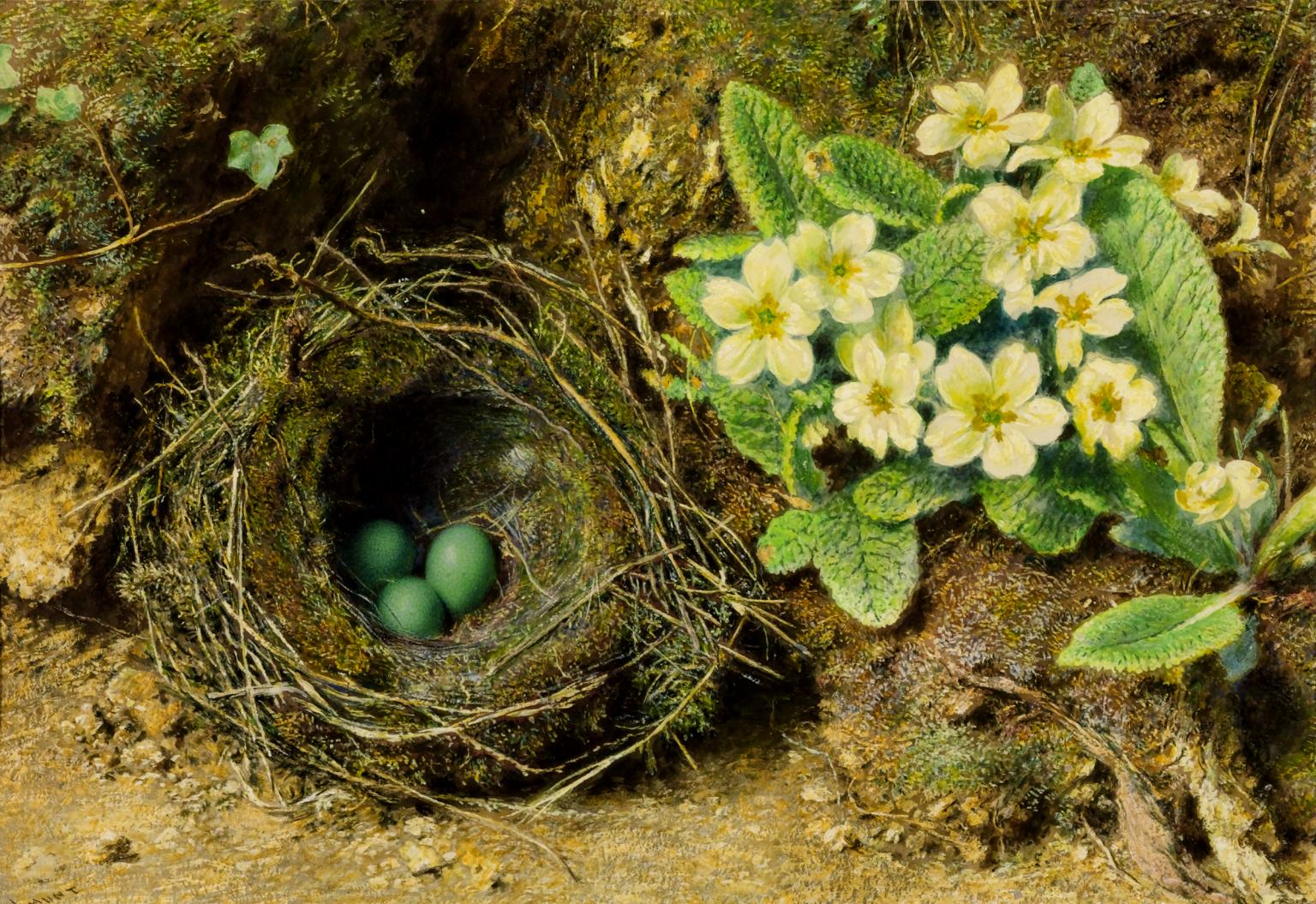
- Artist: William Henry Hunt
- Medium: Watercolour on paper
- Dimensions: support: 184 x 273 mm
- Museum: Tate Britain
- Collection record: Tate Britain website
Listen to the free audio guide
About this artwork
This is the “Primroses and Bird’s Nest” by William Henry Hunt. It’s a watercolour on paper from the 1840s, a time when Hunt was riding the wave of still‑life success. He’d made a name for himself by packing tiny, bright flowers, fruit, and, as the title hints, bird‑nests into these miniature scenes. In fact, his skill earned him the nickname “Bird’s Nest” Hunt.
Notice how Hunt starts with a hard, opaque white base—think gouache—and then layers translucent washes of pure pigment. The result is a brilliant, almost photographic realism: the green of the ivy, the soft brown of the moss, the delicate pink of the primroses all pop with clarity. This technique was revolutionary for watercolours at the time; he was the first to use it, and contemporaries like Ruskin lauded the “truth” in his colours.
Hunt’s life added drama to his work. After early success in oils, he turned to watercolour because his physical condition made open‑air painting difficult. From 1851 to 1864 he was showing eight works a year—mostly fruit and flowers—so much so that he joked in 1863 he had no time for anything else. The painting sits as a bright, carefully composed snapshot of nature, capturing a moment where colour, texture, and the quiet drama of a bird’s nest all collide.
See it in person
Primroses and Bird’s Nest is in the collection of Tate Britain on Millbank, London — free to enter. Point your phone at any artwork there and audioguide.london plays a free audio guide in six languages — no app download needed.