Le Passeur (The Ferryman)
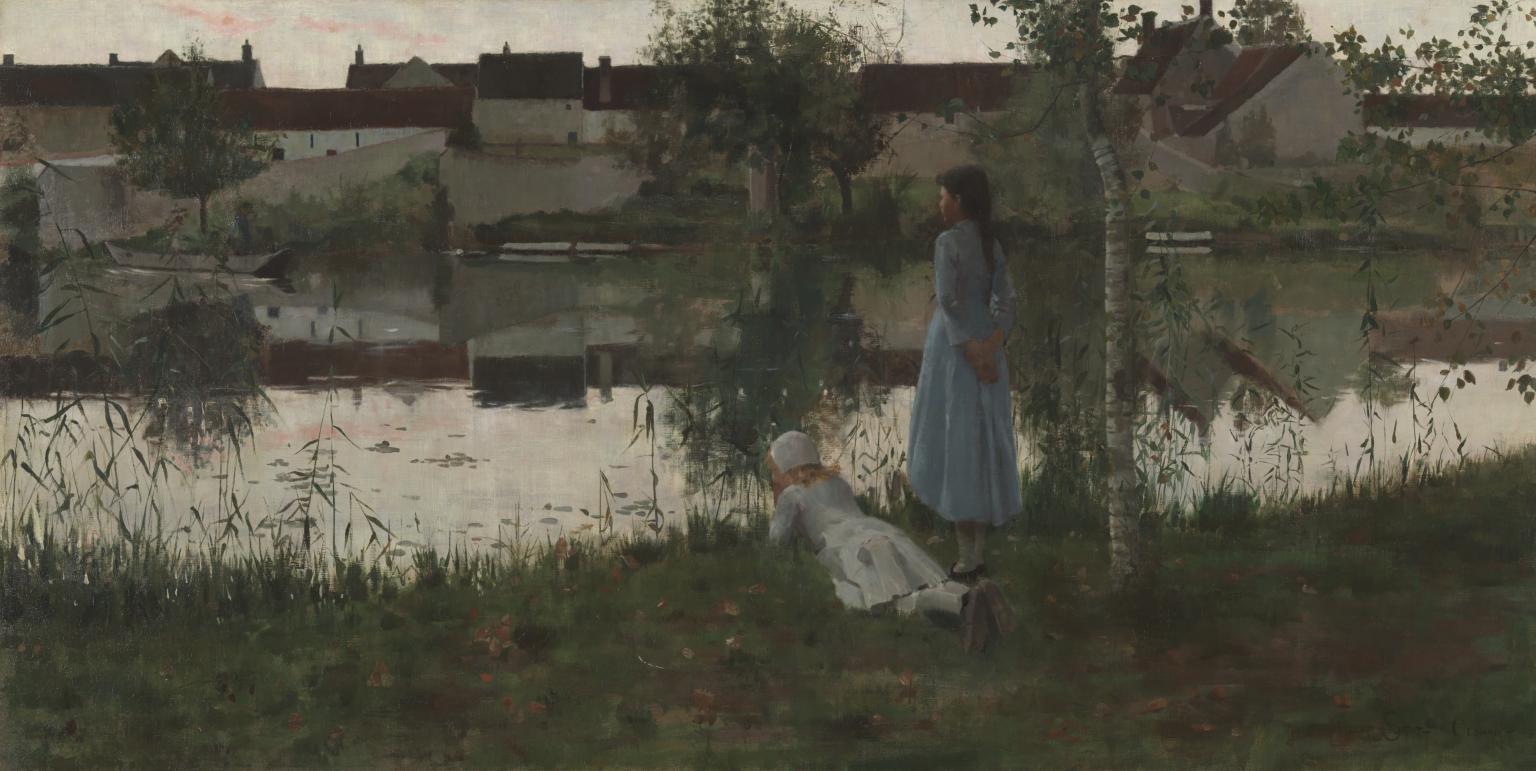
- Artist: William Stott of Oldham
- Date: 1881
- Medium: Oil paint on canvas
- Dimensions: support: 1092 x 2153 mm
- Museum: Tate Britain
- Collection record: Tate Britain website
Listen to the free audio guide
About this artwork
This is the “Le Passeur (The Ferryman)” by William Stott of Oldham, painted in 1881. The oil on canvas captures a quiet dusk by the River Loing in France, where Stott was living with a community of artists at Grez‑sur‑Loing. Two girls, their backs turned to us, stand on the shore waiting for a ferry to cross the water. Their silhouettes are bathed in the fading light that reflects off the river, giving the scene a subtle glow.
The title invites a mythic reading—perhaps a nod to Charon, the ferryman who guides souls across the Styx. The calm river and dimming sky can be seen as symbols of the passage between life and the after‑life, or simply the everyday transition from day to night. Stott’s brushwork is loose yet controlled, hinting at the emerging naturalist and impressionist currents of the time. He mixes the tonal softness of French realism with the dramatic lighting that recalls the works of the Scottish and Scandinavian artists who frequented the colony.
This painting is an important moment in 19th‑century British art, showing how artists absorbed continental ideas and turned them into something uniquely English, while still reaching for the timeless themes that lie beneath a quiet riverside scene.
See it in person
Le Passeur (The Ferryman) is in the collection of Tate Britain on Millbank, London — free to enter. Point your phone at any artwork there and audioguide.london plays a free audio guide in six languages — no app download needed.