Pavlova
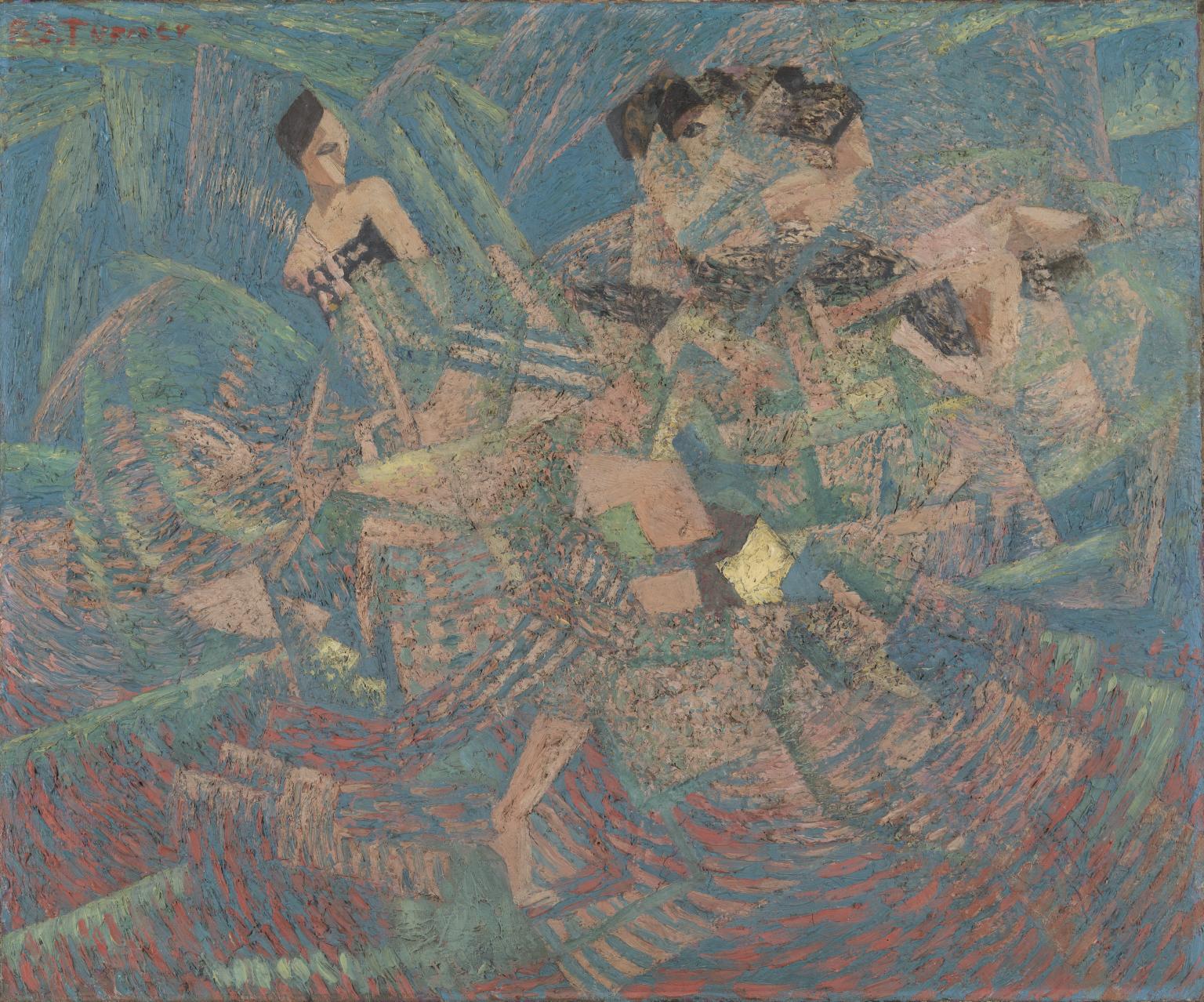
- Artist: Bruce Turner
- Date: c.1912
- Medium: Oil paint on canvas
- Dimensions: support: 516 x 619 mm
- Museum: Tate Britain
- Collection record: Tate Britain website
Listen to the free audio guide
About this artwork
This is the “Pavlova” by Bruce Turner, an oil on canvas from about 1912. It shows the celebrated Russian ballerina Anna Pavlova in the midst of a Leeds performance that the press called “the event of the century.” Turner captures her in mid‑air, but not with a single, graceful line – he fragments the figure, multiplying it across the canvas to give the illusion of motion through space.
The background is a burst of impastoed blue, yellow and red dashes that radiate fan‑wise from various points, a technique Turner borrowed from the Italian Futurists who were touring London that same year. The fragmented dancer echoes Gino Severini’s energetic style and recalls the stop‑action photographs of Eadweard Muybridge. In effect, Turner’s work is one of the earliest British paintings to adopt Futurist ideas, turning the ballerina’s steps into a visual rhythm that collapses her entire performance into a single, dynamic impression.
Turner, a member of the Leeds Art Club, was clearly exposed to the avant‑garde through the 1912 Sackville Gallery show. By rendering Pavlova this way, he fused the excitement of contemporary dance with the cutting‑edge formal experiments of his time, creating a vivid snapshot of modernity captured on canvas.
See it in person
Pavlova is in the collection of Tate Britain on Millbank, London — free to enter. Point your phone at any artwork there and audioguide.london plays a free audio guide in six languages — no app download needed.