Peace - Burial at Sea
- Artist: Joseph Mallord William Turner
- Date: exhibited 1842
- Medium: Oil paint on canvas
- Dimensions: support: 870 x 867 mm
- Museum: Tate Britain
- Collection record: Tate Britain website
Listen to the free audio guide
About this artwork
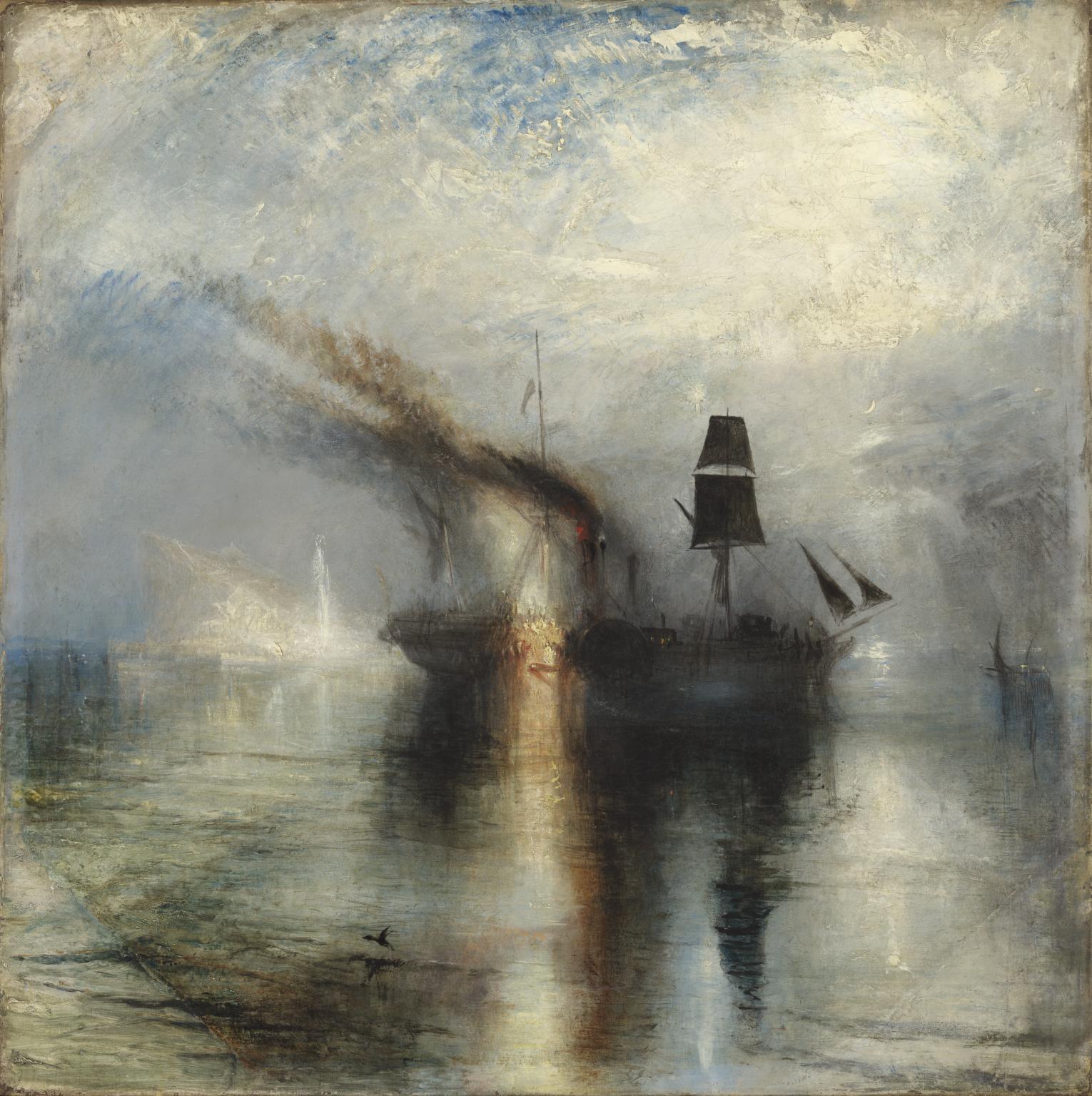
This is the “Peace – Burial at Sea” by Joseph Mallord William Turner, painted in 1842. Turner was experimenting with shapes at the time; here he turns a square canvas into an octagon, a playful tweak that gives the scene a distinctive frame. The picture is a memorial to his friend, the artist David Wilkie, who died of typhoid aboard the *Oriental* on his way back from the Middle East. The governor of Gibraltar, worried the disease might spread, refused Wilkie’s body ashore, so the artist was buried at sea.
In the painting, a steamship cuts through a twilight sky, its black sails cutting a stark silhouette against the pale light. Behind the ship, the white cliffs of Gibraltar loom, lending a dramatic backdrop. On the deck, Turner imagines a funeral carriage, a symbolic gesture of the public mourning Wilkie might have received had he lived on land. The night sky is full of moonlight and a hint of smoke from the ship’s smokestack, giving the whole a quiet, contemplative mood.
The work stirred some debate when it was first shown. Critics took issue with the darkness of the sails; Turner replied that he would have liked them even blacker, hinting at his fascination with the intensity of night. Despite the initial criticism, the painting has come to represent not just a funeral at sea, but also the broader themes of peace and loss that ran through Turner’s late work.
See it in person
Peace - Burial at Sea is in the collection of Tate Britain on Millbank, London — free to enter. Point your phone at any artwork there and audioguide.london plays a free audio guide in six languages — no app download needed.