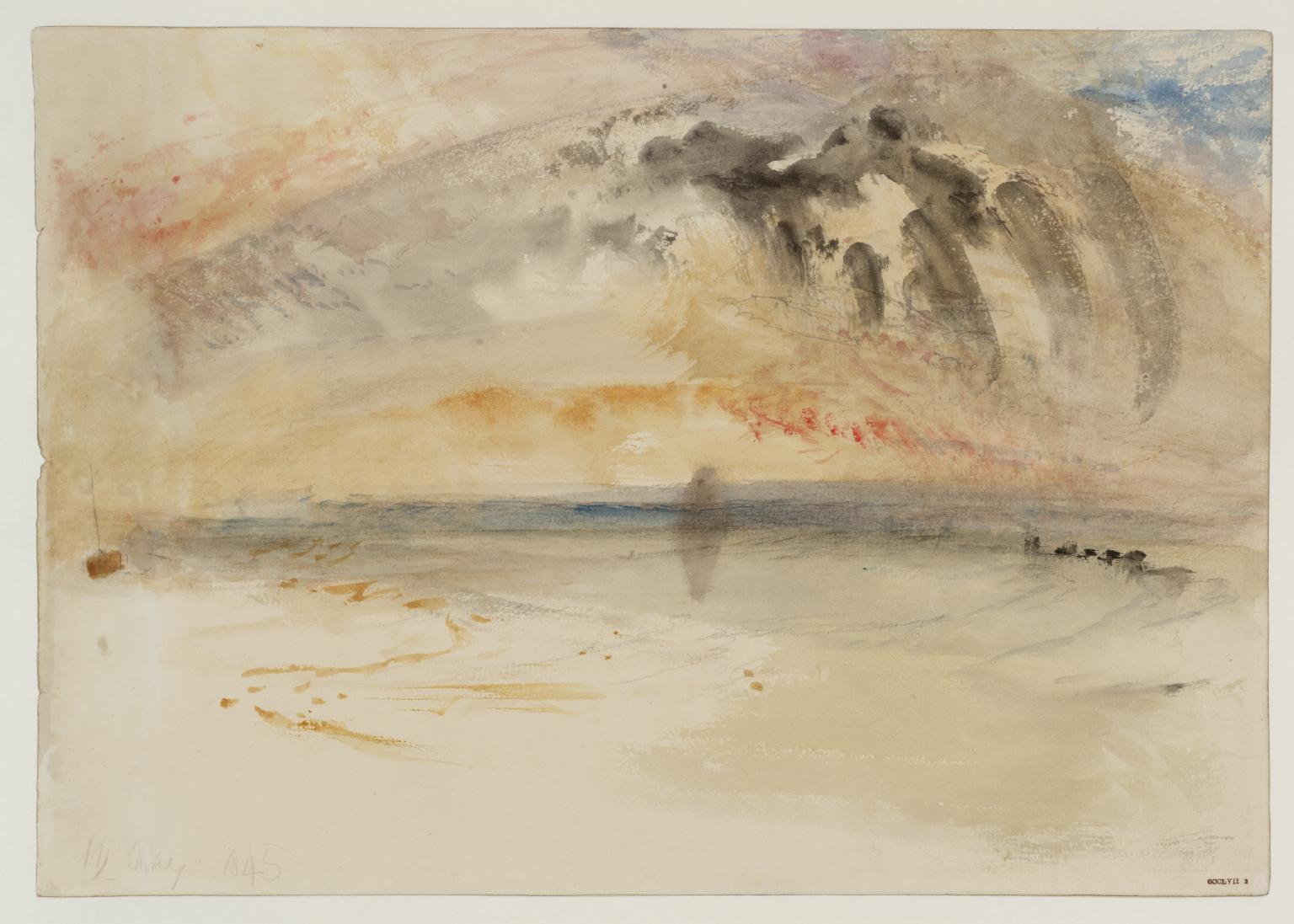
A Beach ?near the Tour de Croy, Wimereux
- Artist: Joseph Mallord William Turner
- Date: 1845
- Medium: Graphite and watercolour on paper
- Dimensions: support: 237 x 337 mm
- Museum: Tate Britain
- Collection record: Tate Britain website
Listen to the free audio guide
About this artwork
This is the “A Beach near the Tour de Croy, Wimereux” by Joseph Mallord William Turner. Painted in 1845, it sits on a modest sheet of paper – only 237 by 337 millimetres – yet it packs the intensity Turner was famous for. It’s a graphite and watercolour study taken from a sketchbook he used on his penultimate trip to France, in May of that year. He paused along the coast north of Boulogne, capturing the fleeting light of sunset on the beach at Wimereux.
What makes this piece special is that Turner actually dated it, a rarity for his sketches of this period. He seems to have felt that the moments he painted held something particular, perhaps a fleeting mood or a reminder of the changing light. The composition balances the low horizon with a vast, cloud‑laden sky that hints at an approaching storm, while the sea is rendered with delicate, almost translucent washes that give the water a dreamlike quality.
Turner’s skill in rendering atmospheric effects is on full display here. Notice how the graphite provides a strong structural backbone for the shoreline and figures, while the watercolours add depth and luminosity to the sky and sea. It’s a snapshot of a specific place and time, but also an early example of Turner’s lifelong fascination with how light transforms a landscape.
See it in person
A Beach ?near the Tour de Croy, Wimereux is in the collection of Tate Britain on Millbank, London — free to enter. Point your phone at any artwork there and audioguide.london plays a free audio guide in six languages — no app download needed.