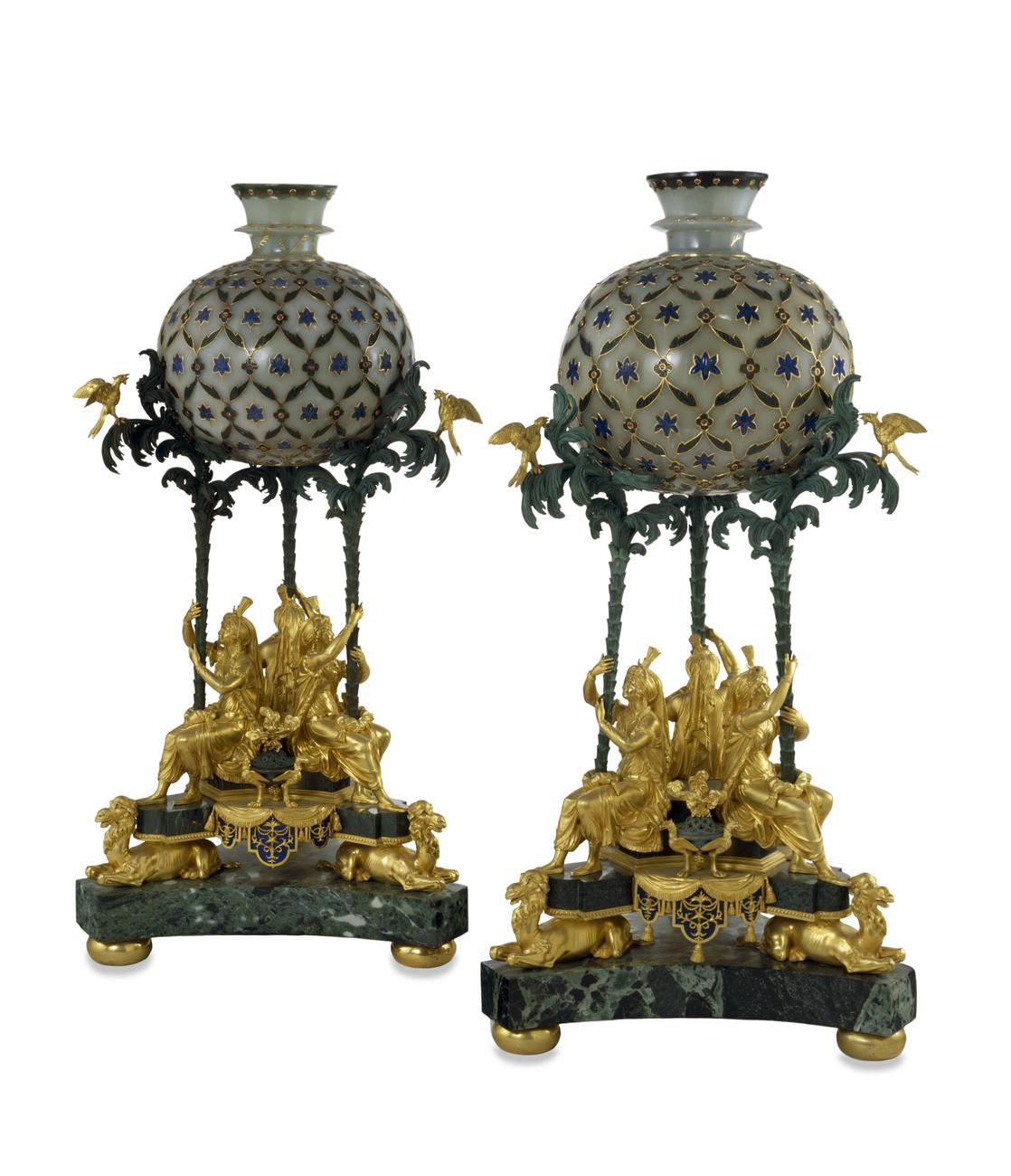
Mughal jade huqqa bases
- Audio guide stop: 606
- Gallery: Room 33
- Culture: Mughal dynasty
- Made in: England (stand); India (historic - pre-1947) (bowl)
- Date: 1700 (circa, bowl); 1798 (stand)
- Object type: bowl, stand
- Materials: jade; lapis lazuli; gold; ruby; marble; metal
- Museum number: 1956,0724.1.a-b
- Museum: The British Museum
- Collection record: British Museum website
- Image © The Trustees of the British Museum, shared under a CC BY-NC-SA 4.0 licence.
Listen to the free audio guide
About this object
Before you are two remarkable Mughal jade huqqa bases from different periods and places. The bowl was made in India in the early 1700s using jade, lapis lazuli, ruby, and gold. The inlaid craftsmanship is delicate, reflecting the Mughal dynasty’s love for rich materials and intricate design.
The second part is a marble base with gilded metal features, made in England in 1798. It has a French cursive inscription carved into the bottom: “Made and Executed by Huot Artiste, Paris 1798.”
Together, the pieces represent a fusion of East and West—Mughal aesthetics combined with European artistry. The huqqa, once a luxury smoking device, was often used in social and royal settings, giving these bases a sense of grandeur and cultural exchange. Take a moment to admire the textures and colors, each telling a story of distant craftsmanship.
See it in person
Mughal jade huqqa bases is on display in Room 33 at the British Museum on Great Russell Street, Bloomsbury, London — free to enter. Choose British Museum on audioguide.london and type its audio guide stop number, 606, from the gallery label, or take a photo of it, to hear this free audio guide in six languages — no app download needed.
New, in beta. British Museum support has just launched and is still improving: over 1,000 objects so far, with more added all the time.