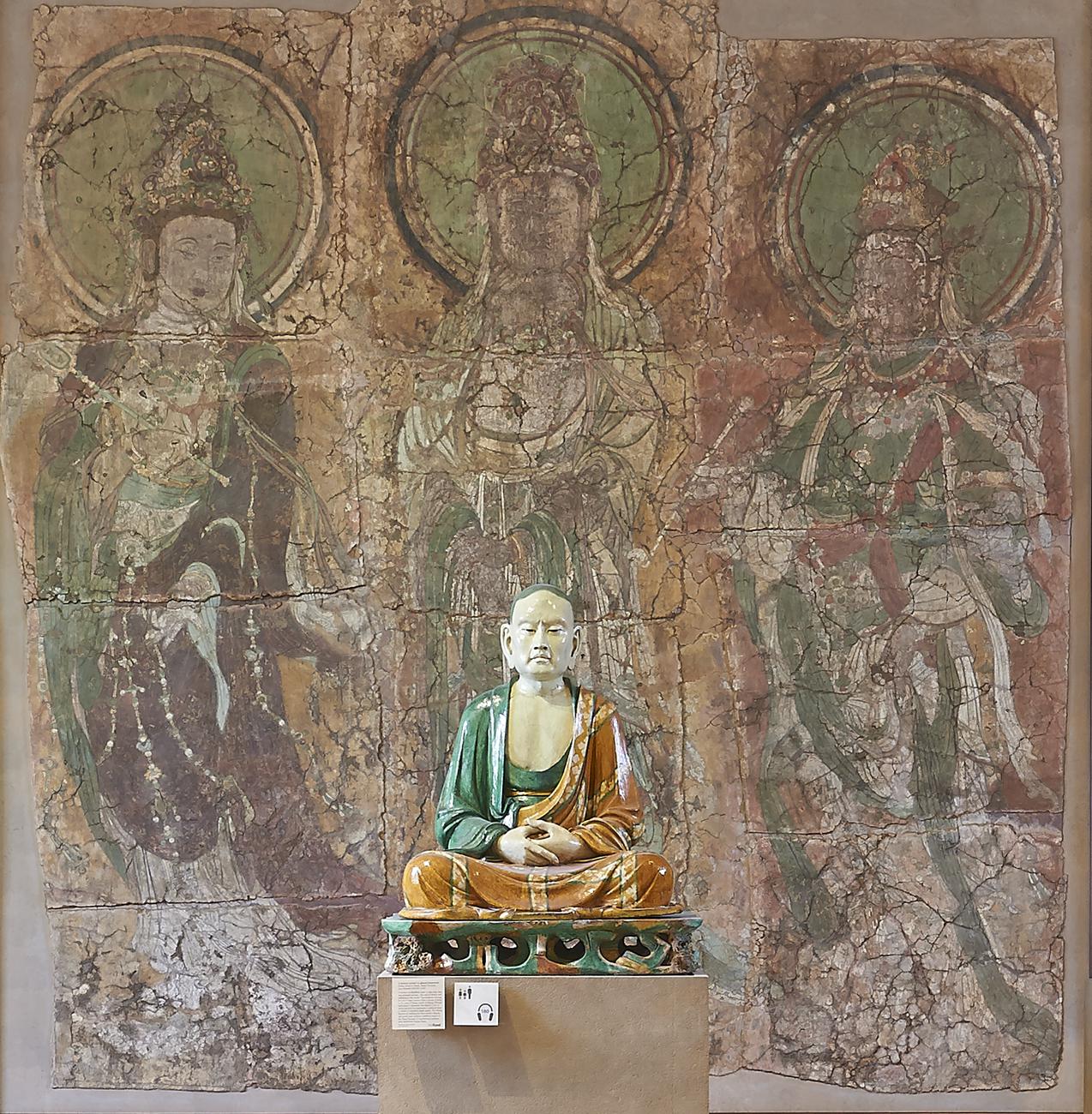
Ming dynasty wall-painting
- Gallery: Room 33
- Culture: Ming dynasty
- Made in: Qingliang Monastery
- Date: 1424 (initially painted? Painting may be earlier); 1437 (subsequent work); 1468 (subsequent work)
- Object type: wall-painting
- Materials: plaster
- Museum number: 1927,0518,0.8
- Museum: The British Museum
- Collection record: British Museum website
- Image © The Trustees of the British Museum, shared under a CC BY-NC-SA 4.0 licence.
Listen to the free audio guide
About this object
This is a wall painting from the Ming dynasty, depicting three standing bodhisattvas. The central figure shows Avalokitesvara (also known as Guanyin), with the image of Amitabha Buddha in his headdress. To the left is Manjusri (Wenshu), identifiable by his fly whisk and three-tiered crown. To the right is Samantabhadra (Puxian), who also holds a sceptre and has a Buddha in his headdress. Each figure is surrounded by a prominent halo.
Painted onto a layer of plaster, these figures are beautifully detailed with fine drapery patterns and expressive features. The work originally came from Qingliang Monastery in Hebei province, a site used by pilgrims visiting Mount Wutai in Shanxi. The painting was created in 1424 by monks from Mount Wutai. Later restorations took place in 1437 and 1468. It was brought to London in 1925 and donated to the British Museum by George Eumorfopoulos three years later.
See it in person
Ming dynasty wall-painting is on display in Room 33 at the British Museum on Great Russell Street, Bloomsbury, London — free to enter. Choose British Museum on audioguide.london and take a photo of it to hear this free audio guide in six languages — no app download needed.
New, in beta. British Museum support has just launched and is still improving: over 1,000 objects so far, with more added all the time.