Mechanical galleon
- Audio guide stop: 513
- Gallery: Room 39
- Maker: Hans Schlottheim
- Made in: Augsburg
- Date: 1580-1590
- Object type: nef, clock
- Materials: brass (hull, masts, movement plates); iron (movement components); silver (clock dial); enamel (clock dial)
- Museum number: 1866,1030.1
- Museum: The British Museum
- Collection record: British Museum website
- Image © The Trustees of the British Museum, shared under a CC BY-NC-SA 4.0 licence.
Listen to the free audio guide
About this object
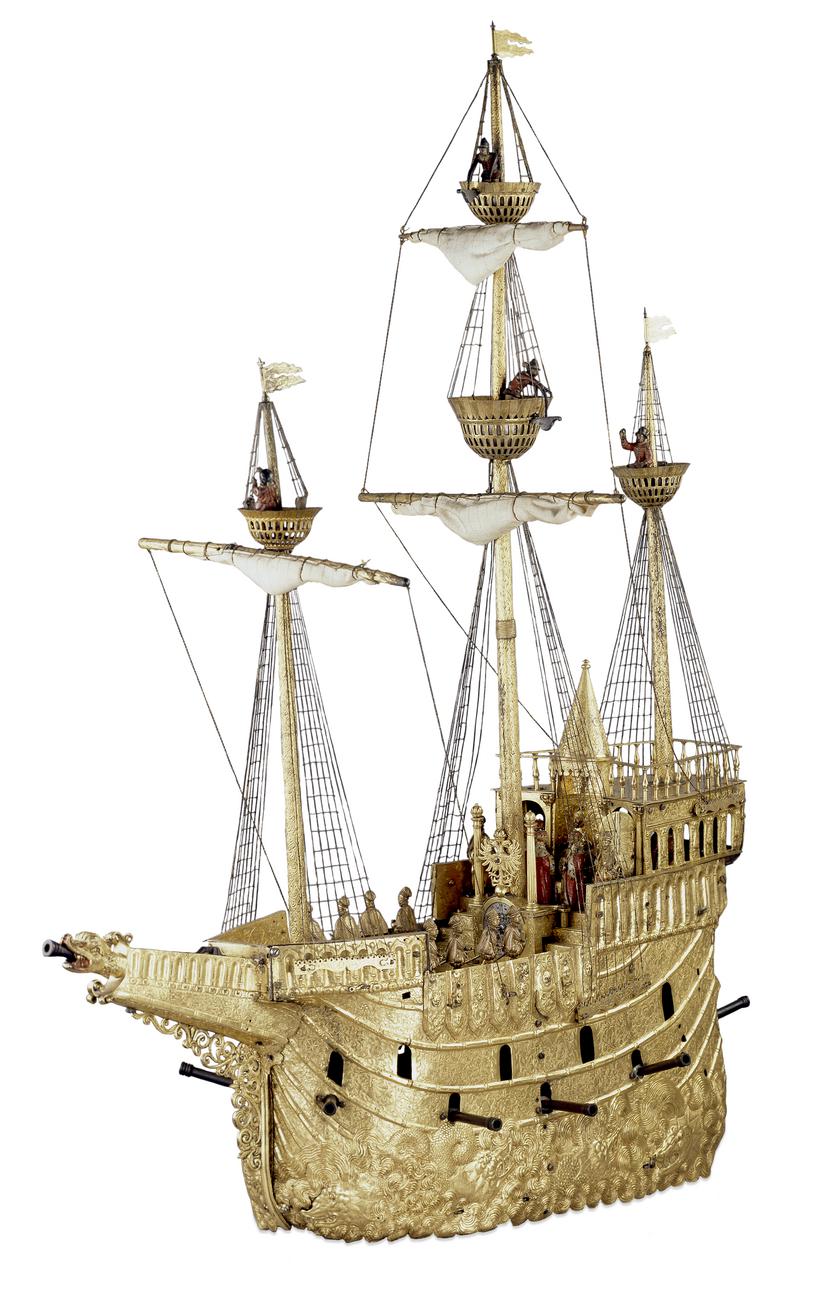
Before you stands a remarkable mechanical galleon, a clockwork automaton crafted by Hans Schlottheim in Augsburg around 1580–1590. This elaborate ship is gilded brass, decorated with waves and mythical sea creatures, and fitted with three masts crowned with furled sails and small metal pennants. Its gilded clock rests in the center with a silver, enamel-detailed dial that marks the hours.
Above the mainmast, sailors in the crows’ nests strike tiny bells to mark hours and quarters. Inside the hull, behind a scene of imperial grandeur, an Emperor sits beneath a double-headed eagle. Around ten cannons line the sides, all ready for automatic firing.
This is more than a ship: it is a clockwork performance. As the automaton moves, its bells chime, its drums beat, and music plays from a hidden regal bellows system. It's a masterpiece of craftsmanship that blends art, music, and mechanical ingenuity, likely made for Emperor Rudolf II.
See it in person
Mechanical galleon is on display in Room 39 at the British Museum on Great Russell Street, Bloomsbury, London — free to enter. Choose British Museum on audioguide.london and type its audio guide stop number, 513, from the gallery label, or take a photo of it, to hear this free audio guide in six languages — no app download needed.
New, in beta. British Museum support has just launched and is still improving: over 1,000 objects so far, with more added all the time.