Hedwig Beaker
- Audio guide stop: 631
- Gallery: Room 42
- Culture: Norman
- Made in: Syria (Or Eastern Mediterranean)
- Date: 12thC
- Object type: beaker
- Materials: glass
- Museum number: 1959,0414.1
- Museum: The British Museum
- Collection record: British Museum website
- Image © The Trustees of the British Museum, shared under a CC BY-NC-SA 4.0 licence.
Listen to the free audio guide
About this object
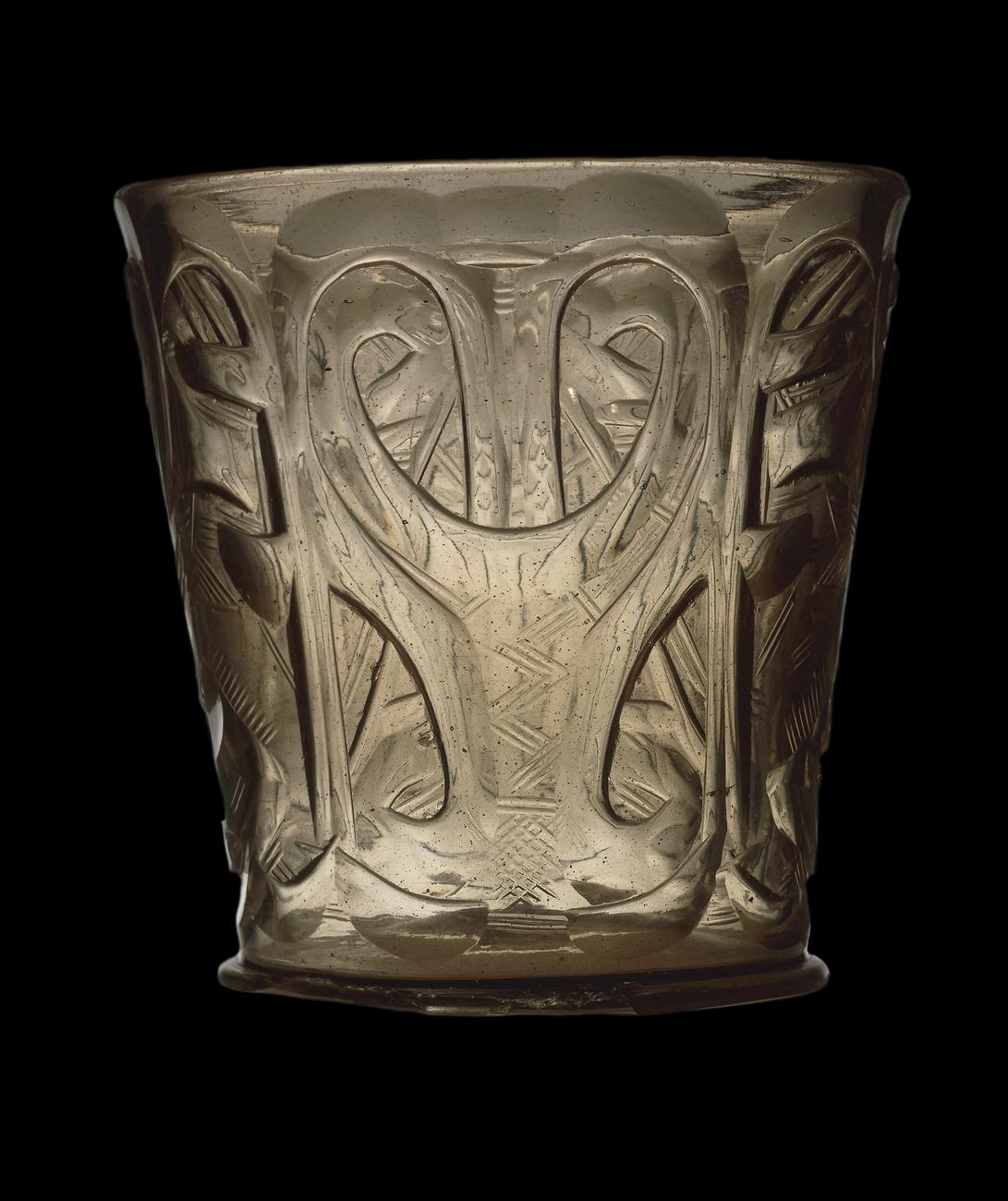
Before you is the Hedwig beaker, a remarkable piece of Norman glasswork from the 12th century. This beaker is made of thick, brownish glass with visible bubbles, and its base clearly shows a pontil mark—left by the rod used in its creation.
What catches the eye are the intricate wheel-cut designs adorning the glass. Look closely: a mighty eagle stretches its wings, flanked by a lion and a winged griffin. These figures are framed by delicate floral patterns composed of half-palmettes stacked one above the other. Though the beaker was originally mounted on a foot ring, this has since been broken off.
This work is part of a small group known as the Hedwig glasses, linked to the venerated St. Hedwig of Silesia. These beakers were thought to have turned water into wine—a miracle connected to the saint. Scholars suggest they may have been made in Syria during the Crusader era, reflecting the vibrant artistic traditions of the Eastern Mediterranean region.
See it in person
Hedwig Beaker is on display in Room 42 at the British Museum on Great Russell Street, Bloomsbury, London — free to enter. Choose British Museum on audioguide.london and type its audio guide stop number, 631, from the gallery label, or take a photo of it, to hear this free audio guide in six languages — no app download needed.
New, in beta. British Museum support has just launched and is still improving: over 1,000 objects so far, with more added all the time.