Etruscan incense-burner
- Gallery: Room 71
- Culture: Etruscan
- Made in: Italy
- Date: 325BC-275BC
- Object type: incense-burner, funerary equipment
- Materials: bronze
- Museum number: 1873,0820.211
- Museum: The British Museum
- Collection record: British Museum website
- Image © The Trustees of the British Museum, shared under a CC BY-NC-SA 4.0 licence.
Listen to the free audio guide
In the museum now? Point your phone at the next object and hear its guide.
About this object
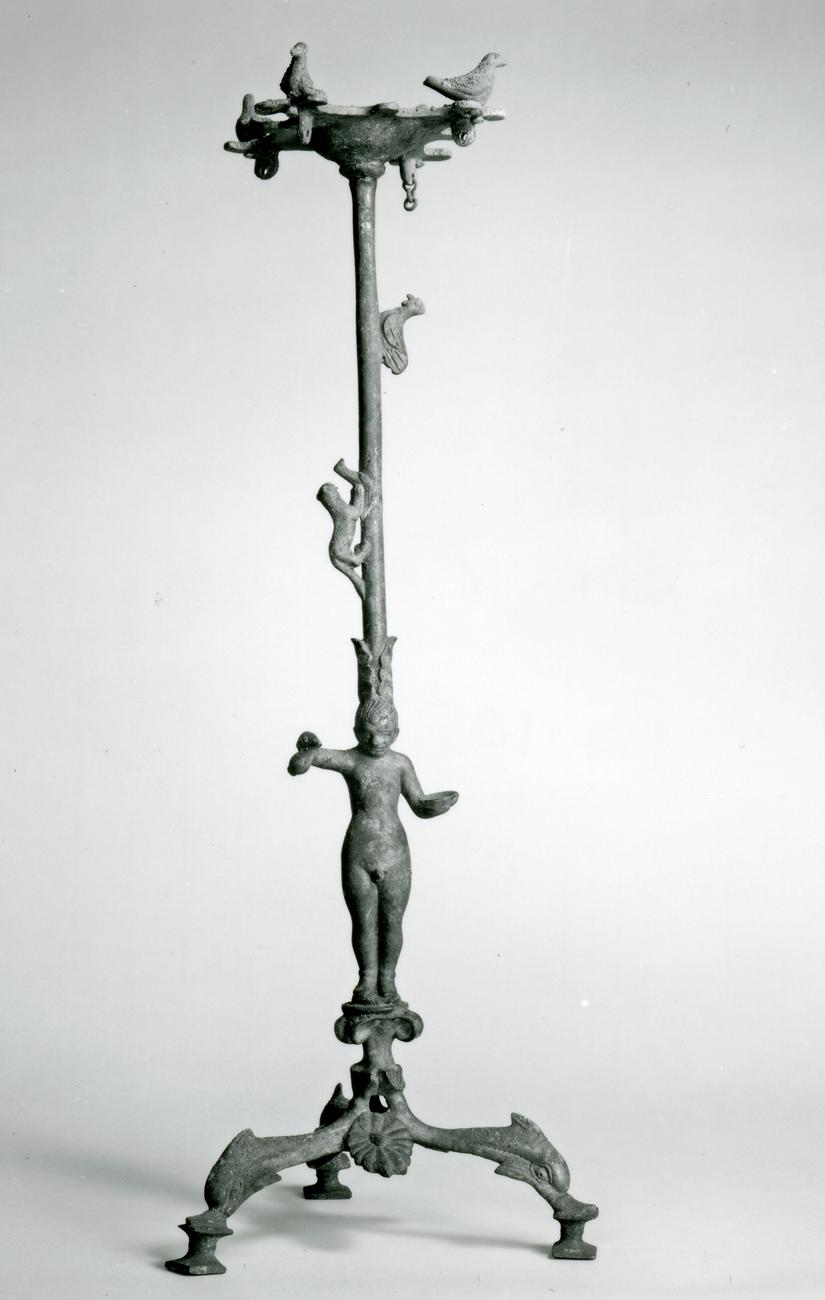
Before you is an Etruscan bronze incense-burner, a masterpiece of intricate design. At its base, two dolphin-shaped feet with carved floral patterns support a caryatid—a young male figure with rounded, childlike features and short hair. In his hands, he holds ceremonial objects: a patera in one, an oinochoe in the other, suggesting a ritual purpose. Above, a shaft is adorned with a dramatic chase between a long-tailed cat and a dove, plus a fleeing bird above, adding movement and narrative to the piece.
The hemispherical bowl atop the incense-burner is framed by a squared, scalloped rim with a dove at each corner. Inscribed on the boy’s back is an Etruscan inscription translated as "of the tomb of Thania Lucini." Such inscriptions help connect the object to a particular burial tradition.
Made around the third century BC in Italy and acquired from Alessandro Castellani, the incense-burner was likely used in domestic or funerary rites, symbolizing an elite lifestyle steeped in Etruscan traditions.
See it in person
Etruscan incense-burner is on display in Room 71 at the British Museum on Great Russell Street, Bloomsbury, London — free to enter. Choose British Museum on audioguide.london and take a photo of it to hear this free audio guide in six languages — no app download needed.
New, in beta. British Museum support has just launched and is still improving: over 1,000 objects so far, with more added all the time.