Daiei Era katana
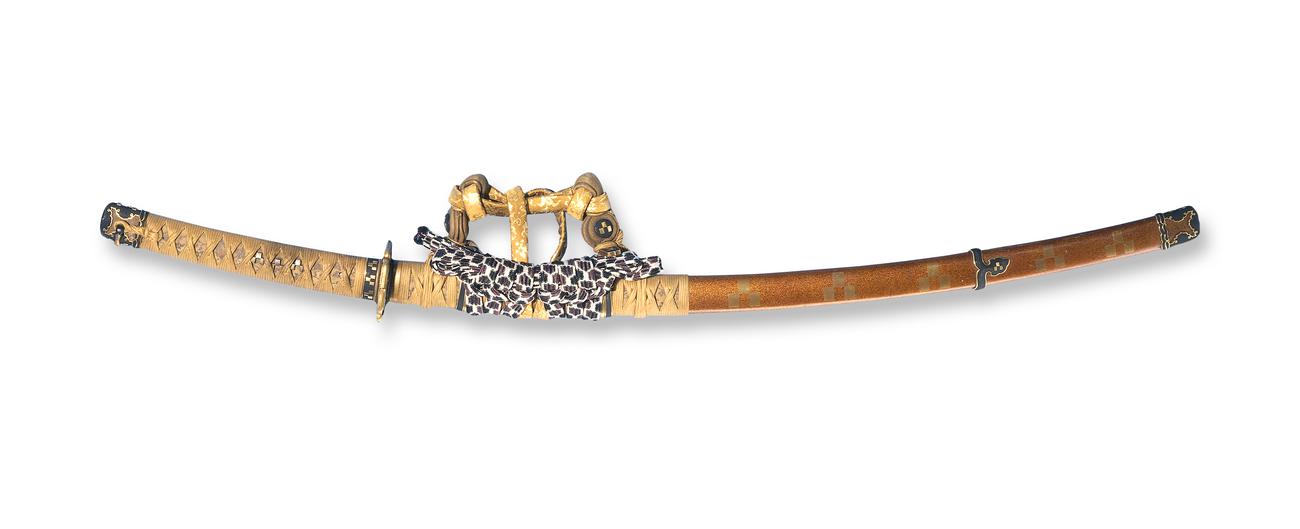
- Gallery: Room 93
- Maker: Osafune Sukesada
- Culture: Daiei Era; Edo Period
- Made in: Bizen (historic - kuni)
- Date: 1521; 18thC
- Object type: katana, blade, saya
- Materials: steel; gold; lacquer; shakudo; wood; textile; ray skin
- Museum number: 1958,0730.149.a-d
- Museum: The British Museum
- Collection record: British Museum website
- Image © The Trustees of the British Museum, shared under a CC BY-NC-SA 4.0 licence.
Listen to the free audio guide
In the museum now? Point your phone at the next object and hear its guide.
About this object
This is a Daiei Era katana, a long sword crafted by the skilled swordsmith Osafune Sukesada in Bizen Province in 1521. The blade shows a striking curve near the hilt, a feature common in swords of the 15th and 16th centuries that improved cutting efficiency. You can see a beautiful "wave pattern" called hamon along the steel's surface, created by the specialized forging and hardening process used by swordmakers.
Complementing the blade is a rich gold-lacquered mounting. The triple paving-stone crest of the Tsuchiya family appears repeatedly in gold inlay and gold foil across the scabbard and fittings, marking this sword as a possession of noble standing. The hilt has a wooden core wrapped in textile and ray skin, while the tsuba, or guard, is shaped like a mokko, or pine seed pod. This katana and its mounting date to two different periods—1521 and the 18th century—and were brought together in a collection bequeathed in 1958.
See it in person
Daiei Era katana is on display in Room 93 at the British Museum on Great Russell Street, Bloomsbury, London — free to enter. Choose British Museum on audioguide.london and take a photo of it to hear this free audio guide in six languages — no app download needed.
New, in beta. British Museum support has just launched and is still improving: over 1,000 objects so far, with more added all the time.