Edo Period dish
- Gallery: Room 93
- Culture: Edo Period
- Made in: Europe; Sarugawa
- Date: 1660-1680
- Object type: dish
- Materials: porcelain
- Museum number: 1961,1212.5
- Museum: The British Museum
- Collection record: British Museum website
- Image © The Trustees of the British Museum, shared under a CC BY-NC-SA 4.0 licence.
Listen to the free audio guide
About this object
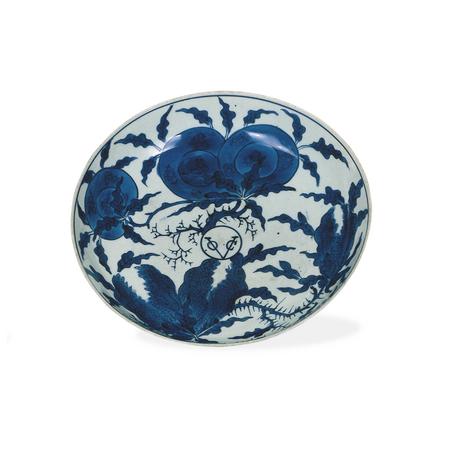
This is an Edo Period dish made for European customers during the years 1660 to 1680. Created in Sarugawa, Japan, it shows fruiting branches of pomegranate and "Buddha's hand" citron, along with a VOC monogram in the center. The reverse side features three peach sprays and another VOC monogram. The dish is made of porcelain painted in underglaze blue, a technique that gives it a striking and vibrant appearance.
This piece reflects the special order custom for the Dutch East India Company, or VOC. Peaches and "Buddha's hand" were chosen as symbols of good fortune. The VOC mark appears both front and back, showing it was commissioned to be unique yet practical.
Designed in a Chinese style, this dish demonstrates the blending of Eastern craftsmanship with Western trade influence—part of a broader tradition of Japanese porcelain made especially for export to Europe.
See it in person
Edo Period dish is on display in Room 93 at the British Museum on Great Russell Street, Bloomsbury, London — free to enter. Choose British Museum on audioguide.london and take a photo of it to hear this free audio guide in six languages — no app download needed.
New, in beta. British Museum support has just launched and is still improving: over 1,000 objects so far, with more added all the time.