Boeotian statue
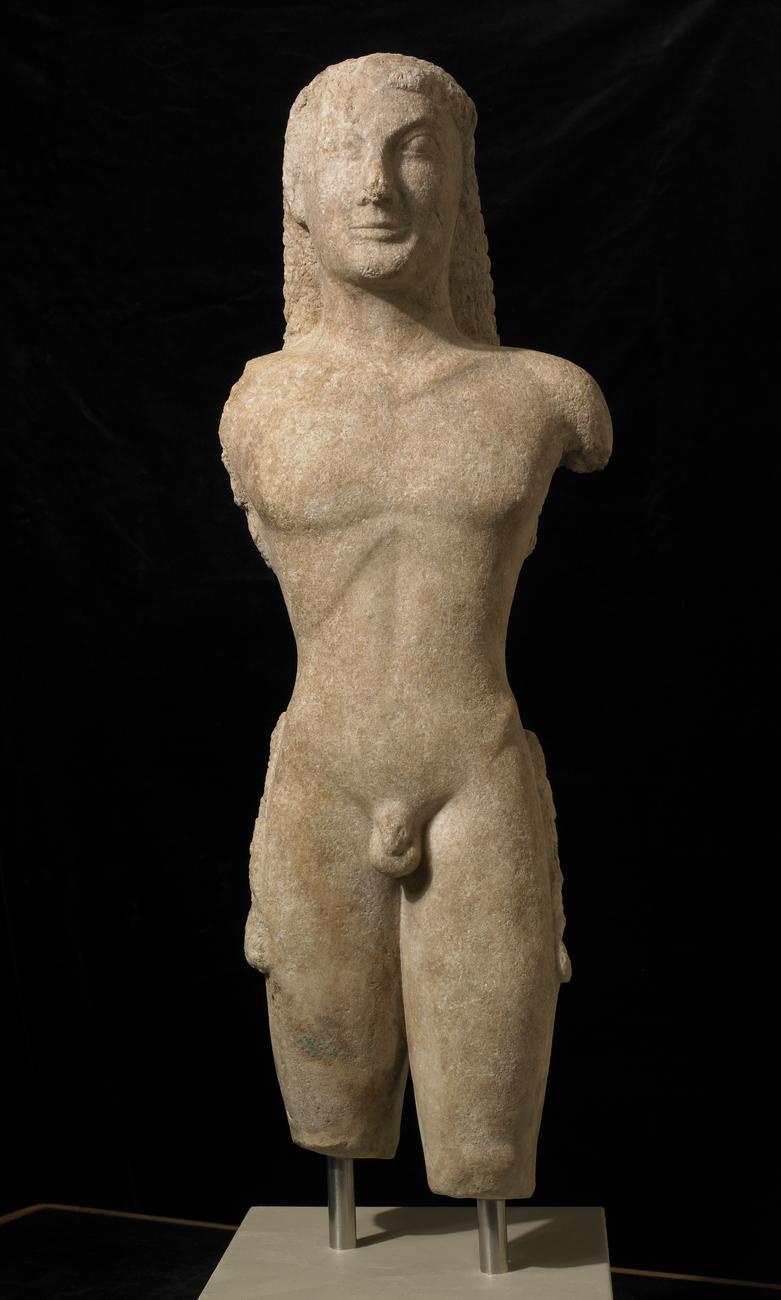
- Gallery: Room 13
- Culture: Boeotian
- Made in: Boeotia (probably)
- Date: 570BC-560BC (circa)
- Object type: statue
- Materials: marble
- Museum number: 1878,0120.1
- Museum: The British Museum
- Collection record: British Museum website
- Image © The Trustees of the British Museum, shared under a CC BY-NC-SA 4.0 licence.
Listen to the free audio guide
In the museum now? Point your phone at the next object and hear its guide.
About this object
Before you stands a statue of a half-life-sized nude youth, known as a Kouros. The figure is carved from coarse-grained white marble, with visible veining, and dates to around 570 to 560 BC. Though damaged, its original posture is clear: arms at the sides, fingers clenched, one leg slightly advanced—the classical stance of these early statues.
The statue’s head and face, though partially worn, capture a long, narrow profile with a prominent chin. The stylized hair is marked by shallow grooves, and the body is angular, with exaggerated width in the shoulders and a defined narrow waist. Though the hands and lower legs are missing, the remaining structure suggests a powerful, youthful form.
Though likely from Boeotia, its precise origin remains uncertain. Scholars have debated its provenance for years, yet the style reflects early Greek sculptural traditions. This artwork offers a glimpse into the evolution of ancient Greek sculpture.
See it in person
Boeotian statue is on display in Room 13 at the British Museum on Great Russell Street, Bloomsbury, London — free to enter. Choose British Museum on audioguide.london and take a photo of it to hear this free audio guide in six languages — no app download needed.
New, in beta. British Museum support has just launched and is still improving: over 1,000 objects so far, with more added all the time.