Abbasid dynasty ewer
- Gallery: Room 42
- Culture: Abbasid dynasty
- Date: 8thC-9thC
- Object type: ewer
- Materials: brass
- Museum number: 1959,1023.1
- Museum: The British Museum
- Collection record: British Museum website
- Image © The Trustees of the British Museum, shared under a CC BY-NC-SA 4.0 licence.
Listen to the free audio guide
In the museum now? Point your phone at the next object and hear its guide.
About this object
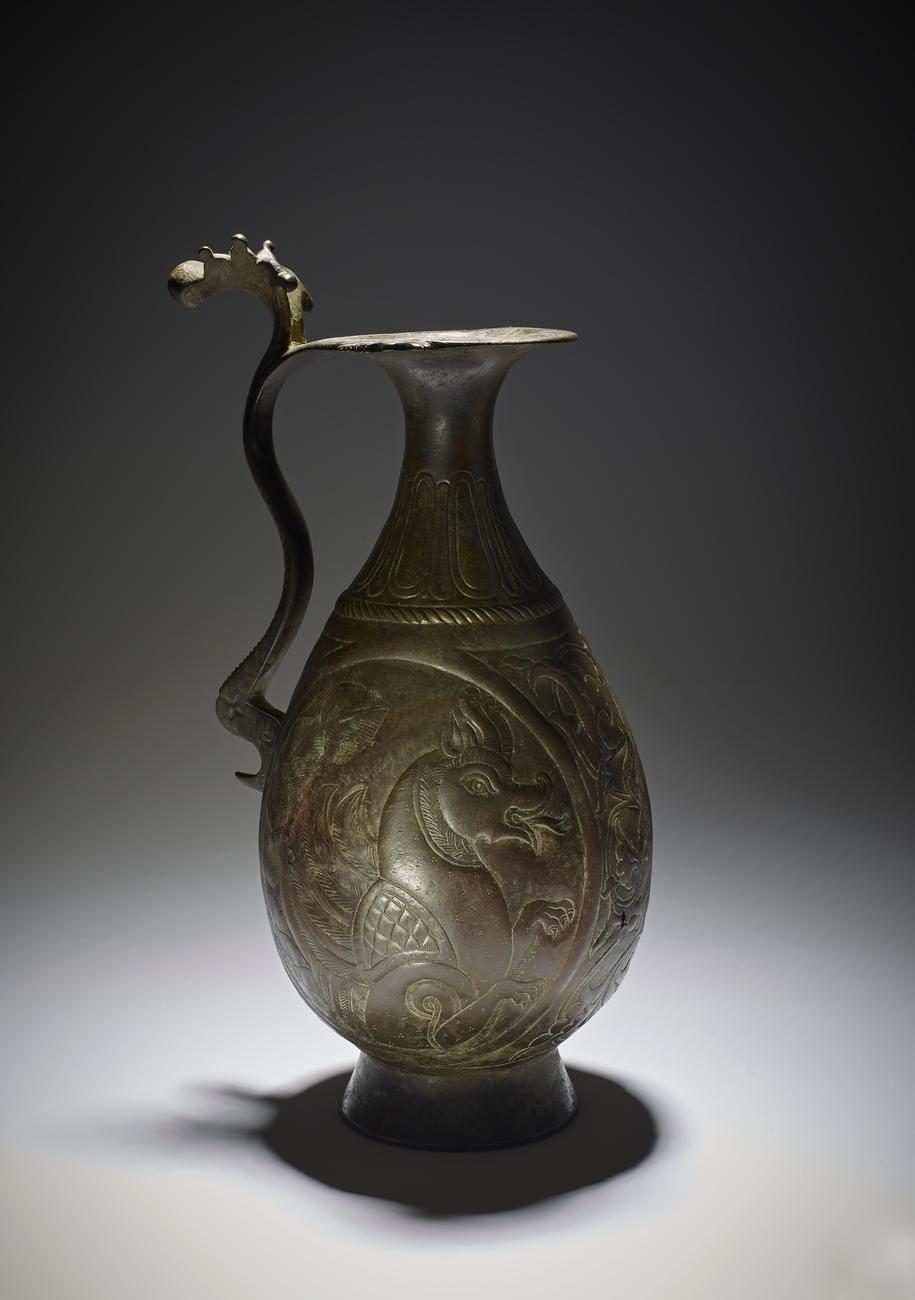
Before you is an elegant brass ewer from the Abbasid dynasty, crafted in Iran sometime between the 8th and 9th centuries. The pear-shaped body, handle, and rim were all cast as a single piece in a complex metalcasting process. You can see small round casting marks scattered along the surface—these are the chaplets, metal spacers used in the mold during production.
After casting, the decoration was carefully added. Centered on the object is a medallion featuring a "senmurv," a mythical bird from Persian legend. Around it, the surface is covered in acanthus leaf patterns and other intricate vegetal designs. This was done using a combination of chasing and hammering, with the interior supported to ensure fine detail.
The form of the vessel reflects influences from Classical Antiquity, while the senmurv motif is distinctly Iranian and dates back to the late Sasanian period and early Islamic times. It appears on textiles, glass, and architectural decoration. This ewer stands nearly 30 centimeters tall and was purchased from Mrs. Khalil Rabenou.
See it in person
Abbasid dynasty ewer is on display in Room 42 at the British Museum on Great Russell Street, Bloomsbury, London — free to enter. Choose British Museum on audioguide.london and take a photo of it to hear this free audio guide in six languages — no app download needed.
New, in beta. British Museum support has just launched and is still improving: over 1,000 objects so far, with more added all the time.