Tol Pedn
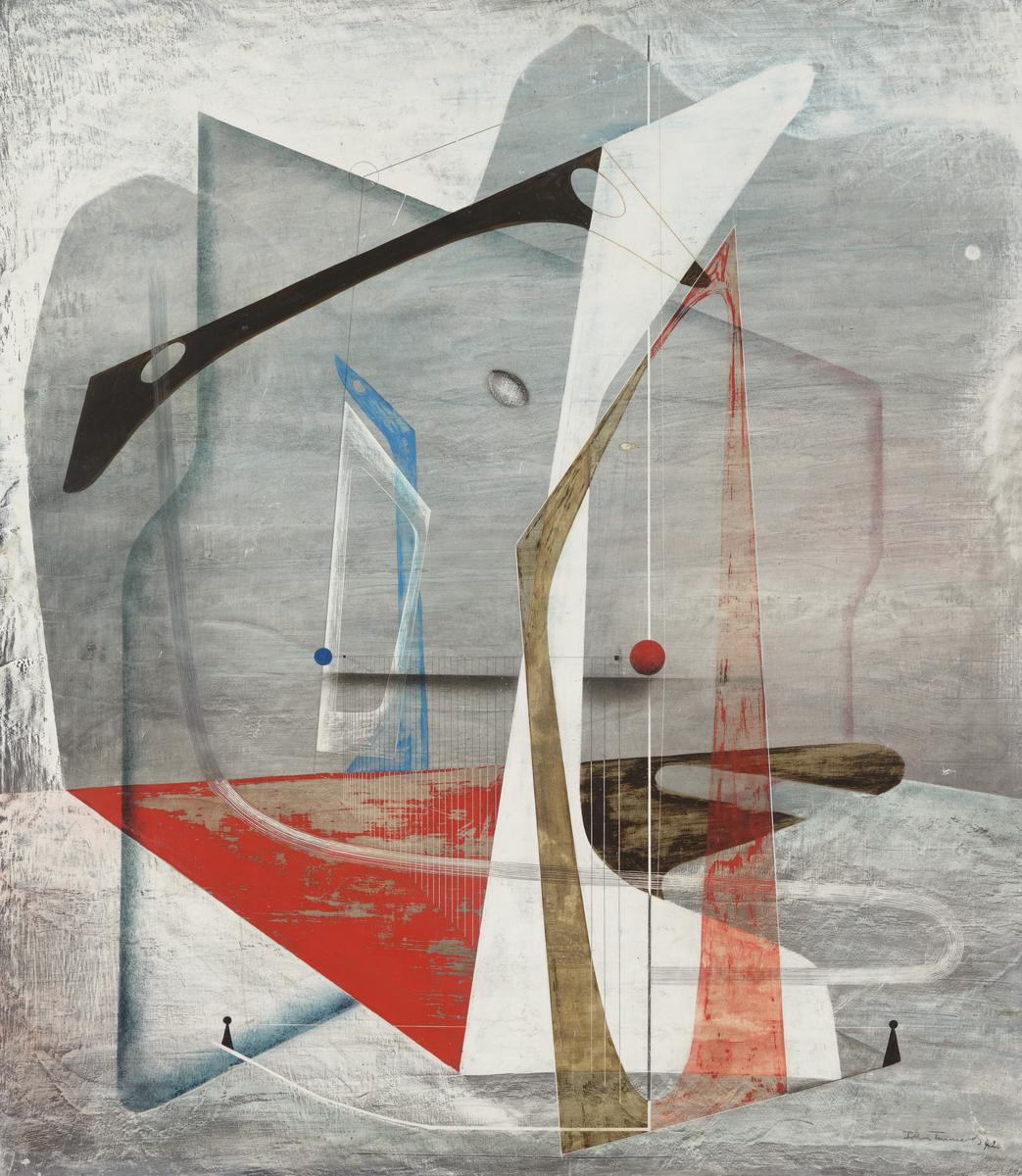
- Artist: John Tunnard
- Date: 1942
- Medium: Oil paint and graphite on board
- Dimensions: support: 733 x 641 mm
- Museum: Tate Modern
- Collection record: Tate Modern website
Listen to the free audio guide
About this artwork
This is “Tol Pedn” by John Tunnard, painted in 1942. The work is a bold abstraction of the very real headland known as Tol‑Pedn in Penwith, the southernmost point of mainland Britain. Tunnard, who had spent time as a coastguard in Cornwall during the war, was fascinated by the concrete obelisks that stand on the cliff tops – large markers painted starkly in red, white, black and white to aid navigation past the Runnel Stone. In the canvas he reduces those obelisks to small, chess‑pawn‑like forms, their size dwarfed by the sweeping, irregular shapes that dominate the composition.
Tunnard was part of the British wave of surrealists that gathered around the 1936 International Surrealist Exhibition. He was so enthused that he reportedly did three somersaults when his show opened at Peggy Guggenheim’s gallery in 1939. “Tol Pedn” captures that energy: a landscape that, while abstract, clearly borrows from a recognisable place, blending the physical reality of the coast with the imaginative logic of surrealism.
See it in person
Tol Pedn is in the collection of Tate Modern on Bankside, London — free to enter. Point your phone at any artwork there and audioguide.london plays a free audio guide in six languages — no app download needed.