The Buddha: figure
- Gallery: Room 33
- Culture: Kushan
- Made in: Gandhara (historic - Pakistan)
- Date: 5thC
- Object type: figure
- Materials: brass
- Museum number: 1981,0610.1
- Museum: The British Museum
- Collection record: British Museum website
- Image © The Trustees of the British Museum, shared under a CC BY-NC-SA 4.0 licence.
Listen to the free audio guide
About this object
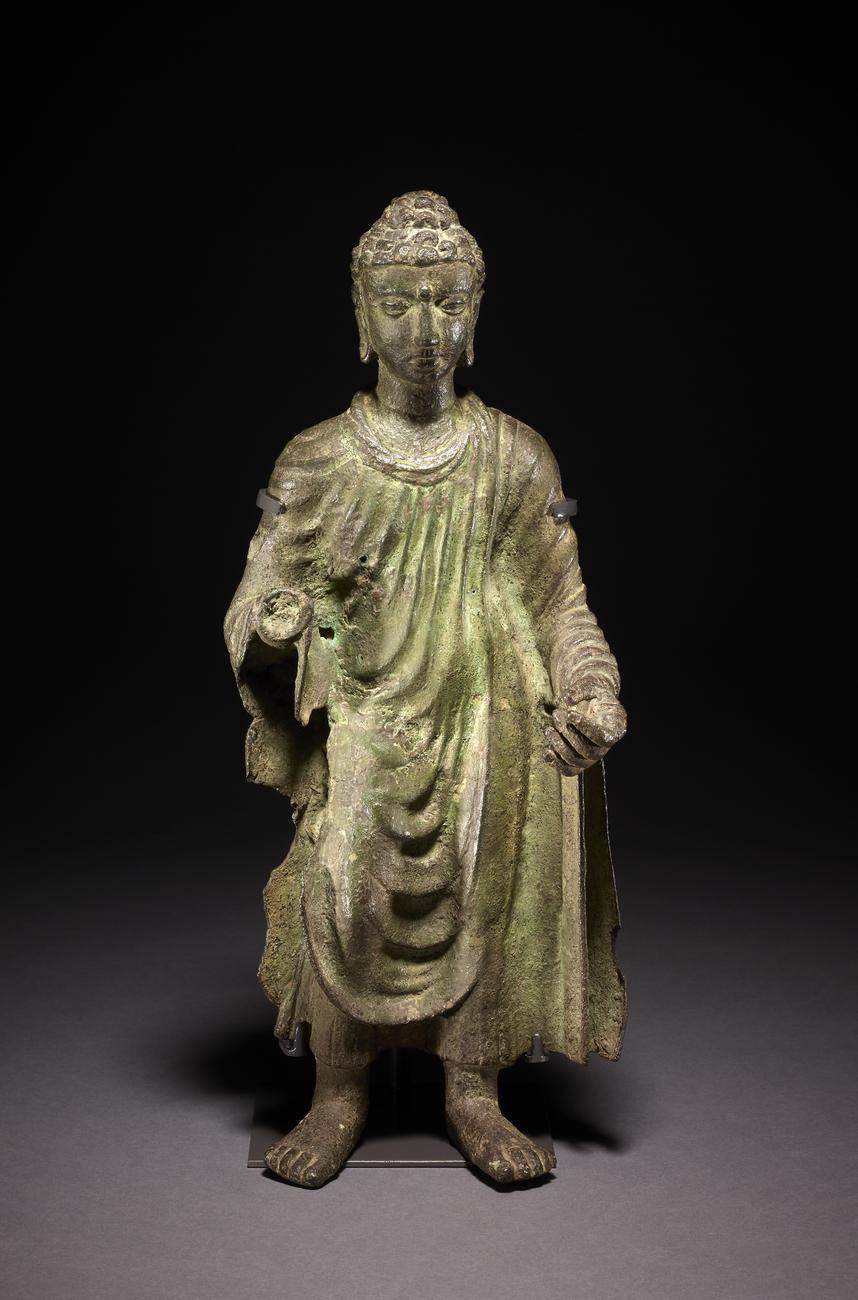
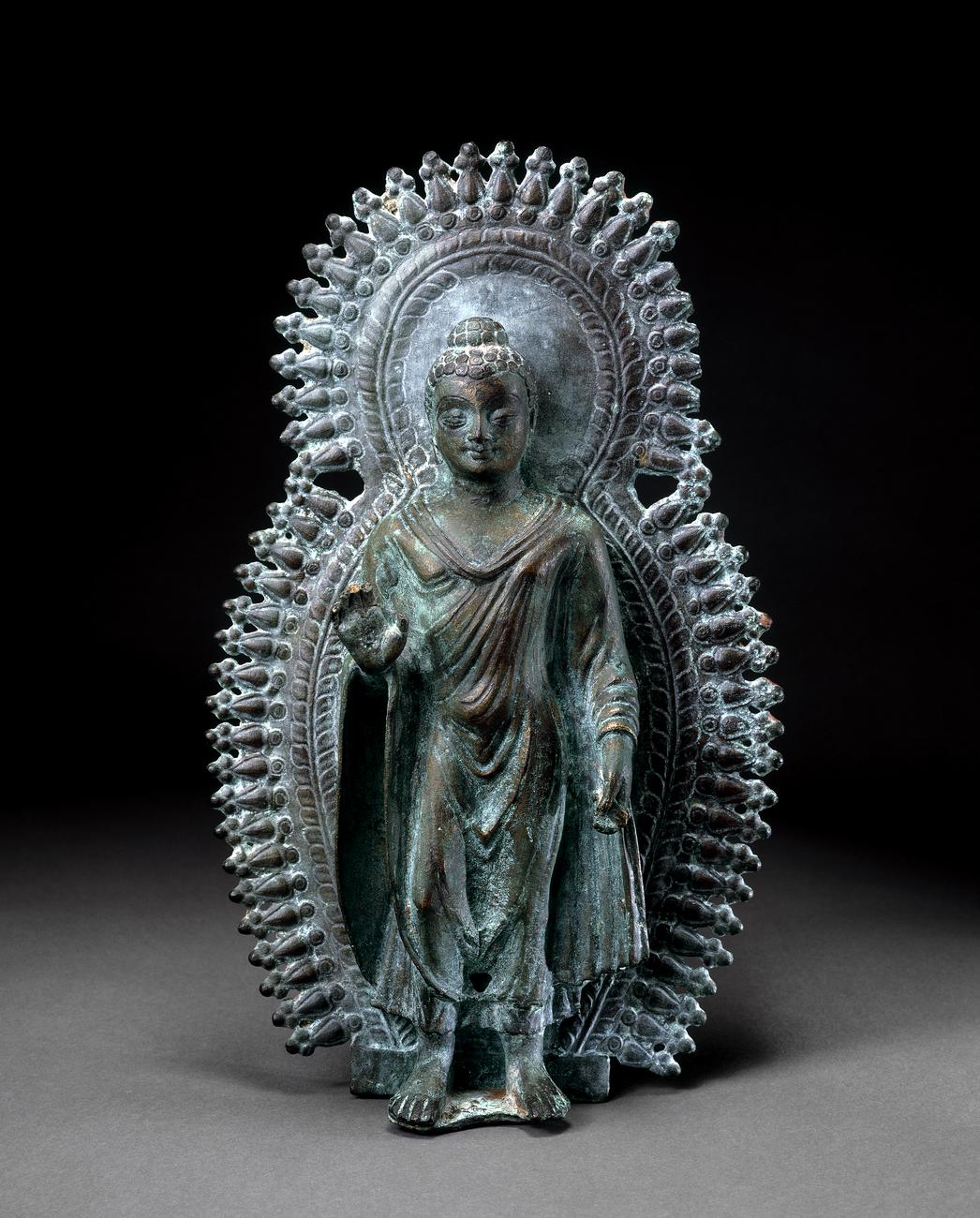
Before you stands a striking representation of the Buddha from the Kushan culture. Created in the 5th century in Gandhara—modern-day Pakistan—this brass figure shows the Buddha in the abhaya-mudra, a gesture of fearlessness and protection.
The Buddha's robe is richly detailed, with folds arranged in a 'V' at the front and dramatic ridges that flow down his body. His garment is close-fitting, hinting at the form beneath, and the drapery is carefully cast to show subtle movement. His right knee bends slightly, and the robe gathers under his left forearm.
His face is serene and full, with long, arched eyebrows and a calm mouth, framed by snail-shell curls that extend into the ushnisha—the symbolic crown of hair on a Buddha's head. The eyes are large and globular, with incised lines adding depth.
Attached to the back is a decorative mandorla-shaped backplate, edged with intricate leaf-like patterns and small circular beads in radiating patterns. The craftsmanship reflects the highly developed metalworking traditions of the time.
This figure is a rare and vivid example of early Buddhist bronze art, with strong ties to the Gandharan and later Gupta sculptural styles.
See it in person
The Buddha: figure is on display in Room 33 at the British Museum on Great Russell Street, Bloomsbury, London — free to enter. Choose British Museum on audioguide.london and take a photo of it to hear this free audio guide in six languages — no app download needed.
New, in beta. British Museum support has just launched and is still improving: over 1,000 objects so far, with more added all the time.