Tablet
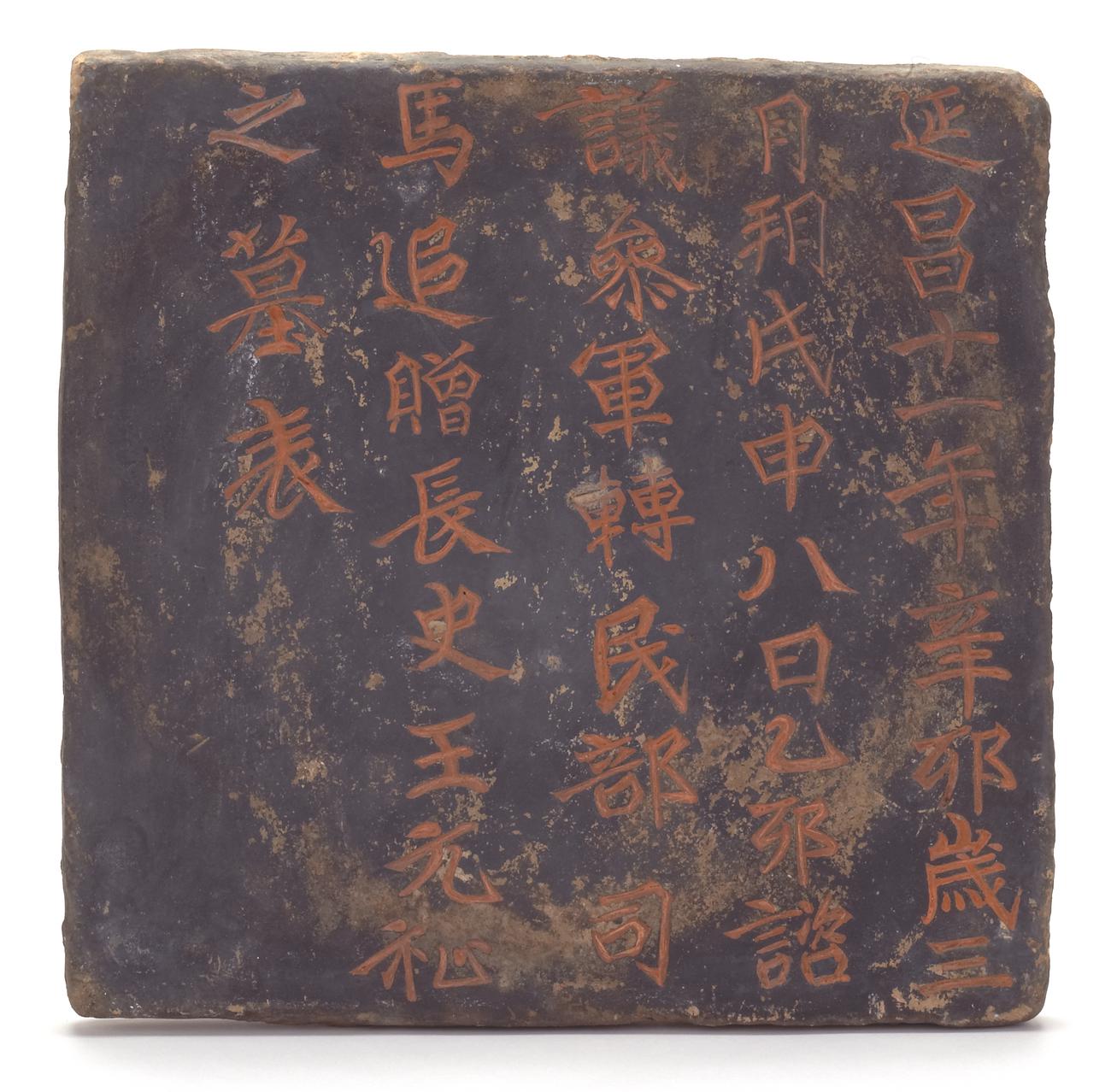
- Gallery: Room 33
- Date: 571
- Object type: tablet, 書板
- Materials: clay; 粘土 (Chinese)
- Museum number: 1928,1022.202
- Museum: The British Museum
- Collection record: British Museum website
- Image © The Trustees of the British Museum, shared under a CC BY-NC-SA 4.0 licence.
Listen to the free audio guide
In the museum now? Point your phone at the next object and hear its guide.
About this object
Before you is an ancient funerary tablet made of grey clay. The tablet features an inscription that was first incised into the surface and then painted in vivid red, set against a dark black background.
This tablet was among several discovered in Astana, China, and brought to the United Kingdom by the explorer Aurel Stein. Unlike traditional stone memorial tablets in northern China, this one is made of clay—an unusual yet practical material choice.
The writing style shows a strong influence from Northern Wei calligraphy, with wedge-like strokes and a bold, forthright appearance. It remains one of the earliest tablets from this collection, inscribed with the name of Wang Yuanzhi, who was honored posthumously as a senior secretary.
Despite its age, the tablet preserves the early calligraphy style and is an important example of how funerary inscriptions were recorded in this period.
See it in person
Tablet is on display in Room 33 at the British Museum on Great Russell Street, Bloomsbury, London — free to enter. Choose British Museum on audioguide.london and take a photo of it to hear this free audio guide in six languages — no app download needed.
New, in beta. British Museum support has just launched and is still improving: over 1,000 objects so far, with more added all the time.