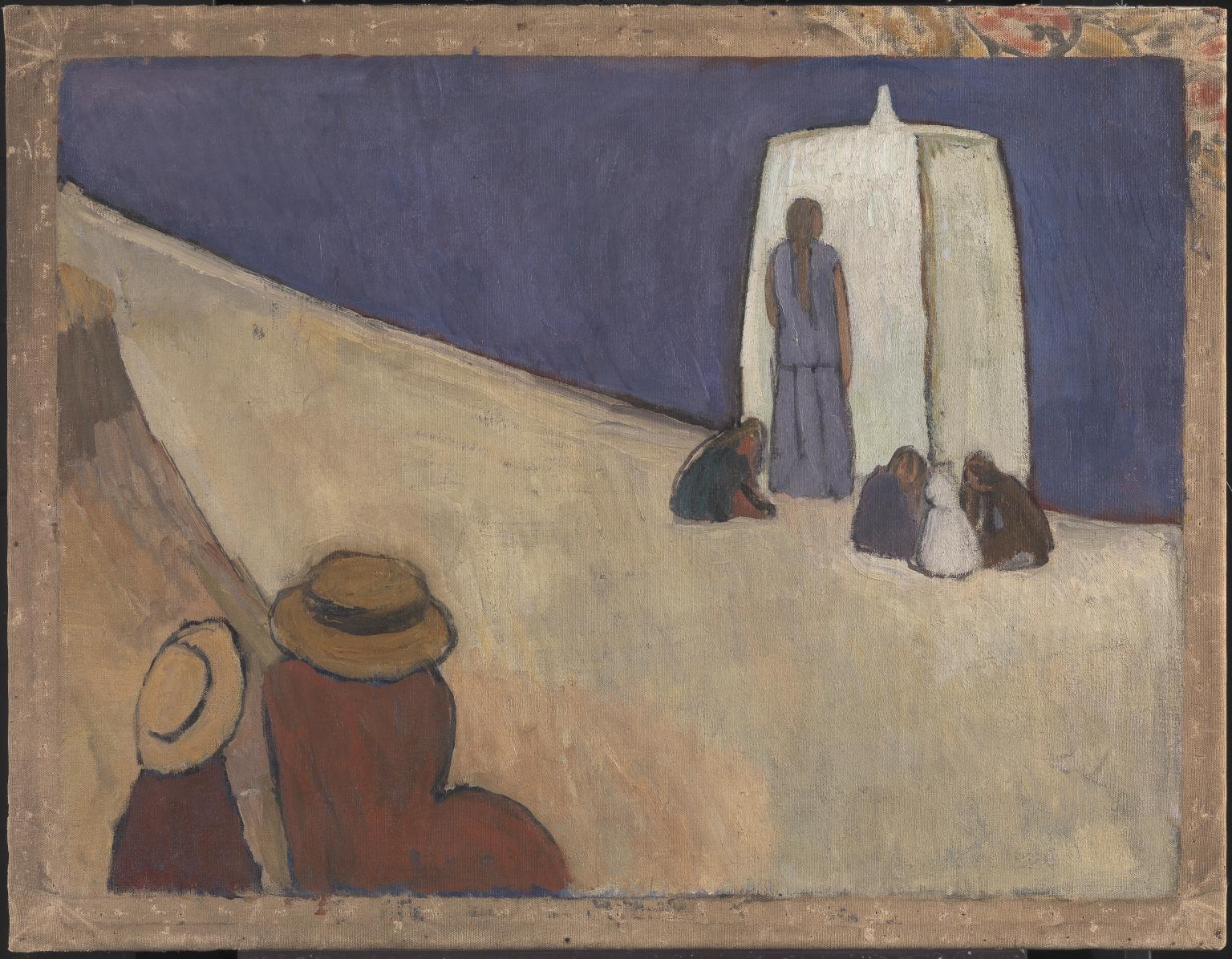
Studland Beach. Verso: Group of Male Nudes by Duncan Grant
- Artist: Vanessa Bell
- Date: c.1912
- Medium: Oil paint on canvas
- Dimensions: support: 762 x 1016 mm
- Museum: Tate Britain
- Collection record: Tate Britain website
Listen to the free audio guide
In the museum now? Point your phone at the next artwork and hear its guide.
About this artwork
This is the “Studland Beach” by Vanessa Bell, painted around 1912. On a modest canvas of about 30 × 40 cm, Bell captures a sunny Dorset bay—a place that, at the time, was just becoming a holiday spot for the Bloomsbury circle. The scene is pared down to bold colours, simplified shapes, and clean lines—an exercise in what Clive Bell and Roger Fry called “significant form.” In other words, the painting is less about the exact beach details and more about the visual impact of colour and shape. The beach still feels alive with light, but the focus is on the rhythm of the horizon and the calm bodies of water.
The back of the canvas hosts a small work by Duncan Grant, a group of male nudes. The two paintings together hint at the collaborative spirit of the group. Bell’s figures in the front are thought to be her son Julian and his nanny, lending a personal touch to an otherwise modernist landscape. Scholars note that the painting was one of the most radical works in England at the time, and it remains a striking example of early 20th‑century British modernism.
See it in person
Studland Beach. Verso: Group of Male Nudes by Duncan Grant is in the collection of Tate Britain on Millbank, London — free to enter. Point your phone at any artwork there and audioguide.london plays a free audio guide in six languages — no app download needed.