Still life with Plaster Cupid
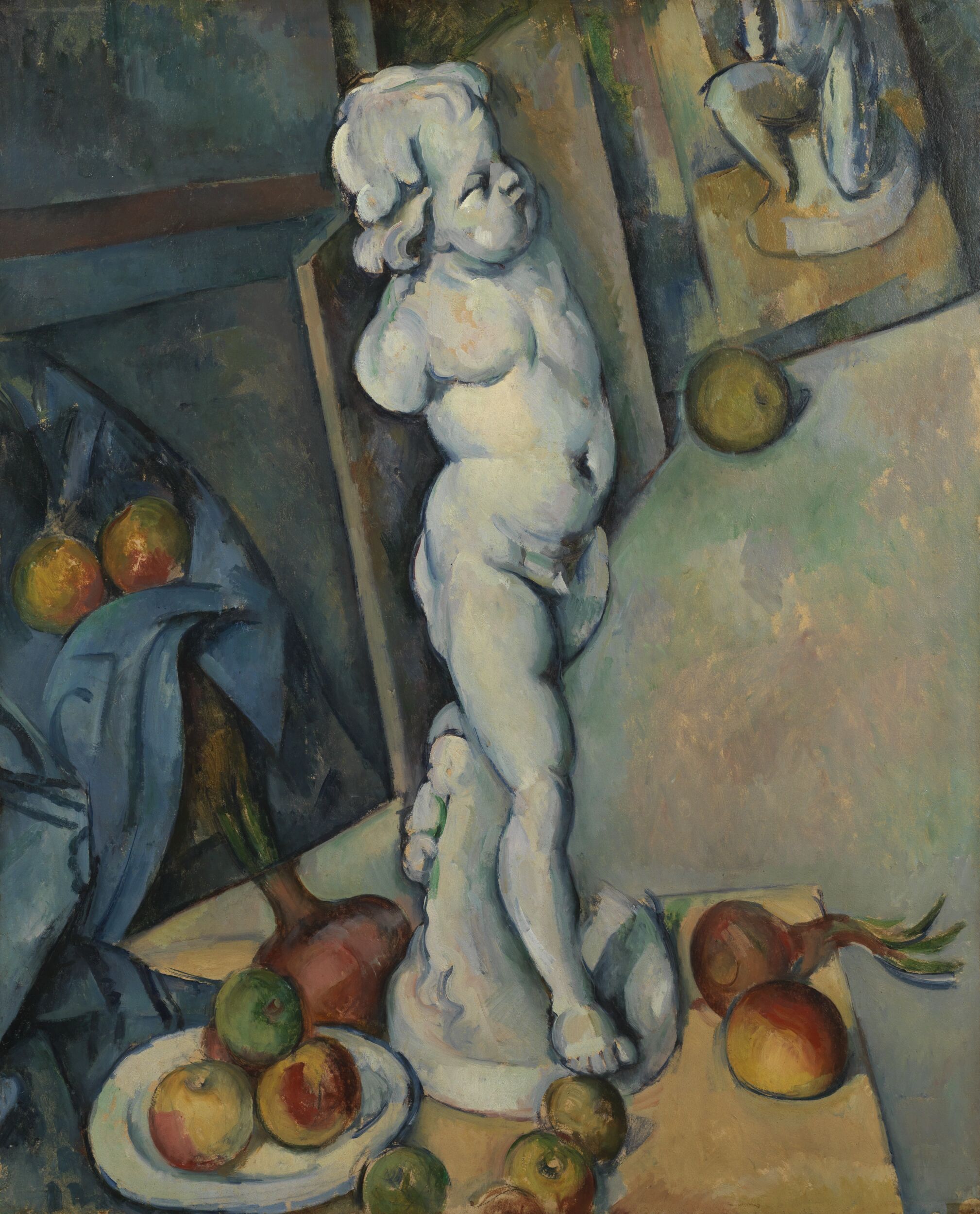
- Artist: Paul Cézanne
- Date: c. 1894
- Medium: oil on paper on board
- Museum: The Courtauld Gallery
- Collection record: The Courtauld Gallery website
Listen to the free audio guide
About this artwork
This is the “Still life with Plaster Cupid” by Paul Cézanne. In this canvas Cézanne recreates his own studio, placing a plaster cast of a tiny 17th‑century sculpture amid a scattering of fruit and vegetables. A handful of unfinished canvases lean against the wall, hinting at the creative process happening here. What makes the work instantly intriguing is how Cézanne distorts space: the green apple in the far corner swells disproportionately, the floor tilts, and the blue drapery on the left merges with the hem of the tablecloth. Even the sprouting onion blurs the line between real produce on the table and its painted counterpart, making you question what’s tangible. This piece turns the conventional still life on its head, using ordinary objects to challenge how we perceive depth and reality. Painted around 1894 in oil on paper laid on board, it marks a turning point where Cézanne uses still life not as a static study but as a playground for breaking visual conventions.
See it in person
Still life with Plaster Cupid hangs in The Courtauld Gallery at Somerset House, London. Point your phone at any artwork there and audioguide.london plays a free audio guide in six languages — no app download needed.