Spiral
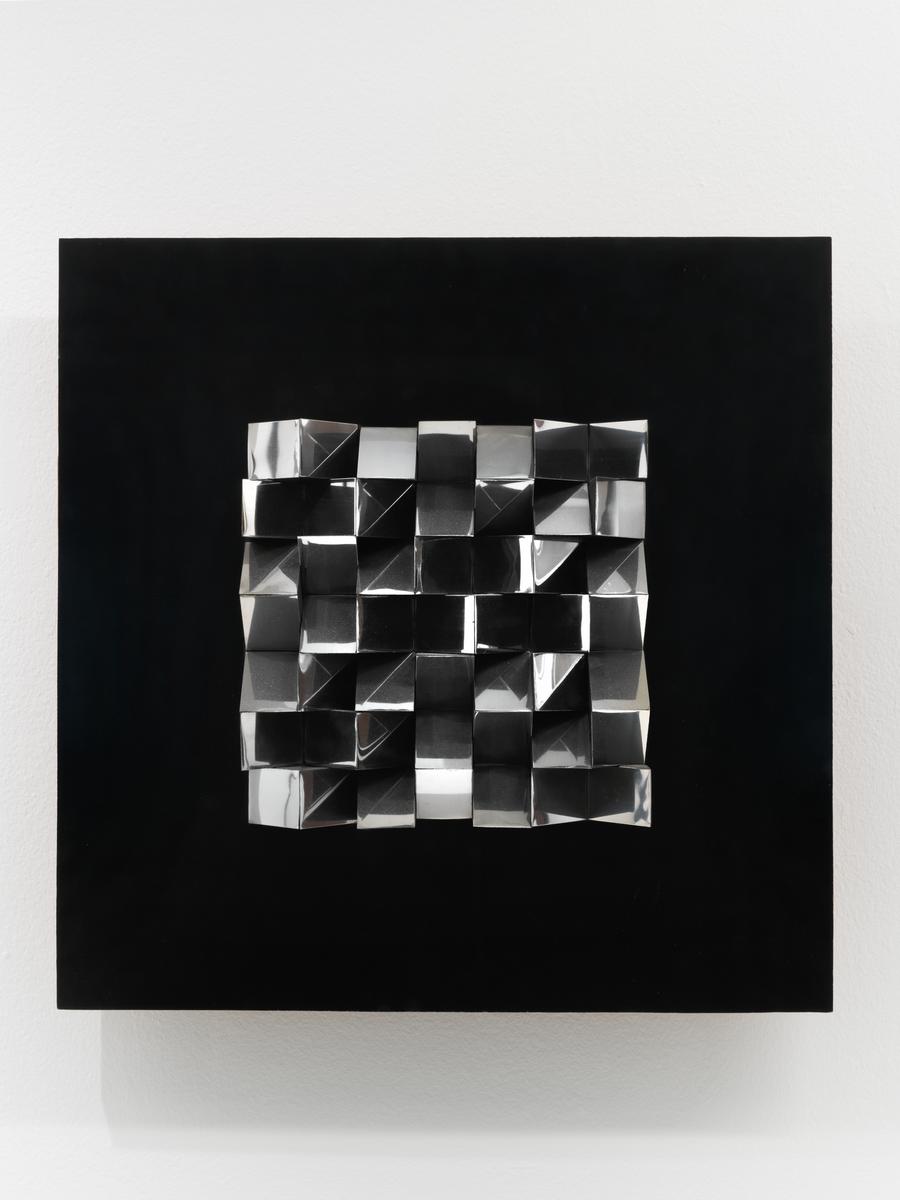
- Artist: Mary Martin
- Date: 1963
- Medium: Plastic laminate and stainless steel on wood
- Dimensions: object: 533 x 533 x 102 mm
- Museum: Tate Britain
- Collection record: Tate Britain website
Listen to the free audio guide
In the museum now? Point your phone at the next artwork and hear its guide.
About this artwork
This is “Spiral” by Mary Martin. The piece sits flush against a wall, built from blocks of wood cut in half‑diagonally and each half glued to a reflective stainless‑steel plate. The steel faces all directions – so the same slab can catch light from any angle. Martin says: “The reflected structures, or hidden structures, are made within the same system as the real structure. Illusion and reality are added to shadow and substance.” Her design lets each viewer’s stance change the play of light and shadow; you see both the object itself and whatever surrounds it reflected on its plates.
Each half‑cube is painted matte black and assembled in seven rows of seven, with four different orientations so the reflections create a rhythmic spiral. The whole relief floats free from the wall by a hidden batten that lifts it 1 ¾ inches off the base. The base is Formica, finished smooth – a contrasting ground to the rough steel edges.
It measures about 533 mm square and 102 mm high, weighing roughly five kilograms. Purchased in 1964 after its first show at the Molton and Lords Gallery, it’s an early example of Martin’s relief technique that later informed her larger public commissions. The result is a dynamic sculpture that blends geometry with reflective play, inviting you to walk around and watch how its own image shifts with each new perspective.
See it in person
Spiral is in the collection of Tate Britain on Millbank, London — free to enter. Point your phone at any artwork there and audioguide.london plays a free audio guide in six languages — no app download needed.