Salting Mihrab
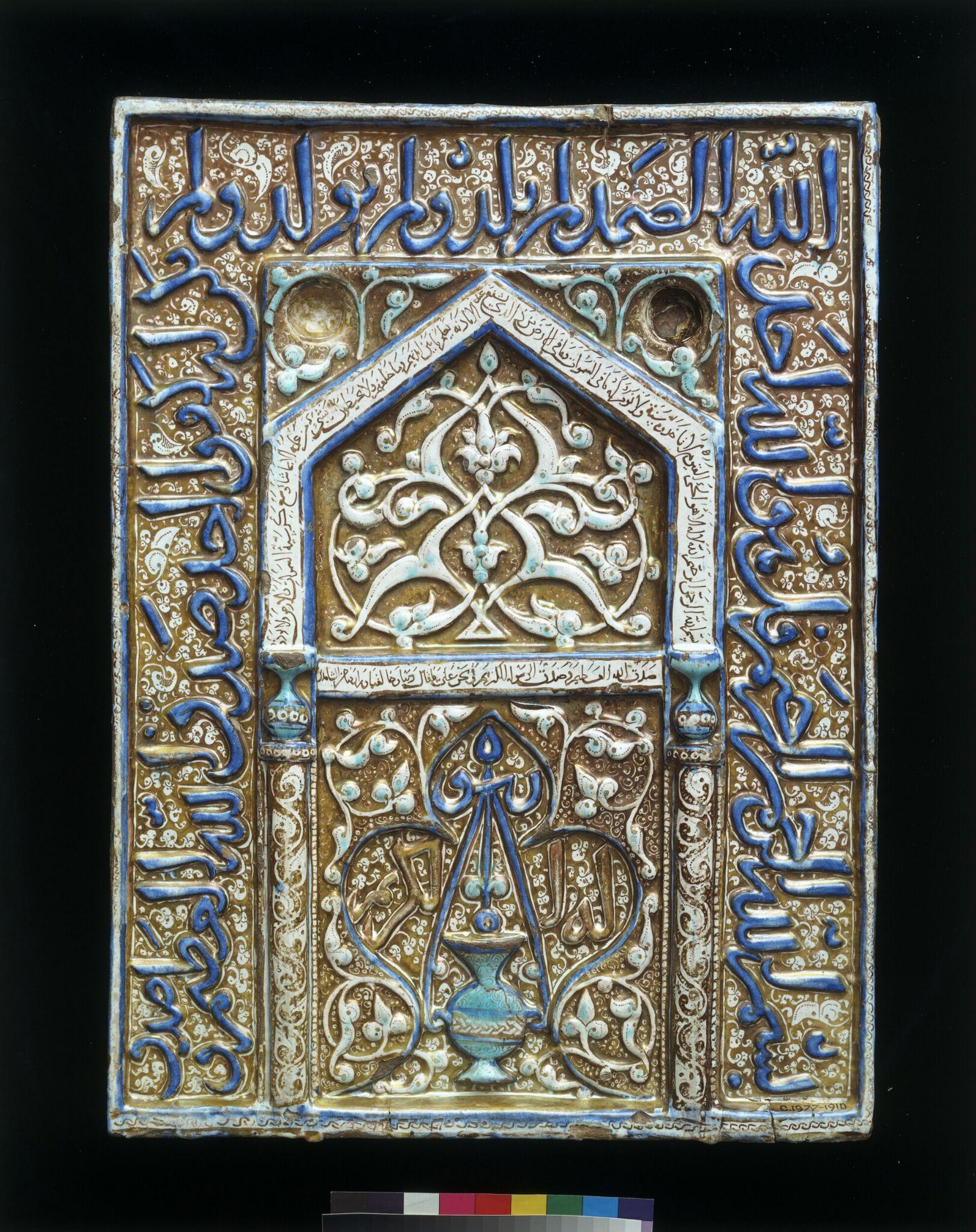
- Gallery: Islamic Middle East, Room 42, The Jameel Gallery
- Made in: Kashan
- Date: ca. 1300
- Object type: Mihrab
- Materials: Moulded fritware with colour in and lustre over the glaze
- Style: Islamic, Kashan
- Dimensions: Height 62 cm; Width 42 cm
- Museum: V&A South Kensington
- Collection record: V&A website
- Image © Victoria and Albert Museum, London.
Listen to the free audio guide
In the museum now? Point your phone at the next object and hear its guide.
About this object
Before you is the "Salting Mihrab", a single-tile tomb marker created around 1300 in Kashan, Iran. This piece is made of moulded fritware, decorated with vibrant blue and green colors and a shimmering lustre glaze.
Notice the arched shape. This is a miniature representation of a mihrab, which is the niche in a mosque that marks the direction of Mecca. Using this design on a tomb indicated that the deceased was buried in accordance with Islamic law, oriented towards the Ka'bah. Inside the niche, you can see a depiction of a hanging lamp, a motif that recalls a verse from the Qur'an describing light.
As you look closely at the edges, you will see a blue framing inscription. This contains the 112th surah, or chapter, of the Qur'an, known as al-Ikhlas, which means Purity of Faith. This remarkable tile is part of a pair, and its high quality reflects the exceptional skill of the lustre tilework produced in this region.
See it in person
Salting Mihrab is on display in Islamic Middle East, Room 42, The Jameel Gallery at the V&A South Kensington on Cromwell Road, London — free to enter. Choose V&A South Kensington on audioguide.london and take a photo of it to hear this free audio guide in six languages — no app download needed.
New, in beta. V&A support has just launched and is still improving: 1,000 objects with audio so far, with more added all the time.