Rush Hour
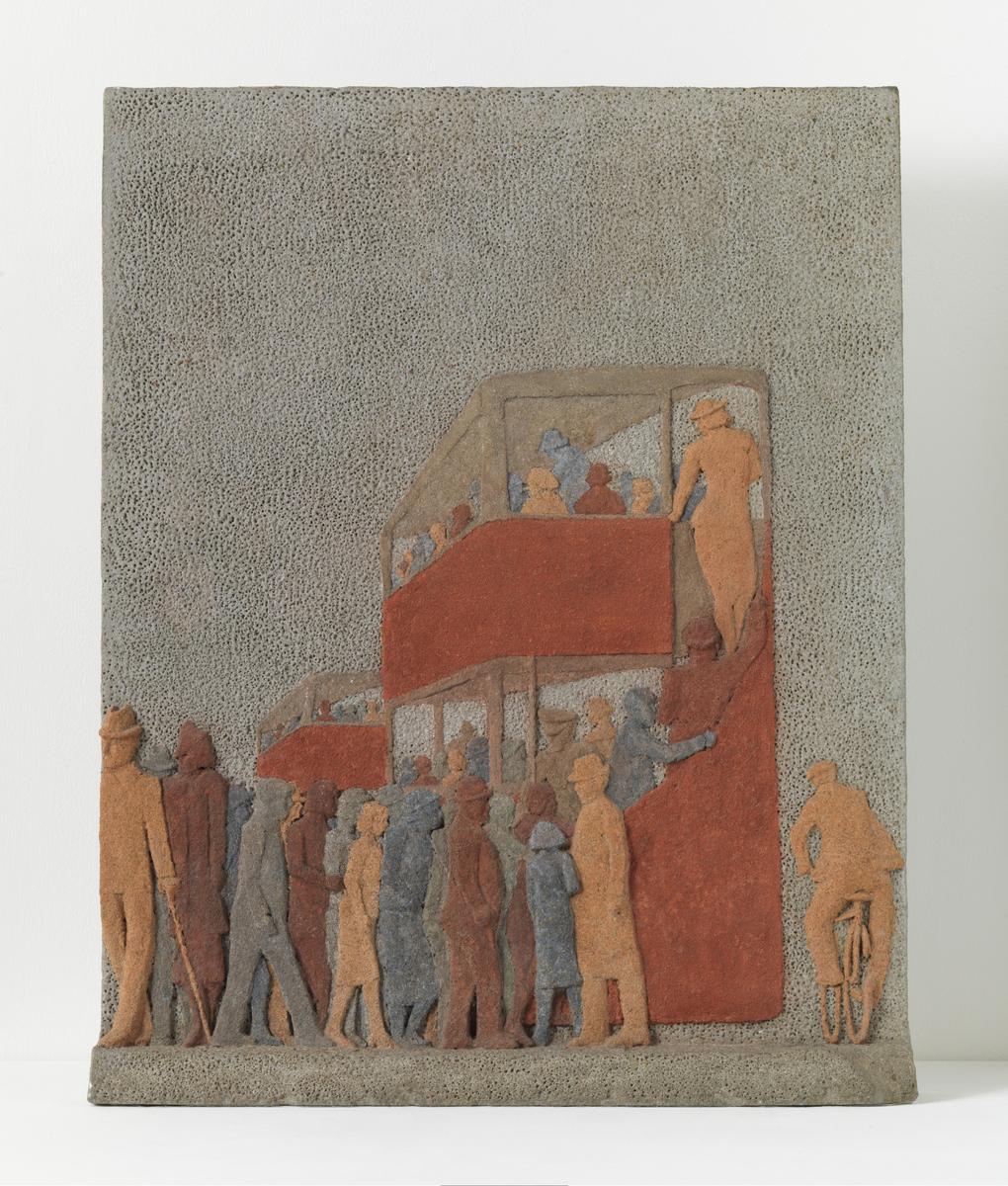
- Artist: Peter László Peri
- Date: 1937
- Medium: Pigmented concrete
- Dimensions: object: 900 x 700 x 190 mm
- Museum: Tate Britain
- Collection record: Tate Britain website
Listen to the free audio guide
About this artwork
This is “Rush Hour” by Peter László Peri. The piece is a low‑relief sculpture made from pigmented concrete, around 900 mm long and 700 mm wide. It shows men and women boarding a double‑decker London bus, their bodies crowded on the pavement as they climb a spiral staircase inside the vehicle while a conductor watches. A cyclist darts past on the right‑hand side, another bus recedes in the distance. Peri combines realism and abstraction: he records everyday actions with precision, yet the buses appear as simplified rectangles of blue, terracotta and grey concrete against a pale background.
Peri’s technique was innovative—he kept the concrete wet and malleable, building up layers of color directly rather than casting separate blocks. The result is a textured surface that feels both utilitarian and egalitarian; it echoes his intention to bring art into everyday life. He first worked as a constructivist in Budapest and Berlin before arriving in Britain as a refugee in 1933, where he produced politically engaged pieces such as *Building Job*.
“Rush Hour” was exhibited in his solo show “London Life in Concrete” at 36 Soho Square in 1938, alongside *Building Job*. The work illustrates Peri’s belief that concrete could be used to depict ordinary people for a wide audience, and it remains a vivid snapshot of 1930s London.
See it in person
Rush Hour is in the collection of Tate Britain on Millbank, London — free to enter. Point your phone at any artwork there and audioguide.london plays a free audio guide in six languages — no app download needed.