Rough Sea
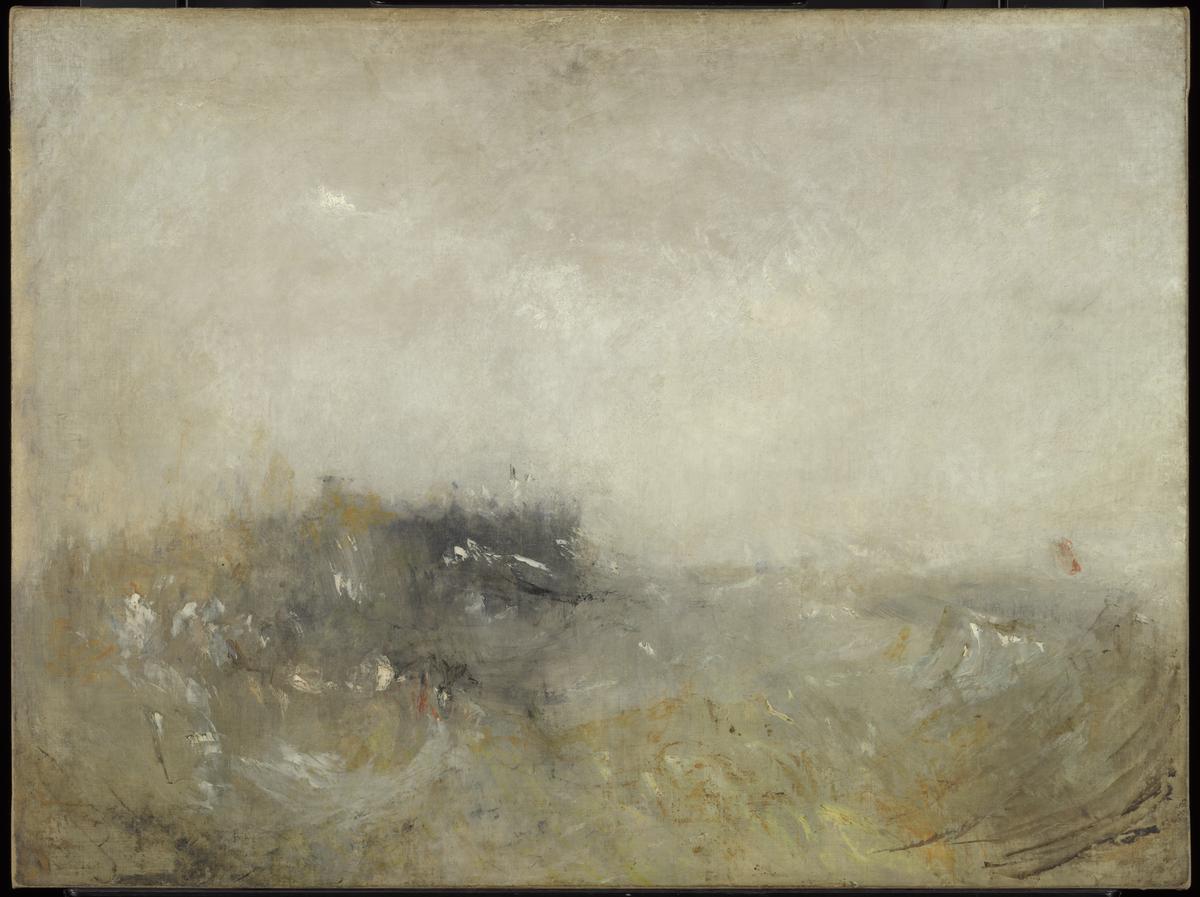
- Artist: Joseph Mallord William Turner
- Date: c.1840–5
- Medium: Oil paint on canvas
- Dimensions: support: 914 x 1219 mm
- Museum: Tate Britain
- Collection record: Tate Britain website
Listen to the free audio guide
About this artwork
This is the “Rough Sea” by Joseph Mallord William Turner, painted around 1840‑45. Though it’s unfinished, the canvas already feels like a storm rolling in. Turner dragged and dabbed the brush to convey the churning waves under a cold, misty sky. The strokes in the corners echo his famous swirling vortex scenes, where sea and cloud tumble together.
You can spot a dark shape left of centre – it could be a large ship or a pier, hinting at a human presence battling the elements. On the right, a reddish‑brown patch might be the sail of a distant boat, caught in a gust. The loss of original paint along the left edge and flaking of reds and whites makes the scene feel even more raw, almost like you’re looking into the heart of a tempest before Turner finished it.
Turner’s late works often lean toward a looser, impressionistic feel, and this piece feels like the boldest of his uncompleted storm paintings. It was accepted into the national collection as part of the Turner Bequest in 1856, a testament to his lasting impact on maritime art. As you stand before it, notice how Turner’s brushwork almost moves on its own, capturing the wild, fleeting nature of a rough sea.
See it in person
Rough Sea is in the collection of Tate Britain on Millbank, London — free to enter. Point your phone at any artwork there and audioguide.london plays a free audio guide in six languages — no app download needed.