Romano-British mosaic pavement
- Gallery: Room 49
- Culture: Romano-British
- Date: 250-350
- Object type: mosaic pavement
- Materials: stone
- Museum number: 1899,0614.1
- Museum: The British Museum
- Collection record: British Museum website
- Image © The Trustees of the British Museum, shared under a CC BY-NC-SA 4.0 licence.
Listen to the free audio guide
About this object
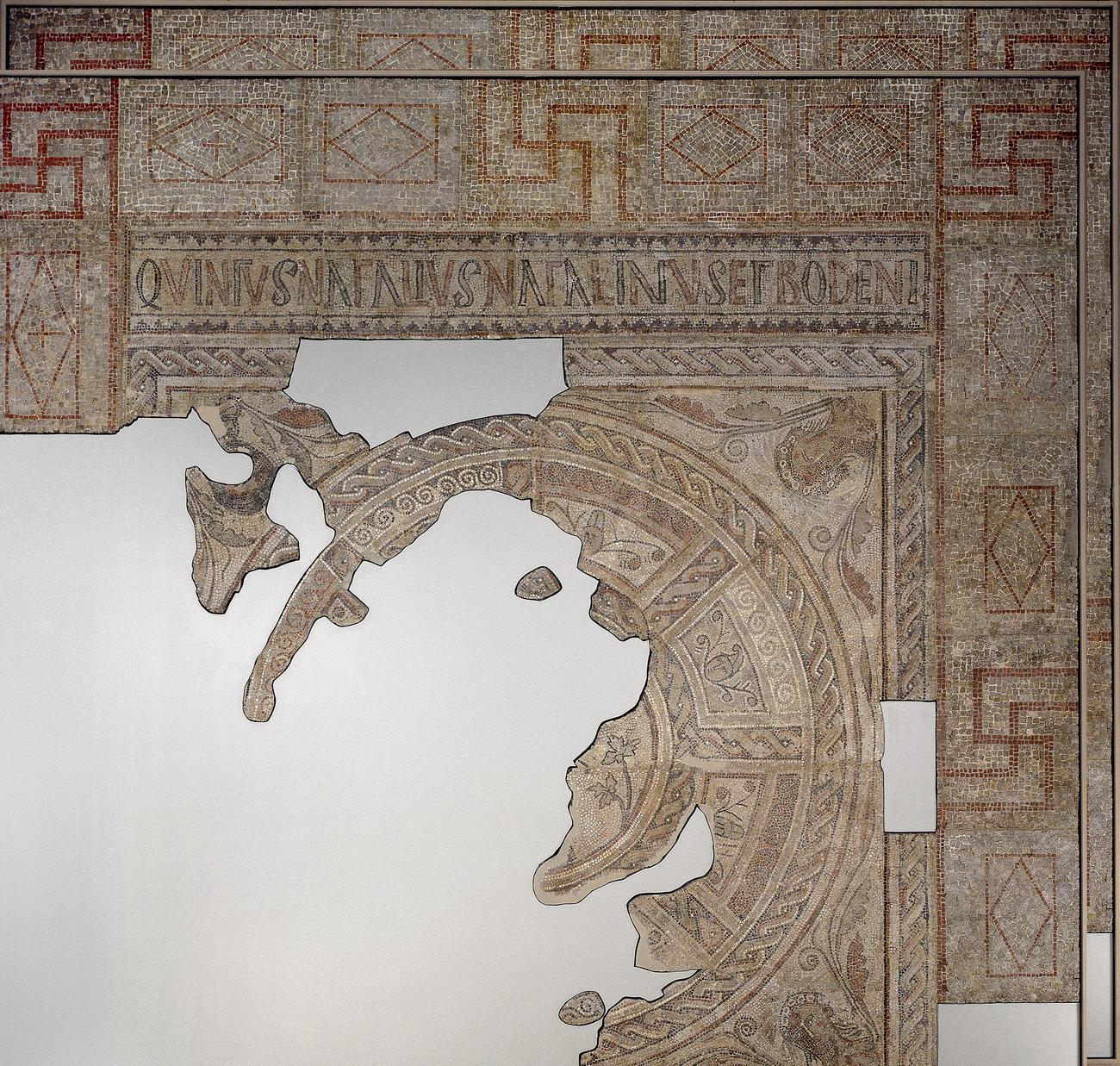
This Romano-British mosaic pavement dates to between 250 and 350 and was found in 1823 at Thruxton. Its original form was quadrangular, featuring a complex central design with eight radial bands linking a main circle to a surrounding square frame. The mosaic uses a bold color scheme of purplish-brown, blue-grey, white, red, and buff.
At the center sits Bacchus, the Roman god of wine, perched on a small leopard. In the spaces between the radial lines are small, stylized heads—some wearing hats, others wearing scrolls emerging from their chins. Above them, wave patterns alternate in color. Three surviving female busts in the corners likely represent the seasons.
Above the scene is an inscription in Latin: "[Q]VINTVS NATALIVS NATALINVS ET BODENI." Though partially lost, the names listed—Quintus, Natalius, Natalinus, and Bodeni—hint at those who may have commissioned the piece.
Now preserved in the museum, the mosaic reflects the artistic achievements of Roman Britain.
See it in person
Romano-British mosaic pavement is on display in Room 49 at the British Museum on Great Russell Street, Bloomsbury, London — free to enter. Choose British Museum on audioguide.london and take a photo of it to hear this free audio guide in six languages — no app download needed.
New, in beta. British Museum support has just launched and is still improving: over 1,000 objects so far, with more added all the time.