Romano-British kantharos
- Gallery: Room 49
- Culture: Romano-British
- Object type: kantharos
- Materials: silver
- Museum number: 1975,1002.6
- Museum: The British Museum
- Collection record: British Museum website
- Image © The Trustees of the British Museum, shared under a CC BY-NC-SA 4.0 licence.
Listen to the free audio guide
About this object
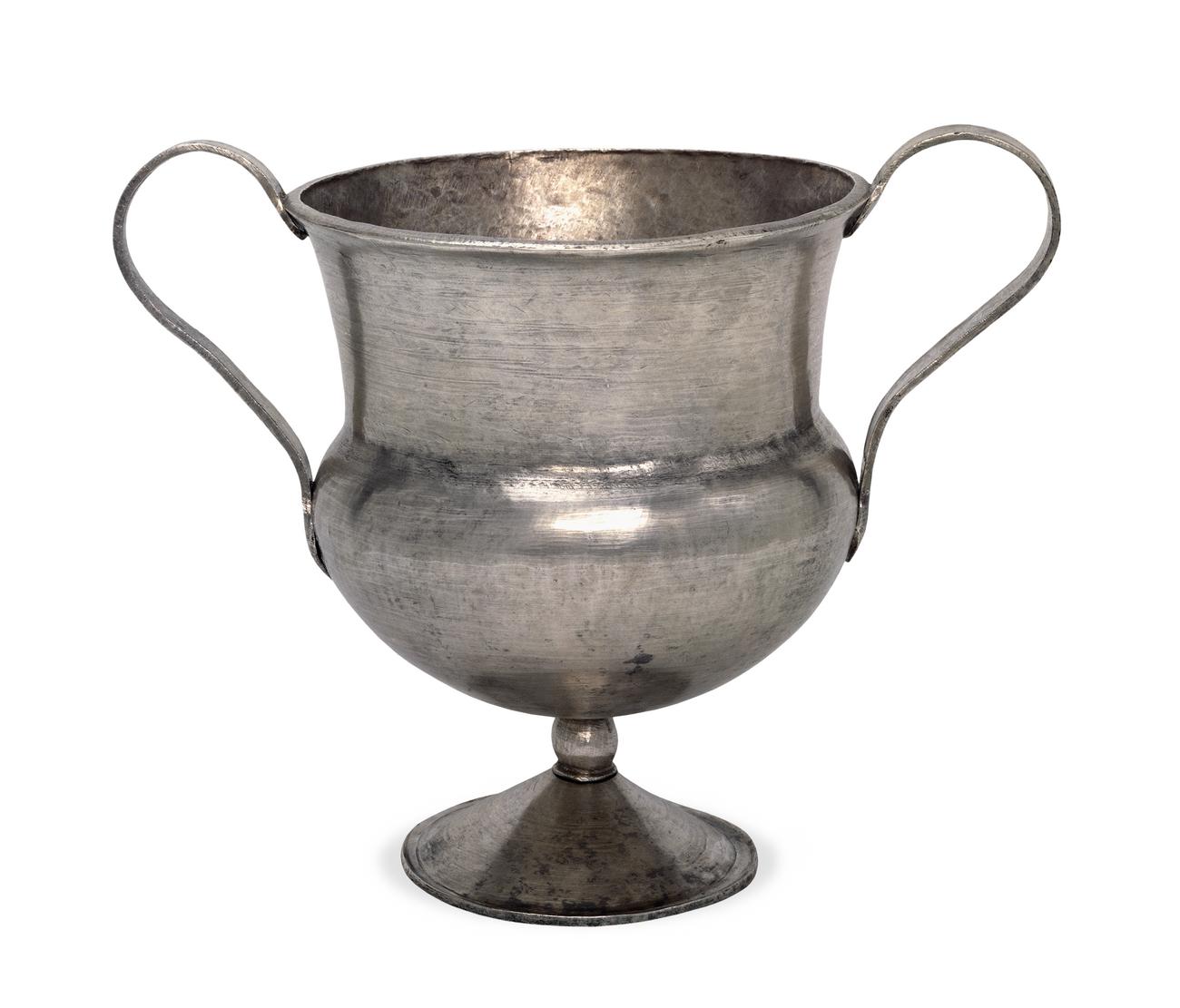
This is a Romano-British kantharos, a two-handled silver cup. Its simple, flat handles are attached to a plain, undecorated body. The exterior has a smooth, polished surface, while the interior shows the hammer marks of the maker's craft.
The cup has a thickened rim and a short, conical foot joined with a square-ended rivet. Small solder marks indicate where the handles were attached. Corrosion has left a greenish tinge near the base.
Though its shape resembles later Christian chalices, we cannot be certain of its use. This vessel is part of the Water Newton hoard, found in 1975 in what was once the Roman town of Durobrivae. The hoard includes nine silver vessels and plaques — some marked with the earliest Christian symbols, like the chi-rho monogram.
This kantharos may have been used in an early Christian church for rituals like communion.
See it in person
Romano-British kantharos is on display in Room 49 at the British Museum on Great Russell Street, Bloomsbury, London — free to enter. Choose British Museum on audioguide.london and take a photo of it to hear this free audio guide in six languages — no app download needed.
New, in beta. British Museum support has just launched and is still improving: over 1,000 objects so far, with more added all the time.