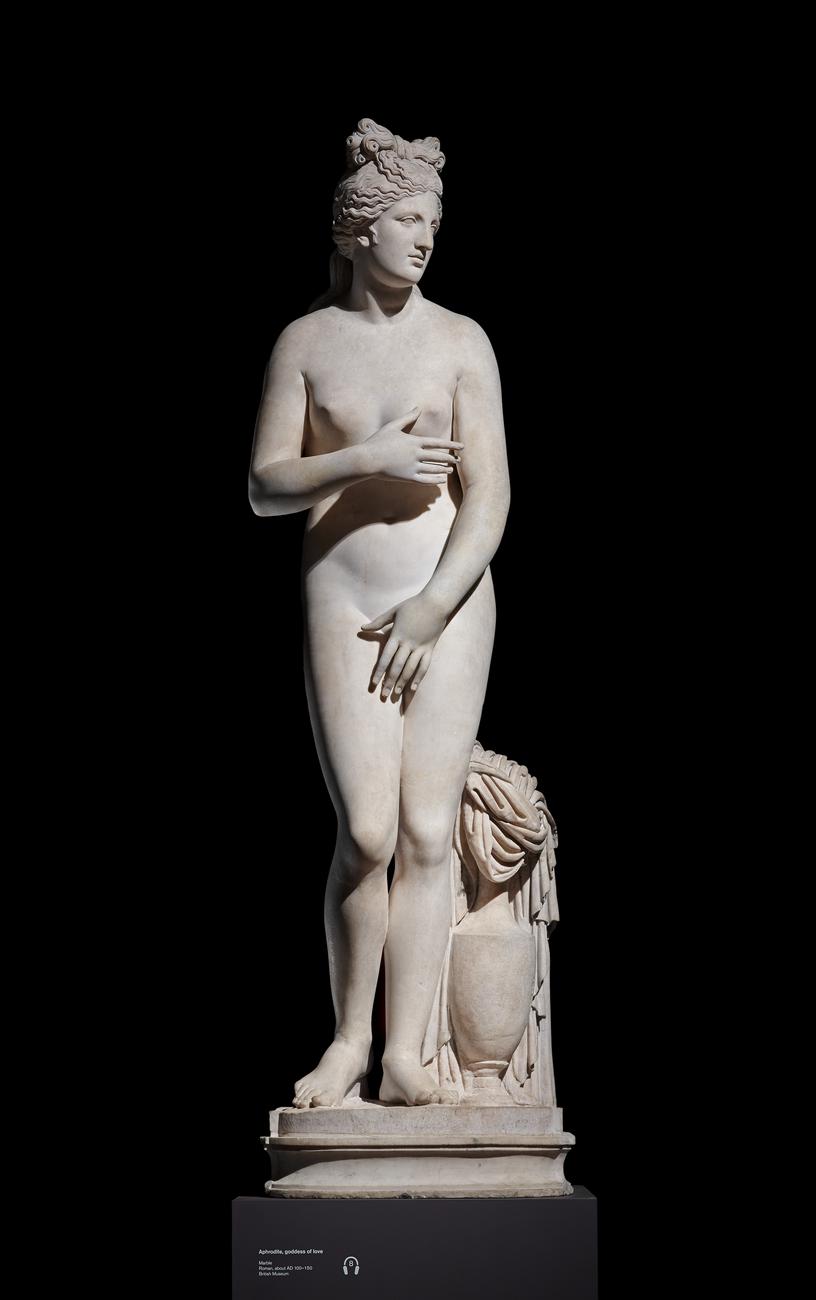
Roman statue
- Gallery: Room 1
- Culture: Roman
- Date: 100-150 (circa)
- Object type: statue
- Materials: marble
- Museum number: 1834,0301.1
- Museum: The British Museum
- Collection record: British Museum website
- Image © The Trustees of the British Museum, shared under a CC BY-NC-SA 4.0 licence.
Listen to the free audio guide
About this object
Before you stands a Roman statue carved from marble, depicting the goddess Aphrodite, or Venus as she was known in Rome. Her hands modestly cover her breasts and genitals, a pose familiar from ancient times. Beneath her, a water vessel, draped with a piece of discarded clothing, serves as the base of the statue.
This type of statue is famously known as the Capitoline Aphrodite/Venus, named after a well-known example in Rome. Around 100 to 150 AD, this version was created somewhere in the Roman world, possibly brought here from the ancient site of Campo Iemini.
These statues were quite popular, with several surviving across Europe, including prominent ones in Rome and Dresden. Some even include small figures of Eros nearby. Though it echoes an earlier Hellenistic model from about 200 BC, this statue is distinctly Roman.
Later restoration was likely performed by John Deare, a skilled 19th-century restorer. The statue was ultimately donated to the museum by King William IV of the United Kingdom.
See it in person
Roman statue is on display in Room 1 at the British Museum on Great Russell Street, Bloomsbury, London — free to enter. Choose British Museum on audioguide.london and take a photo of it to hear this free audio guide in six languages — no app download needed.
New, in beta. British Museum support has just launched and is still improving: over 1,000 objects so far, with more added all the time.