Regulus
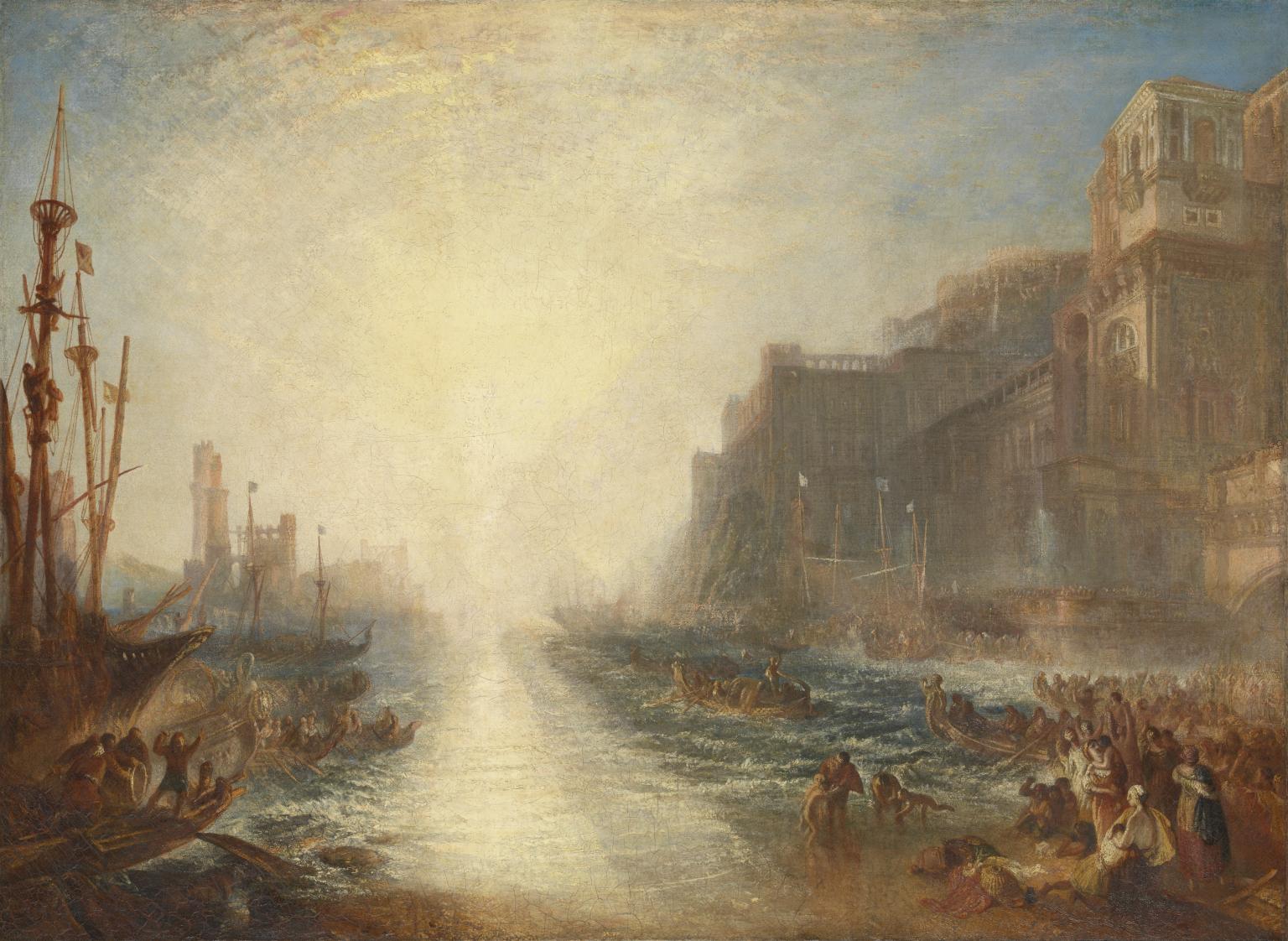
- Artist: Joseph Mallord William Turner
- Date: 1828, reworked 1837
- Medium: Oil paint on canvas
- Dimensions: support: 895 x 1238 mm
- Museum: Tate Britain
- Collection record: Tate Britain website
Listen to the free audio guide
About this artwork
This is the “Regulus” by Joseph Mallord William Turner, oil on canvas from 1828, reworked in 1837. Turner painted it during a three‑month stay in Rome, a city that clearly shows in the architectural backdrop and the bustling harbour. The scene is a dramatic, sun‑lit port: waves, boats, a crowd on the docks, and a bright, almost blinding glare that Turner exaggerates with a huge lump of white on his palette.
The story behind the work is striking. Regulus was a Roman commander captured by the Carthaginians; legend says his eyelids were cut off, leaving him blinded by the sun. Turner hints at this myth in the composition—there’s a pale figure in white at the top of a stairway on the right, perhaps a stand‑in for Regulus himself. The intense light could also be a way to cover up damage that the canvas suffered while being shipped back to England.
Turner’s bold use of light and color here foreshadows his later masterpieces. It was first shown in Rome (1828–9), then appeared in London’s British Institution in 1837 after those last‑minute tweaks. The painting is part of the Turner Bequest, entered into public hands in 1856. It’s a vivid snapshot of a historical moment rendered with dramatic, almost theatrical luminosity.
See it in person
Regulus is in the collection of Tate Britain on Millbank, London — free to enter. Point your phone at any artwork there and audioguide.london plays a free audio guide in six languages — no app download needed.