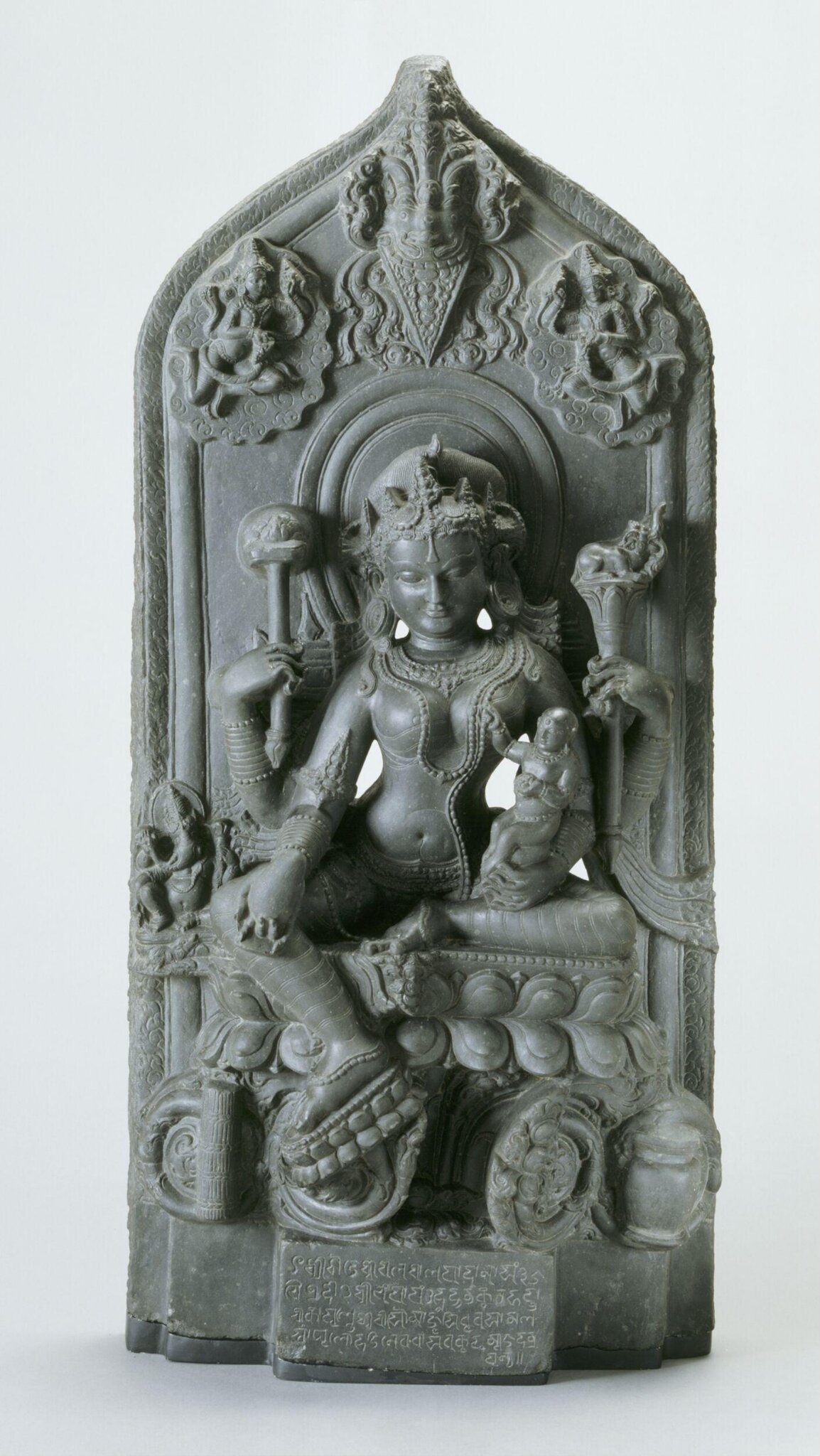
Purneshvari
- Gallery: Buddhism, Room 18, The Robert H. N. Ho Family Foundation Galleries of Buddhist Art
- Made in: Bihar
- Date: 12th century
- Object type: Sculpture
- Materials: Black basalt
- Style: Pala
- Dimensions: Height 82.8 cm; Height 83.5 cm; Width 37.5 cm
- Museum: V&A South Kensington
- Collection record: V&A website
- Image © Victoria and Albert Museum, London.
Listen to the free audio guide
In the museum now? Point your phone at the next object and hear its guide.
About this object
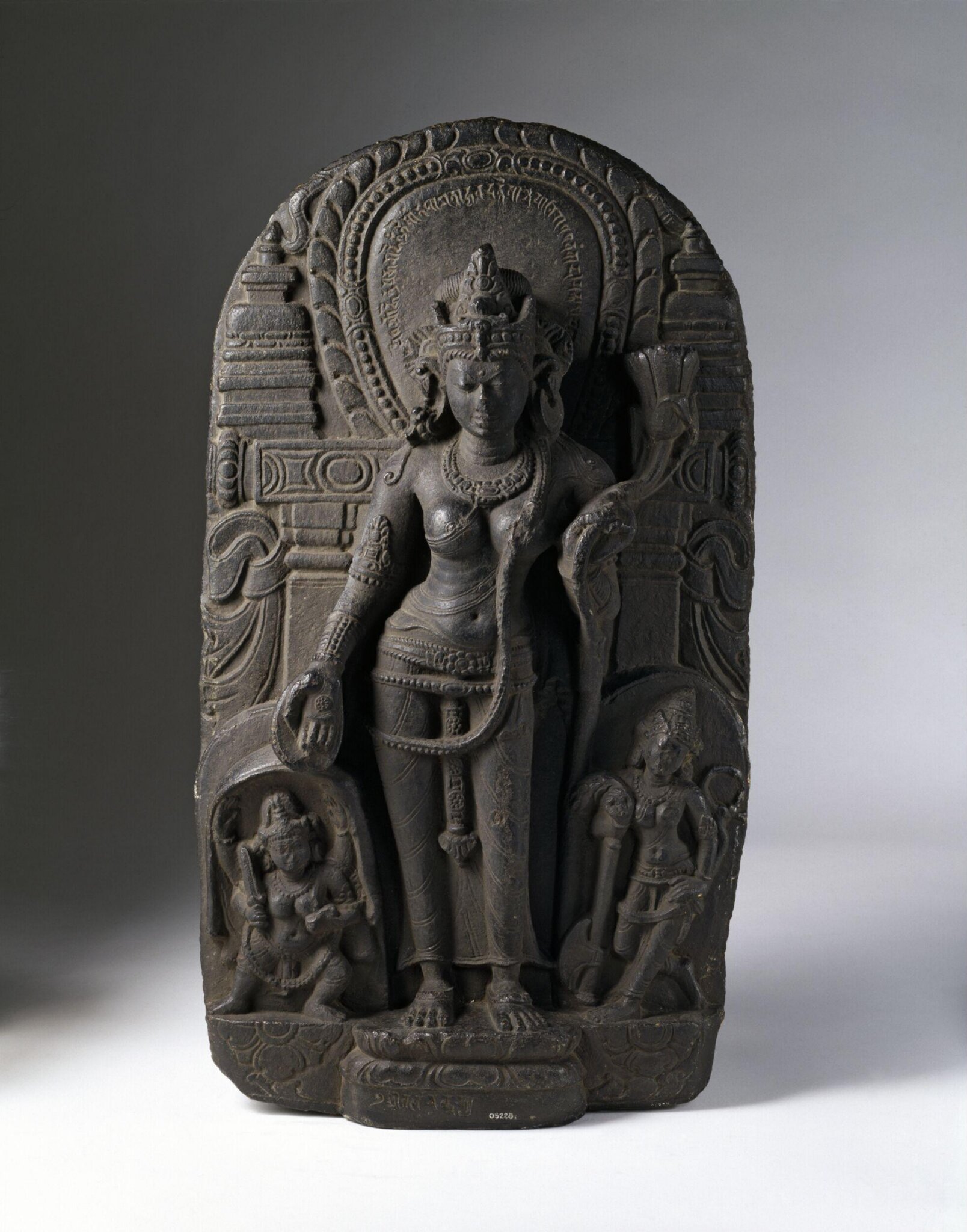
Before you is "Purneshvari", a striking high relief sculpture carved from black basalt in the twelfth century. This work comes from the Bihar region of North East India and reflects the beautiful artistic style of the Pala period.
The central figure is the four-armed goddess, Purneshvari, seated on a double-lotus throne. She is beautifully formed and richly bejewelled, smiling benignly as she supports an infant on her lap. In her upper hands, she holds a fly-whisk and a rod featuring an elephant emblem. If you look closely, you can see the Hindu god Ganesha flanking her. Above the goddess, celestial figures hover in the clouds, while a face of glory presides over the entire scene.
While the presence of Ganesha suggests a Hindu connection, an inscription on the base points to a possible Buddhist affiliation. This goddess was widely worshipped by both Buddhists and Hindus during this time. This rare piece was discovered during an excavation in 1877.
See it in person
Purneshvari is on display in Buddhism, Room 18, The Robert H. N. Ho Family Foundation Galleries of Buddhist Art at the V&A South Kensington on Cromwell Road, London — free to enter. Choose V&A South Kensington on audioguide.london and take a photo of it to hear this free audio guide in six languages — no app download needed.
New, in beta. V&A support has just launched and is still improving: 1,000 objects with audio so far, with more added all the time.