Princess Pauline de Metternich
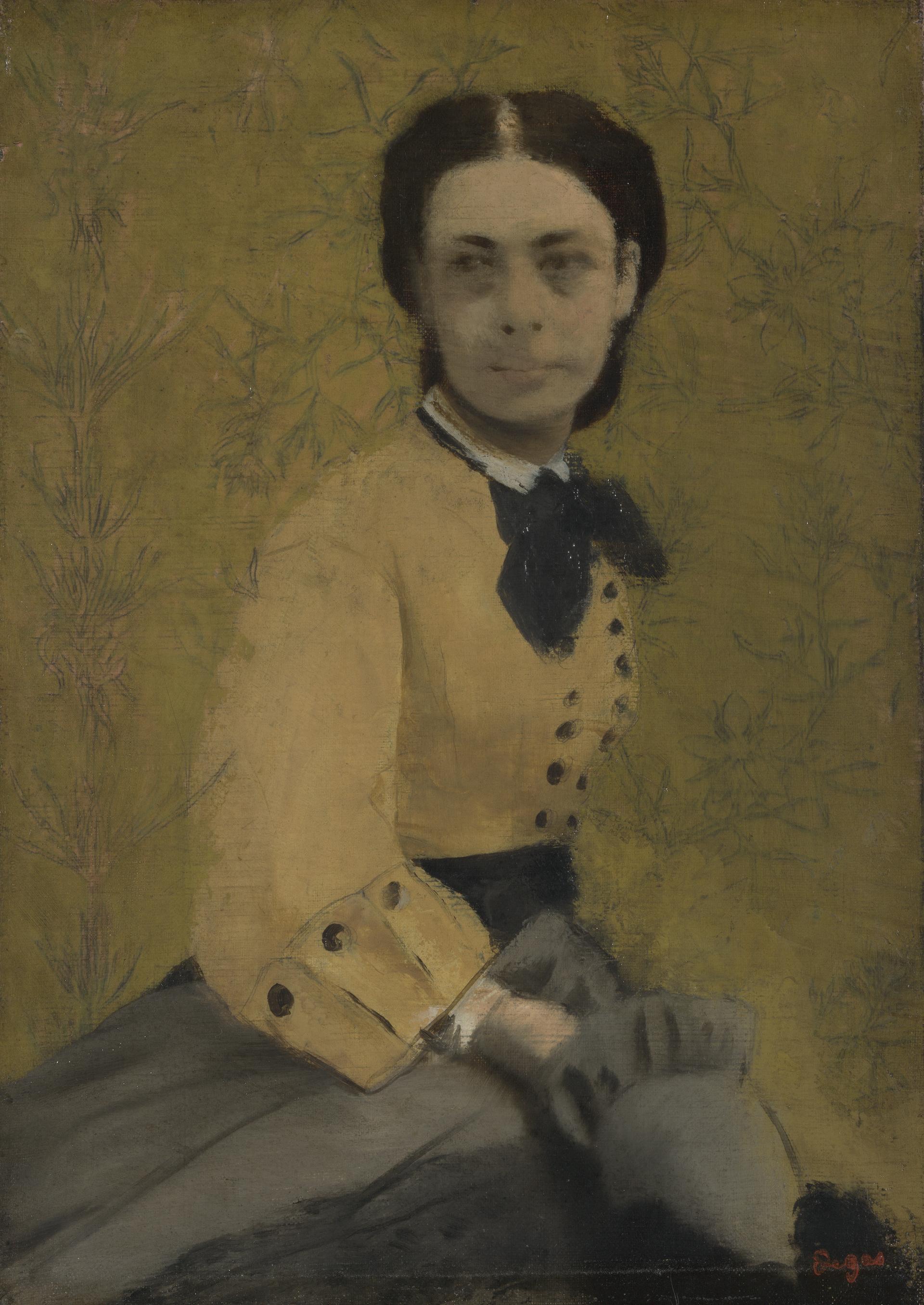
- Artist: Hilaire-Germain-Edgar Degas
- Date: about 1865
- Medium: oil on canvas
- Museum: The National Gallery
- Collection record: The National Gallery website
Listen to the free audio guide
About this artwork
This is the "Princess Pauline de Metternich" by Hilaire-Germain-Edgar Degas. Painted around 1865, it's a portrait of Princess Pauline, the wife of Prince Richard Metternich, who was the Austro-Hungarian Ambassador at the court of Napoleon III from 1860 to 1871.
Degas made this painting by copying a photograph of the Princess and her husband taken in 1867. However, unlike the sharply focused photograph, Degas's painting conveys the effect of blurred movement, as if the Princess has just been caught turning her head.
The Princess is depicted against a background of floral wallpaper, which overlaps her right sleeve. The dominant colours used are variations of mustard yellow and grey-black. What strikes you about this painting is the flat background, which helps project the Princess forward in space.
Degas's painting technique creates a softer and more expressive effect compared to the photograph. Her features, such as her eyes, nose, and mouth, are softened and less prominent than in the photograph.
This is one of the first painted portraits based on a photograph, and Degas makes no attempt to disguise its origin. In fact, he remained deeply interested in photography throughout his career, and many of his paintings reveal his careful study of this new medium.
As you can see, the painting conveys a sense of movement and energy, which is quite different from the more formal pose of the photograph.
See it in person
Princess Pauline de Metternich hangs in The National Gallery on Trafalgar Square, London — free to enter. Point your phone at any artwork there and audioguide.london plays a free audio guide in six languages — no app download needed.