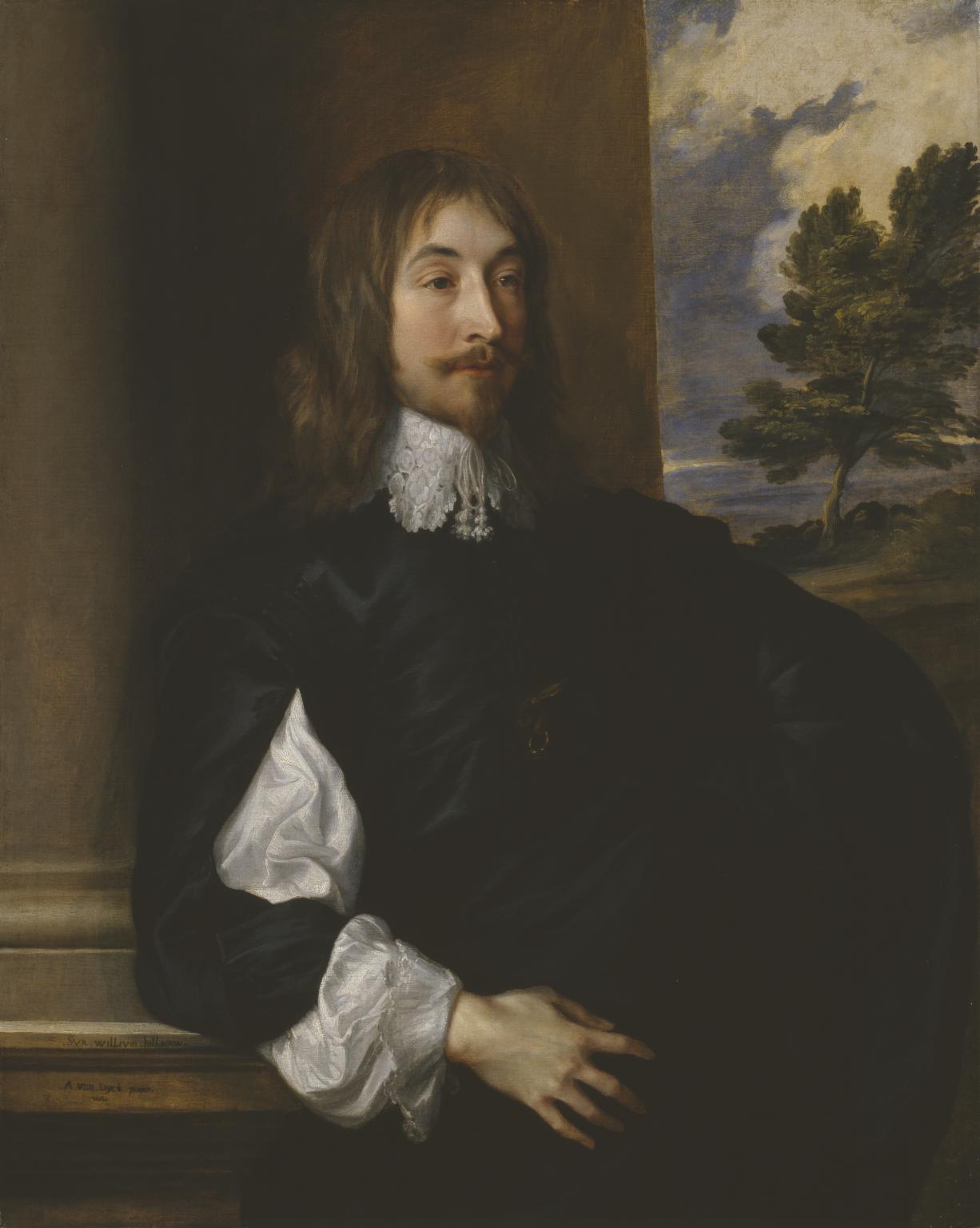
Portrait of Sir William Killigrew
- Artist: Sir Anthony Van Dyck
- Date: 1638
- Medium: Oil paint on canvas
- Dimensions: support: 1052 x 841 mm
- Museum: Tate Britain
- Collection record: Tate Britain website
Listen to the free audio guide
About this artwork
This is the “Portrait of Sir William Killigrew” by Sir Anthony Van Dyck. The canvas was painted in 1638, at a time when Van Dyck was solidifying his reputation as the court painter of Charles I. You’ll notice Killigrew’s relaxed, half‑turned pose against a plain column backdrop—a classic hint from Titian, whose portraits of men in black satin and columns were highly admired at the Stuart court.
His gaze is thoughtful, almost withdrawn, and his right hand is slightly tense, adding a subtle tension to the otherwise calm composition. The rich details of the white satin shirt, lace cuff and the black satin jacket are rendered with Van Dyck’s signature brushwork. The ribbon‑tied ring on his jacket is a little mystery—some interpret it as a romantic token for his wife, others as a mourner’s mark for a lost friend or relative.
Killigrew himself was more than a courtier: he served as Vice‑Chamberlain to Queen Catherine of Braganza after the Restoration and was a noted playwright. The portrait captures him at the intersection of politics, art, and the literary world of 17th‑century England, while also paying homage to the Venetian grandeur that shaped Van Dyck’s style.
See it in person
Portrait of Sir William Killigrew is in the collection of Tate Britain on Millbank, London — free to enter. Point your phone at any artwork there and audioguide.london plays a free audio guide in six languages — no app download needed.