Portrait of Hermine Gallia
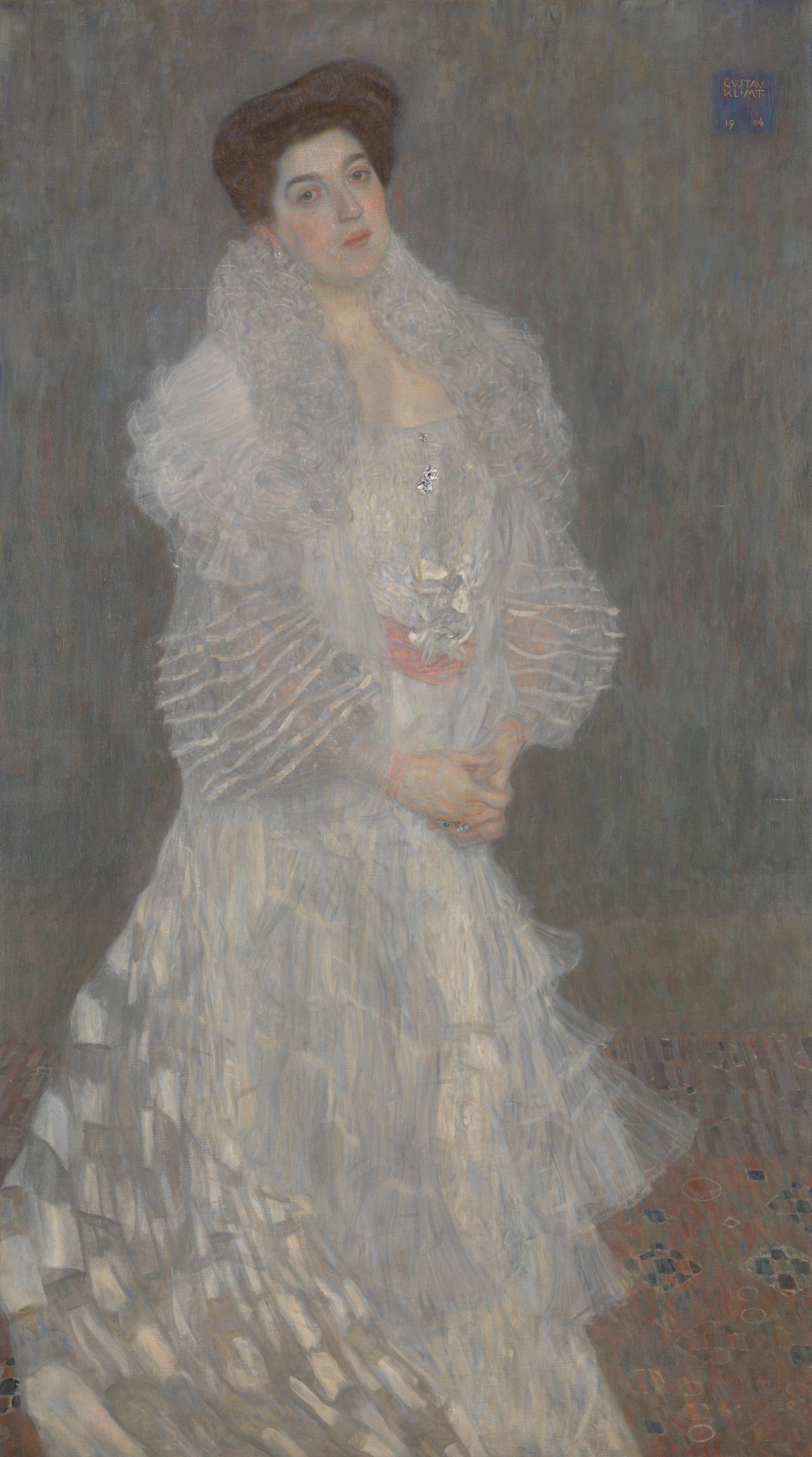
- Artist: Gustav Klimt
- Date: 1904
- Medium: oil on canvas
- Museum: The National Gallery
- Collection record: The National Gallery website
Listen to the free audio guide
About this artwork
This is the Portrait of Hermine Gallia by Gustav Klimt. Painted in 1904, it's a fine example of the portraits of society women he painted in the early years of the twentieth century. Wearing a shimmering dress made of translucent white chiffon, Hermine Gallia appears almost to float before us.
The sinuous lines of her dress recall Art Nouveau and Japanese prints. The geometrical pattern of its lower half, and the mosaic-like design of the carpet, hint at the 'Byzantine' style Klimt was to adopt a few years later. This portrait shows Hermine in a fashionable 'reform' dress, which had recently replaced the narrow wasp-waist style.
The way Klimt painted Hermine's dress is particularly striking - with long sweeping brushstrokes that recreate the effect of the translucent material. Her face is painted more smoothly, but her expression seems slightly distant, even dreamy. The portrait itself was meant to be part of a carefully designed environment, as one of Klimt's 'ladies' portraits' intended to be displayed in a Secessionist interior.
The Portrait of Hermine Gallia is not only a stunning work of art, but it also offers a glimpse into the social status and cultural patronage of Viennese society during this period. The Gallias were part of Klimt's circle, and by commissioning this portrait, they made a clear statement about their own social status - one that was based on taste, rather than birth.
See it in person
Portrait of Hermine Gallia hangs in The National Gallery on Trafalgar Square, London — free to enter. Point your phone at any artwork there and audioguide.london plays a free audio guide in six languages — no app download needed.