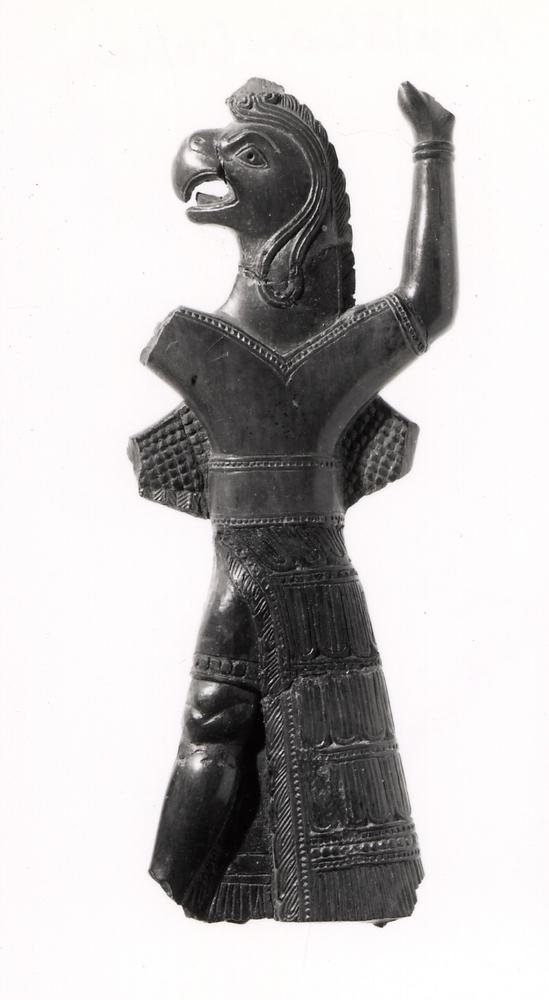
Pair of griffin-demon figures
- Audio guide stop: 413
- Gallery: Room 54
- Audio guide: one commentary for a group of objects shown together
- Museum: The British Museum
- Image © The Trustees of the British Museum, shared under a CC BY-NC-SA 4.0 licence.
Listen to the free audio guide
About these objects
These two striking figures before you are known as the "Pair of Griffin-Demon Figures." They date from the 8th to 7th century BC and come from the ancient region of Urartu, in what is now Turkey. Both carved from ivory, they were uncovered at an archaeological site called Toprakkale.
At first glance, you’ll notice they are nearly identical, each with the fierce head of a griffin — part lion, part eagle — and the body of a man. Their hands are raised, possibly once used to support a throne, indicating their role as symbolic guardians or attendants. One is made of blackened ivory, the other of white, but both are finely detailed.
Look closely at their expressions and posture. The artistry shows a deep understanding of form and function. These figures were more than just decoration — they were likely part of an important ritual or royal setting.
Though small in size — about 18 and 14 centimeters tall — they hold a powerful presence. Their shared form and purpose tell us something about the symbolic world of ancient Urartu.
See it in person
Pair of griffin-demon figures is on display in Room 54 at the British Museum on Great Russell Street, Bloomsbury, London — free to enter. Choose British Museum on audioguide.london and type its audio guide stop number, 413, from the gallery label, or take a photo of it, to hear this free audio guide in six languages — no app download needed.
New, in beta. British Museum support has just launched and is still improving: over 1,000 objects so far, with more added all the time.