Our English Coasts, 1852 (‘Strayed Sheep’)
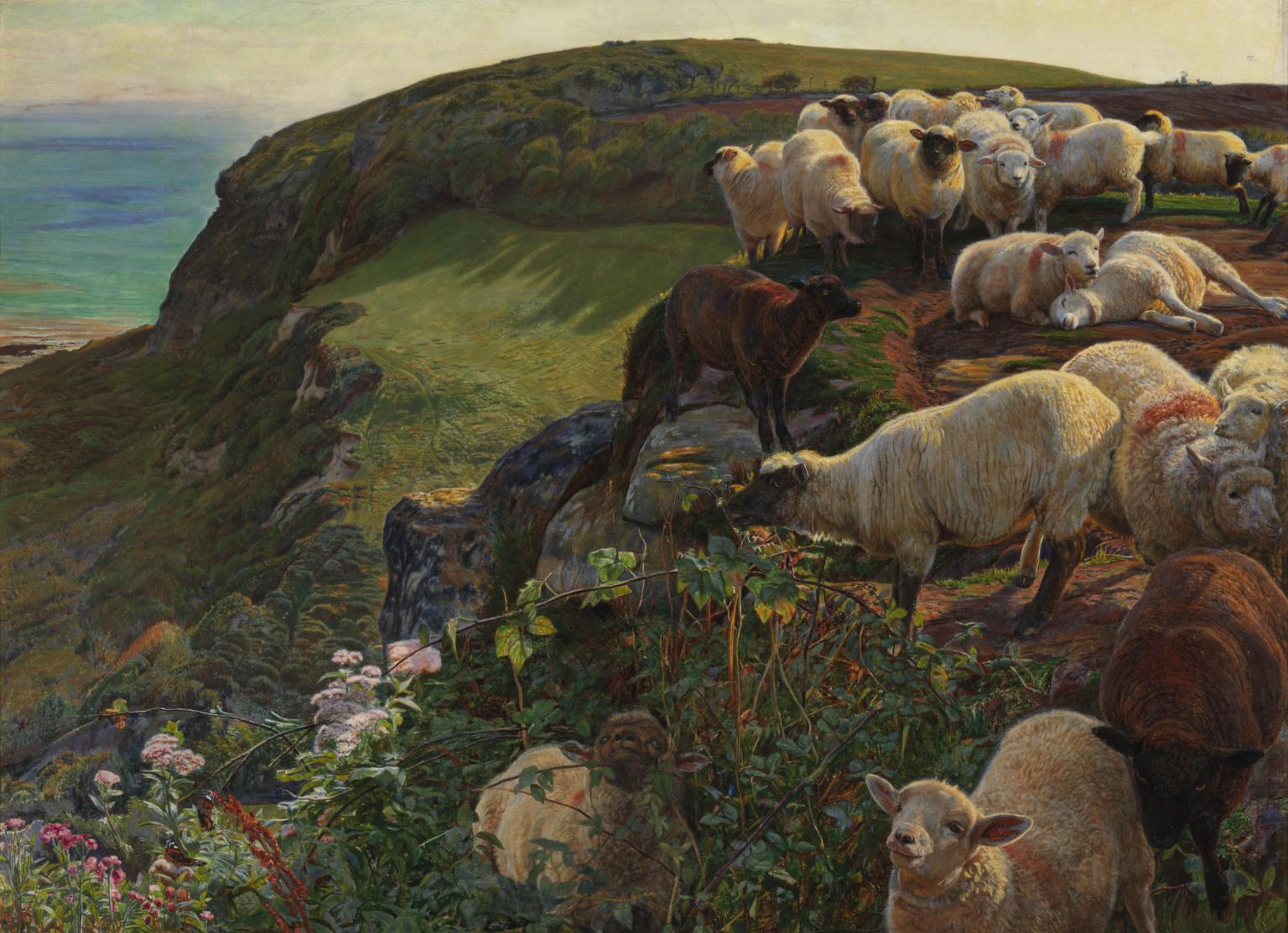
- Artist: William Holman Hunt
- Date: 1852
- Medium: Oil paint on canvas
- Dimensions: support: 432 x 584 mm
- Museum: Tate Britain
- Collection record: Tate Britain website
Listen to the free audio guide
About this artwork
This is the "Our English Coasts, 1852 (Strayed Sheep)" by William Holman Hunt, a key Pre‑Raphaelite landscape. Hunt painted it on the cliff‑top of the Lovers’ Seat in Fairlight Glen, near Hastings, Sussex, from mid‑August to December 1852, braving rain, wind and cold. He worked en plein air—a first for the group—that let him capture the sharp blue shadows and crisp light, making the scene feel almost theatrical. The painting shows a lone sheep in the foreground, a symbolic “lost” flock, against cliffs, brambles, a small bay and a scattering of butterflies (the latter painted indoors from a live specimen). Hunt originally called it Our English Coasts when he showed it at the Royal Academy in 1853. By 1855, when he sent it to Paris, he renamed it Strayed Sheep, underscoring the religious undertones of a flock in peril. Critics at the time were struck more by the fidelity of colour and light than by its symbolism, with John Ruskin praising its faithful translation of sunshine into pigment. The work also comments on England’s perceived military defenselessness, a social satire wrapped in a pastoral scene.
See it in person
Our English Coasts, 1852 (‘Strayed Sheep’) is in the collection of Tate Britain on Millbank, London — free to enter. Point your phone at any artwork there and audioguide.london plays a free audio guide in six languages — no app download needed.