Orange, Black and White Composition
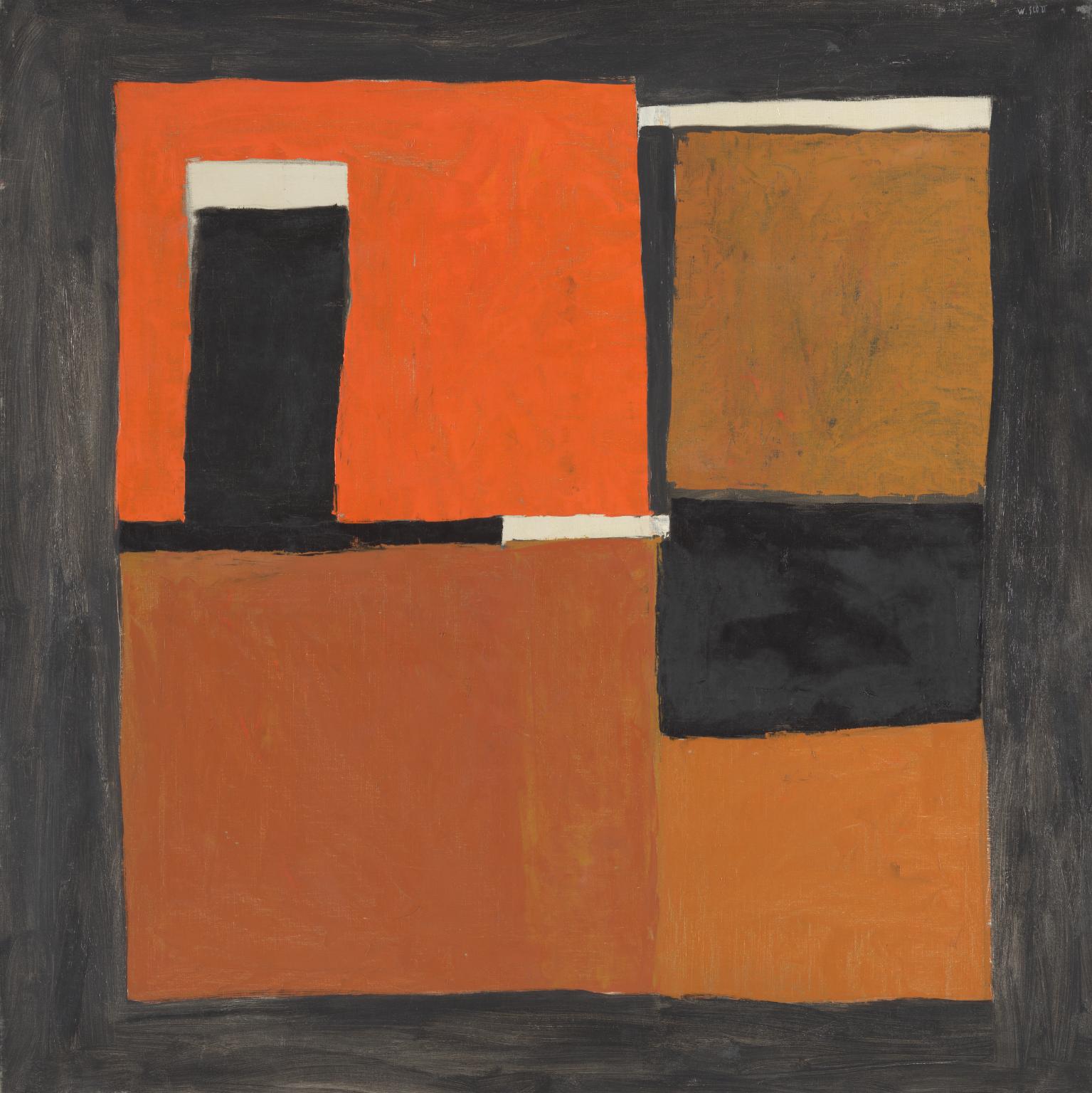
- Artist: William Scott
- Date: 1953
- Medium: Oil paint on canvas
- Dimensions: support: 1219 x 1219 mm
- Museum: Tate Britain
- Collection record: Tate Britain website
Listen to the free audio guide
About this artwork
This is the “Orange, Black and White Composition” by William Scott. Created in 1953, the work is a 48‑inch square oil on canvas that plays with geometric lines and a limited palette of orange, black and white. Scott was a British abstract painter who drew inspiration from still lifes, figures and landscapes, yet he insisted that abstraction for him was a process of “abstracting” the familiar. In his own words, “I am an abstract artist in the sense that I abstract. I cannot be called non‑figurative while I am still interested in the modern magic of space…disconcerting contours, the things of life.” This piece reflects that mindset: the sharp angles and contrasting colours are rooted in everyday observation, but they are arranged in a way that feels almost clinical and yet remains instinctively expressive. The painting was first shown at the Hanover Gallery in 1953 under the title “Orange, Black and Ochre Composition” and later travelled to venues such as the São Paulo Bienal and the Kestner Gesellschaft in Hanover. It was acquired through the Chantrey Bequest in 1966, ensuring its place in a major public collection. The piece exemplifies Scott’s move toward rectilinear abstraction in the 1950s, a phase that would evolve into a looser, more intuitive style in the early 1960s.
See it in person
Orange, Black and White Composition is in the collection of Tate Britain on Millbank, London — free to enter. Point your phone at any artwork there and audioguide.london plays a free audio guide in six languages — no app download needed.