Muse Casket
- Gallery: Room 41
- Culture: Late Roman
- Made in: Rome (city)
- Date: 330-370
- Object type: casket, flask, container
- Materials: silver
- Museum number: 1866,1229.2
- Museum: The British Museum
- Collection record: British Museum website
- Image © The Trustees of the British Museum, shared under a CC BY-NC-SA 4.0 licence.
Listen to the free audio guide
About this object
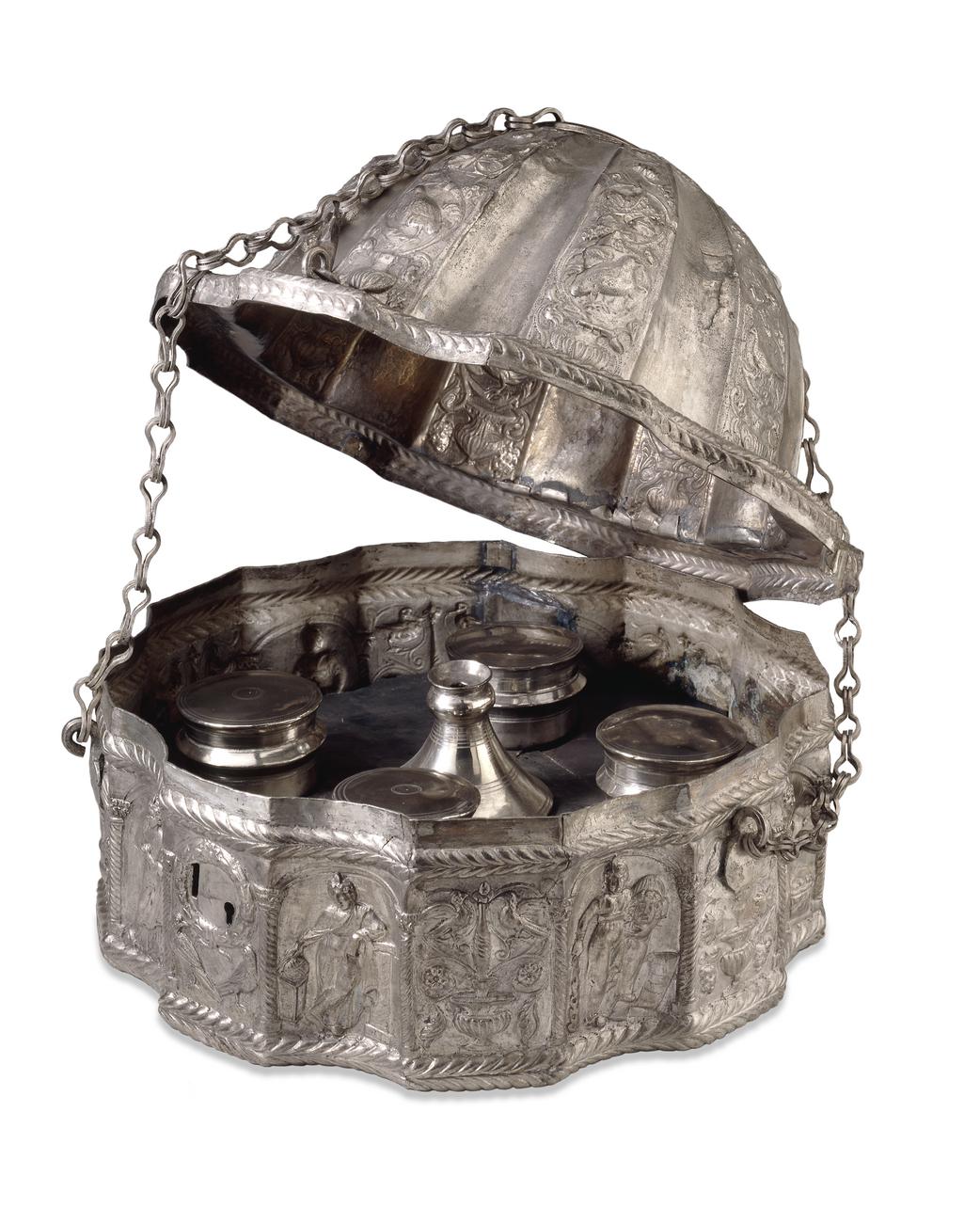
Before you is the "Muse Casket," a stunning silver object created in late Roman times, around 330 to 370 CE. This circular casket features a domed cover divided into sixteen panels—some flat, some concave. The flat panels are richly engraved with vases, vines, and birds, while eight of them depict standing female figures under arches. These are the nine muses, with one panel left unadorned.
Among the figures, you’ll notice Urania holding a globe, Melpomene with a club and mask, and Clio with a book and scrolls. Others each carry symbols of their art, like a lyre or a flute. At the top of the dome sits a medallion containing seated female figures in a landscape scene.
Artisans used engraving and repoussé techniques to create the intricate designs. The casket's interior was later fitted with five silver vessels—four canisters and one flask. It was discovered in Rome and bears the marks of a refined workshop.
See it in person
Muse Casket is on display in Room 41 at the British Museum on Great Russell Street, Bloomsbury, London — free to enter. Choose British Museum on audioguide.london and take a photo of it to hear this free audio guide in six languages — no app download needed.
New, in beta. British Museum support has just launched and is still improving: over 1,000 objects so far, with more added all the time.