Murder
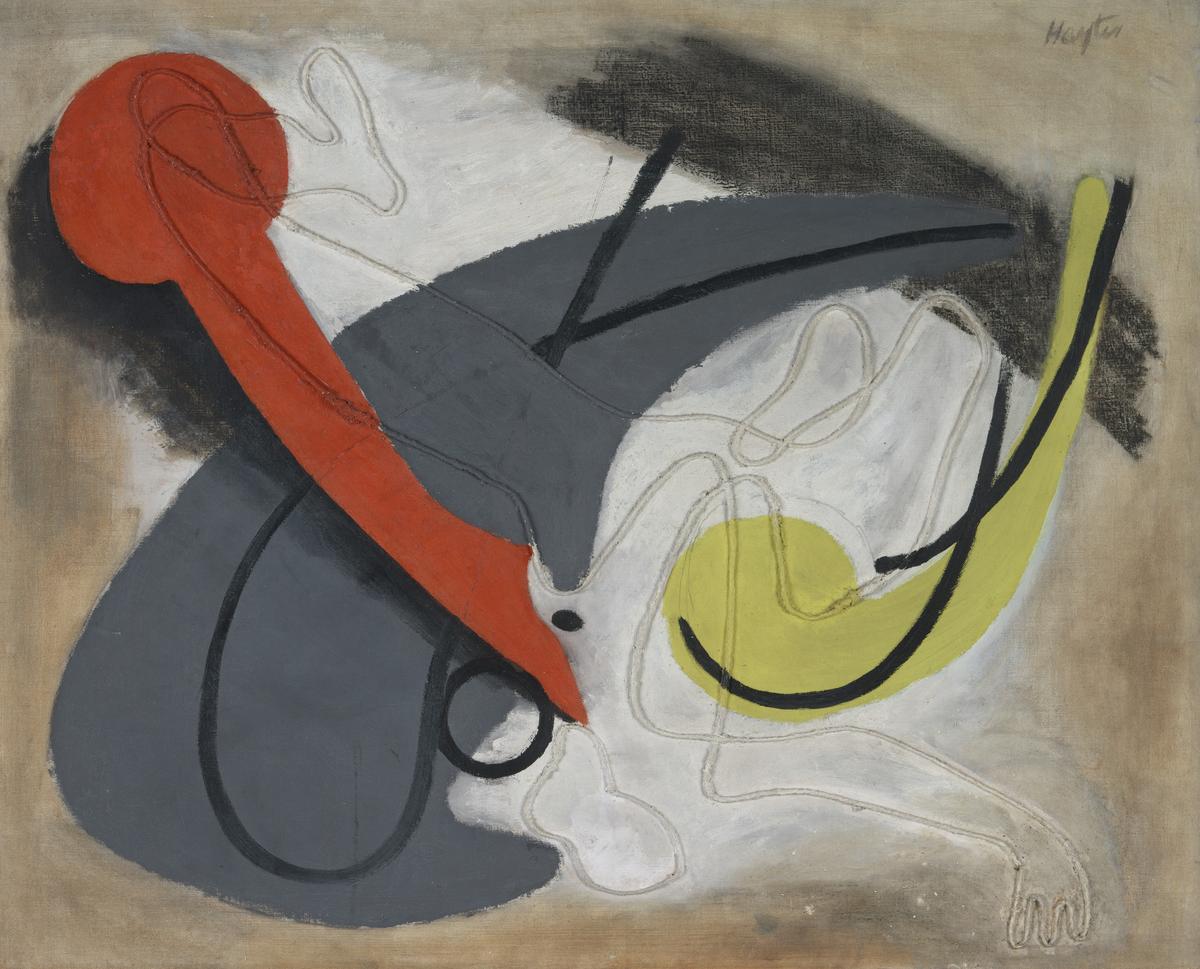
- Artist: Stanley William Hayter
- Date: 1932–3
- Medium: Oil paint and string on canvas
- Dimensions: support: 813 x 1006 mm
- Museum: Tate Britain
- Collection record: Tate Britain website
Listen to the free audio guide
About this artwork
This is the *Murder* by Stanley William Hayter, created between 1932 and 1933. The canvas is a study in contradiction: at first glance it looks like a purely abstract patchwork of shapes, lines and color. Yet when you look closer you can read a semi‑figurative scene—a body lying on a dark horizon, its limbs and head suggested by a long, white string that has been glued or stitched onto the surface.
Hayter was living in Paris at the time, working with a group of Surrealists who loved to blur the line between the automatic and the deliberate. The string becomes a new tool for line, echoing the way the Surrealists would drag lines into a print. It gives the composition a sense of movement and tension, hinting at violence without spelling it out. The title *Murder* nudges the viewer to connect these abstract forms to a violent act, but the specifics—who, where, when—are left intentionally ambiguous.
It’s a rare example of Hayter’s exploration of collage and line, a bridge between the Surrealist experiment in Paris and the burgeoning British modernist scene. The piece invites you to see how a single thread can turn an abstract painting into a haunting, fragmented body.
See it in person
Murder is in the collection of Tate Britain on Millbank, London — free to enter. Point your phone at any artwork there and audioguide.london plays a free audio guide in six languages — no app download needed.