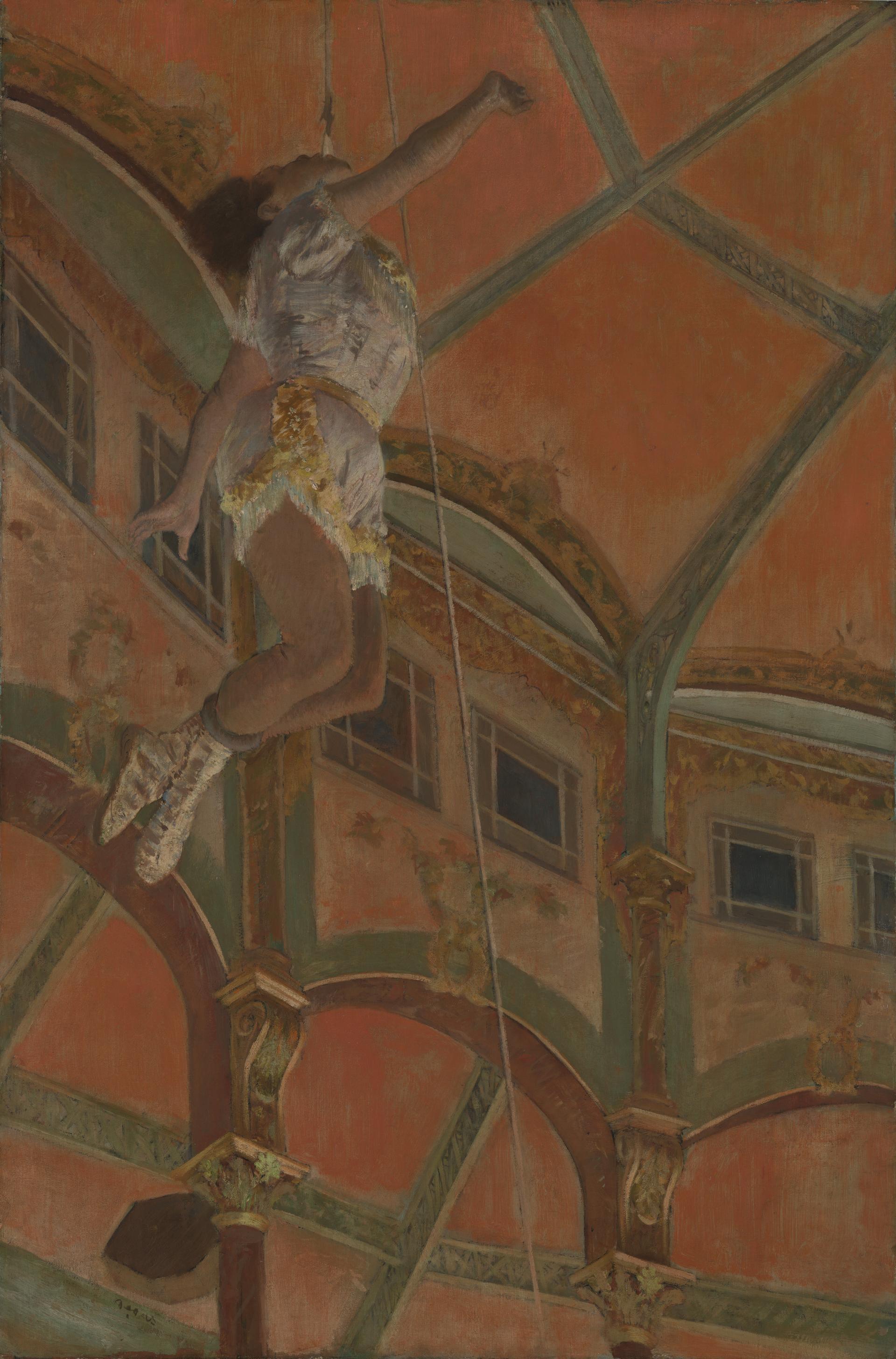
Miss La La at the Cirque Fernando
- Artist: Hilaire-Germain-Edgar Degas
- Date: 1879
- Medium: oil on canvas
- Museum: The National Gallery
- Collection record: The National Gallery website
Listen to the free audio guide
About this artwork
Miss La La at the Cirque Fernando is a painting by Hilaire-Germain-Edgar Degas, made in 1879. Oil on canvas is the medium he used for this work. The subject of the painting is Miss La La, an acrobat who performed at the Cirque Fernando in Paris. Born Anna Albertine Olga Brown, she was known for her incredible feats of strength and invented the 'Iron Jaw' act, where she holds herself up by clenching a leather mouthpiece between her teeth.
In the painting, we see Miss La La during one of her famous performances, suspended from the ceiling as she is hoisted up to the roof by a rope. Degas places us among the audience, looking up at the spectacle above. He made several preparatory studies for this portrait, paying particular attention to the complex construction of the roof, which covers most of the canvas.
Degas's interest in modern life and complicated poses is evident here. By painting an acrobat, he combined his fascination with the everyday world with his passion for capturing intricate movements and gestures. The composition is innovative, as it focuses on the ceiling rather than the circus ring or the audience, giving us a unique perspective on the performance.
The painting was shown at the Fourth Impressionist Exhibition in Paris in 1879, marking an important moment in Degas's career. Miss La La at the Cirque Fernando remains one of his most celebrated works, a testament to his ability to capture the essence of modern life and the human experience through art.
See it in person
Miss La La at the Cirque Fernando hangs in The National Gallery on Trafalgar Square, London — free to enter. Point your phone at any artwork there and audioguide.london plays a free audio guide in six languages — no app download needed.